Fair Park
In 1936, with the Great Depression grinding on and Texas celebrating a hundred years of independence, architects George Dahl and Paul Cret were handed an impossible assignment: transform an aging Dallas fairground into a world-class exposition in time for the Texas Centennial. They delivered an Art Deco wonderland -- terrazzo floors, monumental sculptures, gilded murals, gleaming pylons -- and then expected most of it to be torn down. Almost ninety years later, the buildings are still standing. Fair Park, just east of downtown Dallas, is the largest collection of Art Deco exposition architecture remaining in the United States, a 277-acre National Historic Landmark where the ghosts of 1936 share space with the smell of corny dogs and the mechanical groan of the Texas Star Ferris wheel every autumn.
From Prairie Fairground to City Beautiful
The story begins in 1886, when Dallas established a fairground on the outskirts of East Dallas for its State Fair. Fire and financial trouble struck in 1904, and voters approved the Reardon Plan, converting the site into Dallas's second public park. Landscape architect George Kessler drew up a formal master plan in 1906, inspired by the City Beautiful Movement -- tree-lined boulevards, fountains, monuments, public art. But the real metamorphosis came three decades later. For the 1936 Texas Centennial Exposition, Dahl and Cret draped the grounds in a sleek, futuristic Art Deco skin. The Esplanade, a grand promenade anchored by fountain pylons and six monumental sculptures, became the park's dramatic spine. Though many buildings were designed as temporary, several were built well enough to outlast their intended lifespan by generations. In 1986, Fair Park was declared a National Historic Landmark -- the 50th anniversary of the exposition it was built to celebrate.
The Cotton Bowl and Dallas Cowboys
Sunk below grade in 1930 and originally called Fair Park Stadium, the Cotton Bowl grew through successive expansions to seat 92,200 spectators. The Cotton Bowl Classic college football game was played here from 1937 to 2009, and every October during the State Fair the stadium still hosts the Red River Showdown between the University of Oklahoma and the University of Texas -- a rivalry so fierce the stadium is split down the middle in crimson and burnt orange. The Cotton Bowl was also the first home of the Dallas Cowboys, who played there from 1960 until they moved to Texas Stadium in Irving in 1971. For one sweltering weekend in July 1984, the park's streets were converted into a Formula One circuit for the Dallas Grand Prix, an event conceived to prove Dallas was a 'world-class city.' The melting asphalt told a different story, and the race never returned.
A Campus of Culture
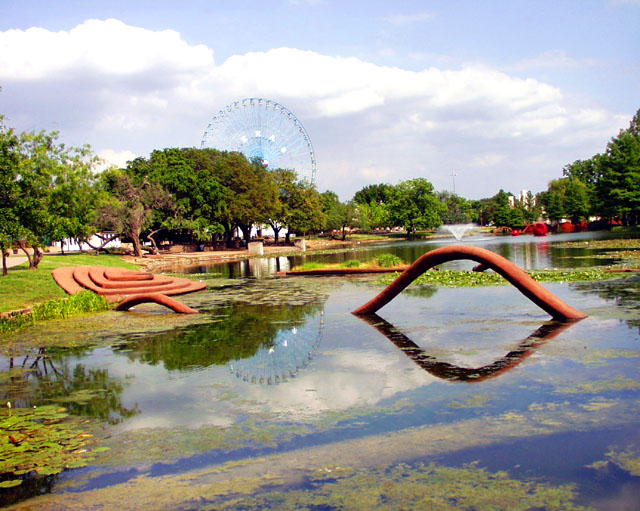
Fair Park packs an improbable density of museums and performance venues into its grounds. The African American Museum sits on virtually the same footprint as the Texas Centennial's Hall of Negro Life, housing works by Romare Bearden, Jacob Lawrence, and other distinguished artists. The Leonhardt Lagoon, a tranquil counterpoint to the exposition bustle when Dahl designed it in 1936, was reimagined in 1981 by sculptor Patricia Johanson as a pioneering earth artwork and one of the earliest examples of art as bioremediation. Nearby, the concentric plaster arches of the Band Shell frame a 5,000-seat amphitheater in pure Art Deco style. Music Hall, originally the General Motors Building during the Centennial, served as home to the Dallas Opera until 2009 and now hosts Dallas Summer Musicals. The Magnolia Lounge, designed by New York architect William Lescaze for the Magnolia Petroleum Company, introduced European Modernism to Texas -- a radical departure from every other structure at the exposition.
Big Tex and the State Fair
The signature event at Fair Park has always been the State Fair of Texas, running continuously since 1886. Each fall for 24 days, from late September to mid-October, the fairgrounds erupt with midway rides, livestock shows, auto exhibits, and the legendary fried foods that push the boundaries of culinary logic. The Texas Star, which opened in 1985, was the tallest Ferris wheel in North America until 2013. In 2007, the Texas Skyway added an Art Deco-styled gondola ride carrying visitors a third of a mile above the grounds. And overseeing it all stands Big Tex, the 55-foot talking cowboy who has greeted fairgoers since 1952. Fair Park has also served as a backdrop for the 1936 Gene Autry film The Big Show, the 1961 musical State Fair, and, in January 2021, a mass COVID-19 vaccination hub that served 17 underserved zip codes.
Preservation and Its Discontents
Fair Park's survival has never been guaranteed. Many of the Art Deco buildings have been painstakingly restored to their 1936 appearance, with the Esplanade's fountain pylons and monumental sculptures reconstructed in 2004 and the historic Parry Avenue entrance gates restored in 2009. A $72 million city bond allocation in 2006 funded critical repairs. But governance of this 277-acre landmark has sparked fierce debate. In 2018, Dallas City Council unanimously approved a management contract with the nonprofit Fair Park First, committing $35 million over 10 years. Questions about oversight and accountability dogged the arrangement, and a 2024 whistleblower report revealed that more than $5 million in donor-restricted funds had been improperly spent on park operations. The tension reflects a fundamental question Dallas has wrestled with for decades: how to honor a place that is simultaneously a historic treasure, a living cultural campus, and the grounds of the state's biggest party.
From the Air
Located at 32.782°N, 96.766°W, immediately east of downtown Dallas. The park's 277-acre footprint is clearly identifiable from the air by the oval Cotton Bowl stadium and the large midway area. The Esplanade axis and Art Deco building cluster are visible at lower altitudes. Dallas Love Field (KDAL) is approximately 6 nm northwest; Dallas/Fort Worth International Airport (KDFW) is about 17 nm northwest. Fair Park sits at approximately 460 feet MSL. Best viewed at 2,000-4,000 feet AGL on approach from the east, where the full layout of the exposition grounds and the Cotton Bowl are most apparent.