Fairy Circles
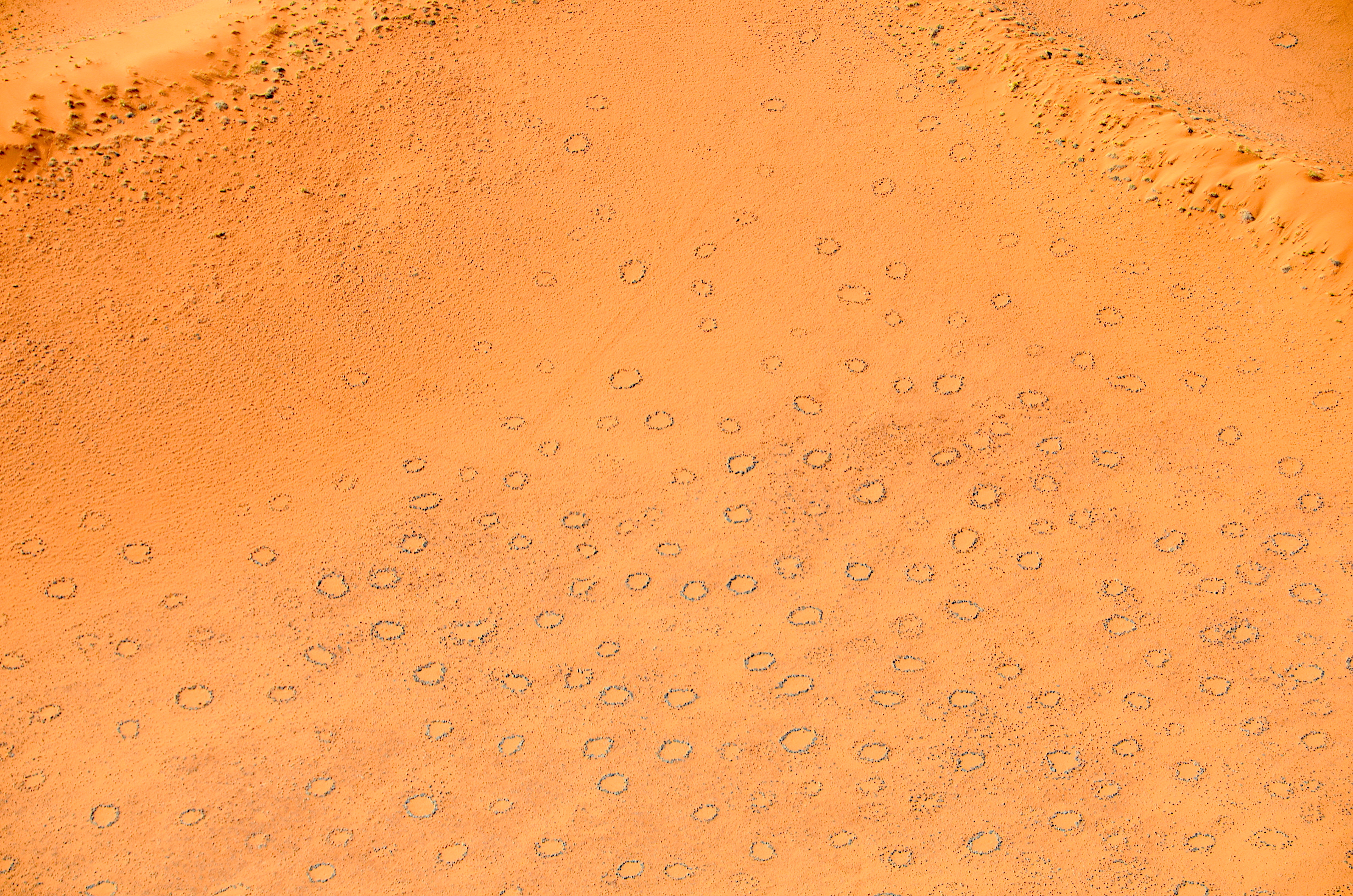
Fly low over the grasslands of the Namib and the ground looks diseased. Thousands of bare circles, each between two and twelve meters across, pock the landscape in an almost unnervingly regular pattern -- like polka dots stamped onto the earth by something with a sense of geometry. A ring of taller, greener grass borders each bare patch, making the pattern even more conspicuous. The Himba people of northern Namibia say their ancestor Mukuru made them. Some tour guides blame a dragon living underground whose poisonous breath kills the vegetation. Scientists, after a century of study, have offered explanations nearly as varied -- and until recently, nearly as inconclusive.
Footprints of the Gods
The circles were first noted in technical literature in the 1920s, but the Himba and San peoples of the region had known about them far longer. To the Himba, they are the work of gods, spirits, or their original ancestor Mukuru. The San have traditionally ascribed spiritual and magical powers to them. These are not idle myths -- the Himba incorporated fairy circles into their agricultural practice, using the rings of stimulated grass growth to provide grazing in otherwise barren terrain. Temporary wooden fences erected around the circles corralled young cattle overnight, protecting them from predators. The circles, in other words, were practical long before they were scientific puzzles. They occur in a band roughly 100 miles inland from the coast, stretching 1,500 miles from Angola south to the Northwestern Cape of South Africa -- a remote, inhospitable region where the nearest village may be over a hundred kilometers away.
The Termite Wars
For decades, the leading explanation blamed termites. In 2012, Eugene Moll proposed that the species Baucaliotermes hainsei and Psammotermes allocerus created the circles by clearing vegetation. Every ring examined contained termite casts, and radar showed moist soil beneath. The following year, Norbert Juergens bolstered the theory, finding sand termites in 80 to 100 percent of circles and in every newly formed one. The termite hypothesis had the seductive quality of a simple answer to a complex question. But it began to unravel. In 2014, researchers demonstrated that neither termites nor underground gas could explain the remarkably regular spacing of the circles -- a pattern more consistent with mathematical self-organization than with insect behavior. A large meta-analysis later confirmed that termite nest patterns differ significantly from fairy circle distributions worldwide.
When Grasses Compete
The alternative explanation is elegant and strange: the circles may be the landscape organizing itself. In arid environments, plants compete fiercely for water. The theory holds that grasses essentially sacrifice the center of each patch, allowing rain to collect in the bare soil and flow outward to the ring's edge, where roots are densest. More water produces more biomass, which loosens the soil, which allows more water to penetrate -- a feedback loop that sustains the ring while starving the center. In 2022, researchers excavated hundreds of grasses within and around Namibian fairy circles and found that plants inside the circles died of water stress, not root damage from termites. Their roots were undamaged and as long as or longer than those of healthy grasses outside. Several researchers declared the termite theory conclusively dead. By 2025, a comprehensive review confirmed that vegetation self-organization is the only theory consistent with all field observations.
Born and Dying
Each fairy circle has a lifespan. They become visible at about two meters in diameter, grow to a peak of perhaps twelve meters, then slowly "die" as grasses invade the center. The full cycle takes between 30 and 60 years, though some circles may persist for centuries. What makes this lifecycle unsettling is its larger implication: the birth of new fairy circles may signal gradual desertification. Scientists studying the phenomenon across long time spans have found that cycles of appearance and disappearance can herald regime shifts in the ecosystem -- the kind of transformation that turns marginal grassland into true desert. In 2014, ecologists discovered similar circles in the Pilbara region of Western Australia, expanding the mystery beyond Africa. Aboriginal Australians in the Pilbara call them linyji in the Manyjilyjarra language and mingkirri in Warlpiri. But a 2023 study involving Martu peoples and their traditional knowledge concluded that Australian fairy circles and Namibian ones are not produced by the same mechanism.
Turing Patterns in the Sand
Perhaps the most remarkable aspect of fairy circles is what they share with leopard spots, zebra stripes, and the branching patterns of coral. The mathematician Alan Turing proposed in 1952 that such patterns could arise from the interaction of chemical substances diffusing at different rates. Fairy circles now appear to be a large-scale Turing pattern -- vegetation organizing itself according to the same mathematical principles that govern pattern formation across the natural world. The circles' spacing is so regular that satellite imagery reveals an almost crystalline lattice across the landscape. It is a pattern that emerges not from any central plan or organism but from the collective behavior of millions of grass plants responding to the same brutal scarcity. What looks from above like the footprints of gods turns out to be mathematics written in sand and grass.
From the Air
Located at approximately 24.95S, 15.93E in the Namib Desert grasslands of Namibia. Fairy circles are best observed from low altitude (500-2,000 feet AGL) where the regular pattern of bare circles within grassland becomes strikingly visible. The circles occur in a band roughly 100 miles inland from the coast. Nearest airports: Walvis Bay (FYWB) approximately 150 km northwest, Windhoek Hosea Kutako International (FYWH) approximately 400 km northeast. The area is extremely remote with no nearby settlements or infrastructure.