Fairytale Forest
Around a bend in the wooded path stands a small cottage made of gingerbread, with pancakes for roof tiles and a cake on top. A red lemonade fountain bubbles in the garden. A black cat with yellow eyes pokes out of a hole in the wall, smoke rises from the chimney, and a witch's voice rasps through the gate: 'Knibbel, knabbel, knuisje, wie knabbelt aan mijn huisje?' Hansel sits caged. Gretel waits. The voice belongs to the daughter of Peter Reijnders, the inventor who, in 1955, helped build this exact scene at Efteling. Children have been pressing the gate latch and triggering the witch for seventy years.
Three Men and a Forest
The Sprookjesbos - 'fairy tale forest' in Dutch - opened in 1952 as the answer to a tourism question. R.J.Th. van der Heijden had the idea in the early 1950s to attract visitors to the woods at Kaatsheuvel. He brought in his brother-in-law Peter Reijnders, a filmmaker and amateur inventor from Eindhoven, who had built a small fairy-tale park before. Reijnders in turn brought in Anton Pieck, the Dutch illustrator whose nostalgic, almost Brothers-Grimm-by-way-of-Arthur-Rackham style still defines the park's visual identity today. Two years of design and building produced the first ten scenes: The Chinese Nightingale, The Naughty Princess, Sleeping Beauty, the Gnome Village, the public toilets (charmingly labelled 'Number One'), The Frog Prince, the Magic Clock, Mother Holle, Snow White, and The Six Servants. The Fairytale Forest now contains twenty-five scenes spread across fifteen acres of real woodland, and a remarkable proportion of them date back to those founding two years.
Three Ways to See a Story
The Sprookjesbos invented a vocabulary for telling fairy tales in three dimensions. There are indoor scenes with voice-over commentary, like The Indian Water Lilies. There are buildings too small to enter, where you peer through the windows: Little Red Riding Hood's grandmother's house, the gingerbread house of Hansel and Gretel, Snow White's cave. And there are open-air tableaux you walk among, like the four frog fountain of The Frog King or the dancing red shoes spinning on hidden magnetic discs that Peter Reijnders designed in 1953. Each book plaque tells the tale in Dutch, English, German, and French. Some scenes go further, with electronic narration triggered by the visitor's presence. The Magic Clock awakens every fifteen minutes; its six animatronic princes act out one of Efteling's own original tales. Mother Hulda lives in a cottage next to her well; call her name and she opens the shutters, shakes her pillow, and it begins to snow.
What Got Cut, What Stayed
The forest carries a curatorial history that fans track in microscopic detail. The original Long-neck of The Six Servants, built in 1952, received a new head in the 1970s, then a renewed body and neck in 1979, then another new head in 2013. A small pond was added around his stone in 1955. A bust of Bullet-eye stood beside him until the late 1950s, when he was replaced by a smaller blindfolded version on a nearby kiosk. Sleeping Beauty's castle dates from 1952; chicken wire and plaster gave way to real brick in the 1981 renovation, when an animatronic witch was added spinning yarn. In 2024 the same castle was refurbished again - and the park made headlines when it confirmed it had enlarged Sleeping Beauty's chest to bring it closer to the original 1950s design, an announcement the operator pre-emptively assured the public was not an April Fools' joke. Little Red Riding Hood has been stolen twice from the forest, once in 1998 (recovered at a church in Tiel the next day) and again in 2006 (found at a retirement home in Kaatsheuvel).
The Hardest Animatronic
The Troll King arrived in 1988 at a cost of 2.6 million guilders. He sits in a hollow tree near no particular Scandinavian myth, the creature of designer Ton van de Ven, who had illustrated a Norwegian fairy-tale book in 1974. Point at one of the twelve astrological signs on the stone in front of him and the king wakes, mumbles a few words about your future, and subsides. Along with Hugo from the Villa Volta attraction, he is the most complex animatronic in the park - twenty-six moving body parts including eyebrows, eyes, jaws, back, and wrists, built jointly by Van de Ven, the Dutch applied-research organisation TNO, and the British puppet studio Spitting Image. The voice is by Peter van Ostade. Compare him to the older animatronics nearby and the four-decade gap in technology is audible as much as visible: where the Troll King breathes and frowns, the older scenes click and turn, charmingly mechanical, the puppets they were.
Holle Bolle Gijs Wants Your Paper
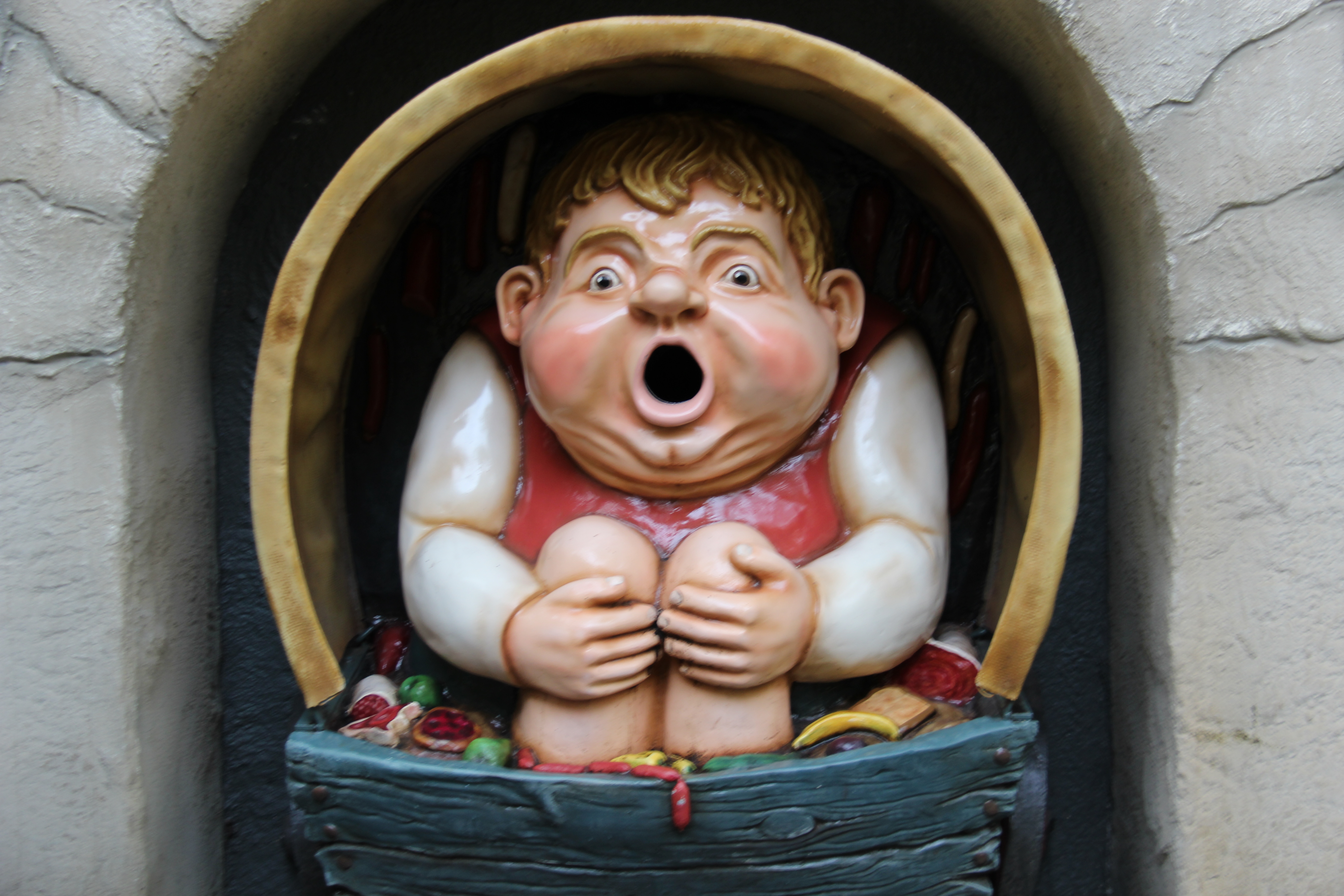
Eleven of the forest's most beloved characters are not princesses or witches but waste bins. The Paper Gobblers - one in particular, Holle Bolle Gijs or 'Hollow Bulging Gijs' - sit with their mouths open, shouting 'Papier hier!' until a child stuffs a wrapper or a ticket stub into the opening. The bin makes a gobbling sound and politely thanks the donor. Captain Gijs used to fire a small cannon in approval, but he was retired when the forest expanded to include Pinocchio in 2016. Each new fairy tale displaces something or someone, and the choice of what to keep is genuinely careful: when the Chinese Nightingale was redone in 1999, its scene moved into a building inspired by classical Chinese architecture, with new narration by Angélique de Boer. Wieteke van Dort, the actress and singer, voices Little Red Riding Hood, Rapunzel, and the Red Shoes story. The Princess and the Pea, the most recent scene, opened on 14 May 2025 in a gazebo in the shadow of the Efteling Grand Hotel, with musical narration sung by the Belgian singer Geike Arnaert. The forest is not a museum. It is still being written.
From the Cockpit
The Fairytale Forest sits at the western edge of the larger Efteling park, in mature woodland on the outskirts of Kaatsheuvel village. From the air, look for a darker, denser patch of trees within the main park, with the small towers of Rapunzel and Sleeping Beauty barely peeking above the canopy. Coordinates 51.65°N, 5.05°E. Best viewed at 2,000-4,000 feet. Nearest airports: Eindhoven (EHEH) 35 km southeast; Rotterdam The Hague (EHRD) 55 km west.
From the Air
Located at 51.6508°N, 5.0467°E within the Efteling park in Kaatsheuvel, North Brabant. Forms the densely-wooded western section of the park - look for the slim Rapunzel tower (~10 m) and the Sleeping Beauty castle just above the canopy. Recommended viewing altitude 2,000-4,000 feet. Visual landmarks: the Aquanura lake at the park entrance to the east, the Pagode flying tower of the main park, the village of Kaatsheuvel to the south. Nearest airports: Eindhoven (EHEH) 35 km SE; Rotterdam The Hague (EHRD) 55 km W.