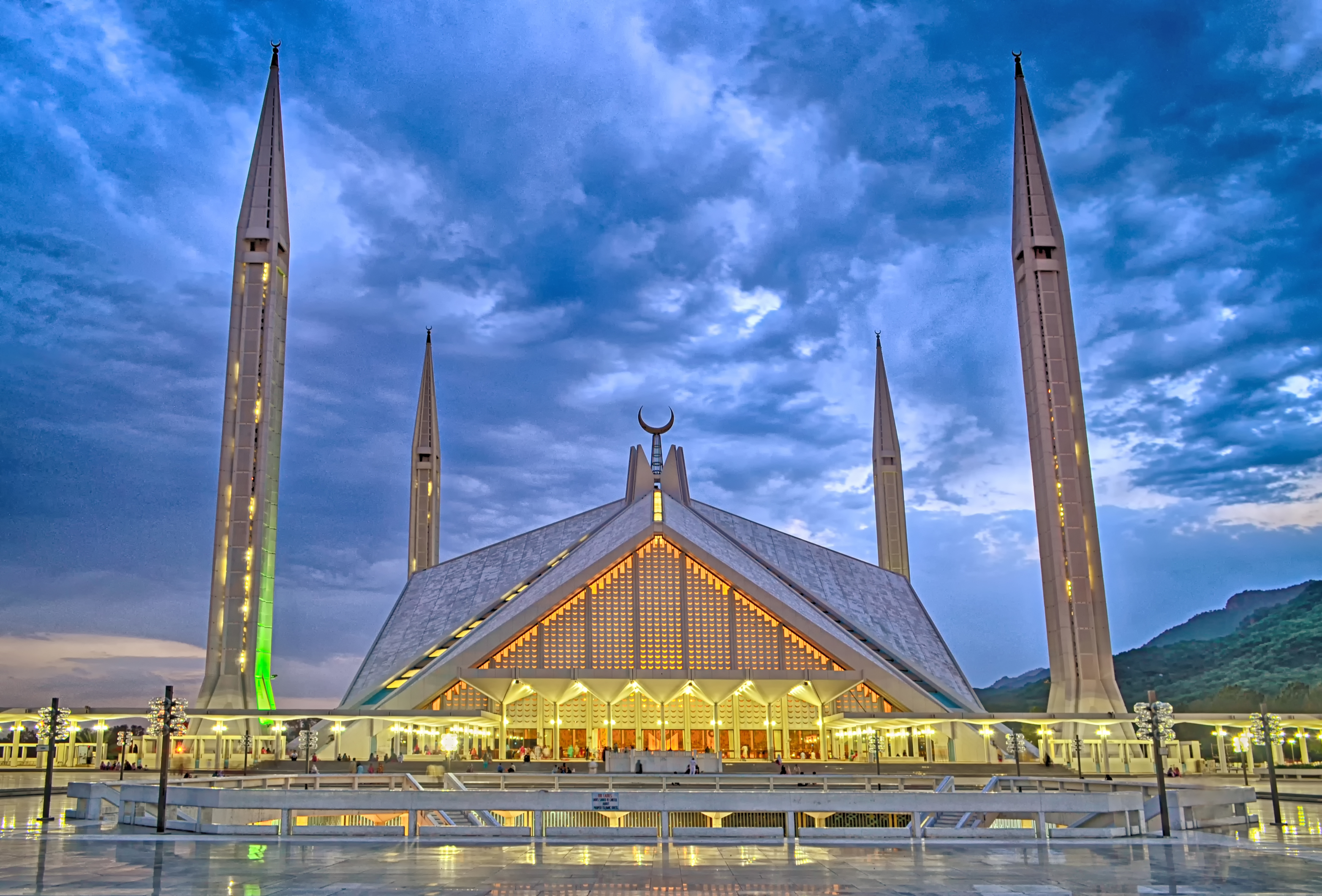
Faisal Mosque
There is no dome. Where every expectation says there should be one -- the crowning curve that has defined mosque architecture for a thousand years -- there is instead an angular, tent-like shell of concrete, its eight sides sloping sharply to a point. The Faisal Mosque in Islamabad broke so fundamentally with tradition that conservative critics rejected it outright when it opened. Three decades later, it is Pakistan's national mosque, one of the largest in the world, and the structure that defines the Islamabad skyline from virtually any vantage point. It sits at the foot of the Margalla Hills, facing the city it was built to serve, backed by green mountain ranges that make its white marble and concrete forms appear to float against the landscape.
A King's Promise, a Competition Won
The story begins in 1966, when Saudi Arabia's King Faisal bin Abdul-Aziz visited Pakistan and endorsed the Pakistani government's ambition to build a national mosque in its new capital. Three years later, an international competition drew forty-three proposals from architects in seventeen countries. The winner was Vedat Dalokay, a Turkish architect whose design dispensed with the dome entirely in favor of a massive tent-shaped prayer hall. It was a radical proposal. Dalokay envisioned the structure as an abstraction of a Bedouin desert tent, marrying nomadic form to monumental scale. The four minarets -- ninety meters tall, the tallest in South Asia -- drew on Ottoman Turkish tradition rather than Mughal or Persian precedent. King Faisal's government funded the project at a cost exceeding 130 million Saudi riyals. When the king was assassinated in 1975, both the mosque and the road leading to it were named in his honor.
Twelve Years of Construction
National Construction Limited of Pakistan broke ground in 1976, led by engineer Azim Khan. King Khalid, Faisal's successor, laid the foundation stone that October and signed the formal construction agreement in 1978. The project took a decade. Forty-six acres of land at the base of the Margalla Hills had been set aside, and the completed structure and its grounds cover thirty-three acres -- a scale that dwarfs most mosques anywhere. The mosque was functionally complete by 1986, but the first prayer was not held until 18 June 1988. For several years, the International Islamic University operated from facilities beneath the main courtyard before relocating to its own campus in 2000. The mosque still houses a library, lecture hall, museum, and cafe, making it as much a cultural complex as a place of worship.
Tent of Concrete and Light
Dalokay's design works through contrast. The prayer hall's eight-sided concrete shell is severe and geometric from the outside, all sharp angles and massive scale. Inside, the effect inverts. White marble covers the surfaces, and the space fills with diffused light that softens the geometry. The interior decoration was entrusted to Sadequain, one of Pakistan's most celebrated artists, whose mosaics and calligraphy adorn the walls. The west wall carries the Kalimah written in early Kufic script, rendered in mosaic and repeated in mirror-image pattern -- an ancient Islamic calligraphic tradition executed in a thoroughly modern space. A Turkish-style chandelier hangs from the angular ceiling. The fusion of influences is deliberate: Ottoman minarets, Bedouin tent form, Pakistani decorative arts, and the abstract suggestion of the Kaaba's square shape. The inner hall holds 10,000 worshippers. With the courtyards, capacity rises to 74,000. On the grounds surrounding the mosque, up to 200,000 people can gather.
A Mosque in the Landscape
The topography matters. Islamabad was a planned capital, built from the 1960s onward on a grid aligned with the Margalla Hills to its north. The mosque sits at the terminus of the city's central axis, elevated above the main urban area on the hillside. It is visible from kilometers away -- a deliberate architectural statement that the mosque should anchor the capital's visual identity. From the Daman-e-Koh viewpoint in the Margalla Hills, the full composition reveals itself: the white tent-shape framed by green ridges, the four minarets rising like sentinels, and the planned city spreading south toward Rawalpindi. The relationship between mosque and mountain is not accidental. Dalokay chose a design that would complement rather than compete with the natural backdrop. The result is a building that appears to grow from the hillside rather than merely sit on it.
Beyond the Controversy
Conservative objections to the design were loud at first. A mosque without a dome seemed to some traditionalists like a violation of religious architecture's most fundamental grammar. But Dalokay's design had its own Islamic logic. The Kaaba in Mecca -- the most sacred structure in Islam -- is a cube, not a dome. The Bedouin tent was the dwelling of the Prophet's earliest followers. The minarets, though modern in execution, honored Ottoman tradition. Over time, the Faisal Mosque won acceptance through sheer presence and accumulated association. It appears in Khaled Hosseini's novel The Kite Runner. Michael Muhammad Knight, the American writer, came to it as a teenager to study Islam. It has become the image most commonly associated with Islamabad itself -- proof that in architecture, as in faith, orthodoxy is often just yesterday's innovation that survived long enough to become familiar.
From the Air
The Faisal Mosque (33.73N, 73.04E) is located at the northern end of Islamabad's central axis, at the foot of the Margalla Hills. It is among the most recognizable structures in the Islamabad-Rawalpindi metropolitan area, visible from considerable distance due to its hilltop elevation and white exterior. Nearest airport: Islamabad International Airport (OPIS/ISB), approximately 25km to the northwest. The older Benazir Bhutto International Airport (OPRN) is closer, roughly 15km south. The mosque's four 90-meter minarets and distinctive angular tent shape are identifiable from altitude. The Margalla Hills rise immediately behind the mosque to the north, providing strong visual contrast between the built structure and the forested ridgeline.