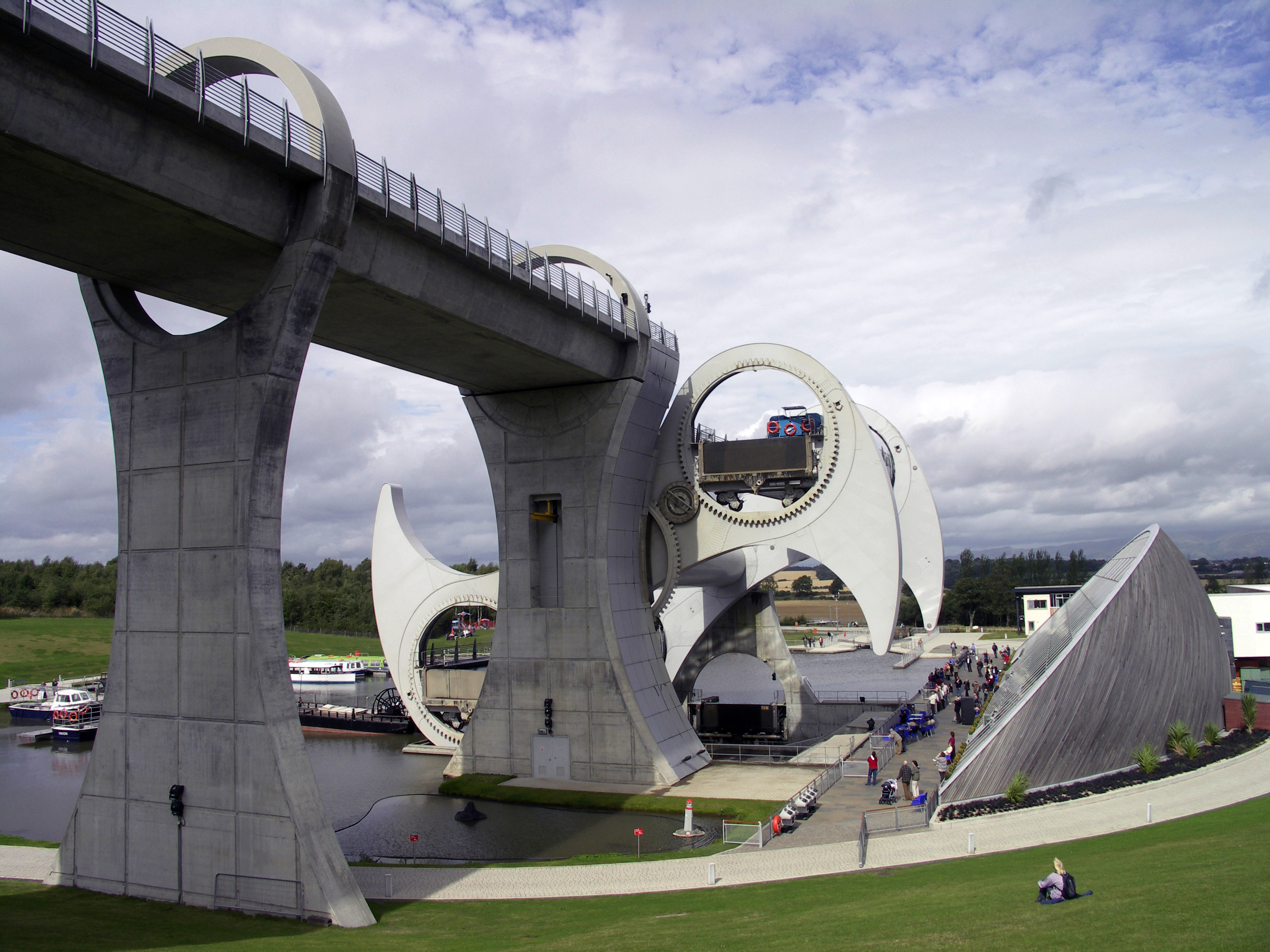
Falkirk Wheel
It takes 1.5 kilowatt-hours to lift a boat twenty-four metres into the air. That is roughly the energy required to boil eight kettles of water. The Falkirk Wheel, which opened in central Scotland in 2002, accomplishes this feat by exploiting a principle that Archimedes understood two thousand years ago: a floating object displaces its own weight in water, so a boat entering one side of the wheel is always perfectly counterbalanced by the water on the other side. The result is the world's only rotating boat lift, a structure that moves 500 tonnes of water and vessels through half a revolution with the casual efficiency of a slowly turning door. It is, by any measure, one of the most beautiful pieces of engineering built in the twenty-first century.
The Canals That Lost Their Connection
The Falkirk Wheel exists because two canals needed to talk to each other again. The Forth and Clyde Canal and the Union Canal once formed a continuous waterway linking Glasgow to Edinburgh, connected at Falkirk by a flight of eleven locks that stepped boats up and down a thirty-five-metre height difference. The journey through the locks consumed 3,500 tonnes of water per passage and took most of a day. By the 1930s, commercial traffic had dwindled, and the locks were dismantled in 1933. The canals silted up, were built over, and by the 1970s the Union Canal had been filled in at both ends and run through pipes beneath a housing estate. Scotland's industrial-age waterway network was severed, apparently for good.
Lego and a Celtic Axe
The Millennium Link project, launched in the late 1990s with a budget of seventy-eight million pounds, aimed to reconnect the two canals as a landmark achievement for the new century. The question was how. Rebuilding eleven locks was feasible but uninspiring. Planners wanted something that would announce itself. A team of twenty architects and engineers, led by Tony Kettle of the firm RMJM, developed the concept during an intense three-week design sprint in the summer of 1999. Kettle modelled early gear-system concepts using his eight-year-old daughter's Lego. The final design drew inspiration from a double-headed Celtic axe, the propeller of a ship, and the ribcage of a whale. Kettle described it as 'a beautiful, organic flowing thing, like the spine of a fish.' The engineering consultancy Arup and fabrication firm Butterley Engineering turned the vision into steel, and the structure was fully assembled at Butterley's plant in Derbyshire before being dismantled and transported to Falkirk on thirty-five lorry loads.
How the Wheel Turns
The wheel's diameter is thirty-five metres. Two opposing arms, shaped like axe blades, extend fifteen metres beyond a central axle and hold two water-filled gondolas, each carrying 250,000 litres. When a boat enters the lower gondola from the basin below, it displaces exactly its own weight in water, so the gondola's total mass does not change. The upper gondola, connected diametrically opposite, provides a perfect counterweight. Ten hydraulic motors rotate the entire assembly through 180 degrees, delivering the lower boat to a canal aqueduct at the top and the upper boat to the basin below. The process takes about fifteen minutes. Because the system is balanced, the motors need only overcome friction and the small energy cost of starting the rotation. The wheel consumes just 1.5 kilowatt-hours per half-turn. Two additional locks above the wheel account for the remaining eleven metres of height difference between the wheel's upper aqueduct and the Union Canal.
Scotland on a Banknote
Since its opening by Queen Elizabeth II in 2002, the Falkirk Wheel has welcomed over 5.5 million visitors, with 1.3 million taking the boat trip through the rotation. It has become one of Scotland's most recognisable modern landmarks, appearing on the Bank of Scotland's fifty-pound note alongside other engineering achievements like the Glenfinnan Viaduct and the Forth Bridge. The visitor centre, designed by RMJM architect Paul Stallan, sits at the base of the wheel, and boat tours run daily during the season. The structure represents something Scotland does not always get credit for: the ability to solve an old problem with new thinking, to replace eleven Victorian locks with a single elegant rotation, and to do it with the energy it takes to make a few cups of tea. The canals are connected again. The boats are moving. And the wheel keeps turning.
From the Air
Located at 56.00N, 3.84W at Tamfourhill, Falkirk, in central Scotland. The wheel is a striking visual landmark from the air: a large white rotating structure at the junction of two canals, with the upper aqueduct extending to the south and the lower basin to the north. The Forth and Clyde Canal runs east-west through the site. Nearest airports: Edinburgh (EGPH) approximately 24 nm east; Glasgow (EGPF) approximately 24 nm west. Best viewed at 1,500-2,500 ft AGL for a clear perspective of the wheel's relationship to the two canals.