The Fall of Antwerp
Sixty thousand people had to decide where to put their lives. The terms of surrender, signed in Beveren on 17 August 1585, gave every Protestant in Antwerp four years to settle their affairs and leave the city forever. Some would convert to Catholicism and stay. Most would not. They were the merchants who had built the cultural and financial capital of Northwestern Europe, the printers and diamond cutters and bankers and weavers whose work had made Antwerp the largest city in the Habsburg Netherlands. Now they had to pack their workshops onto barges, kiss aunts goodbye, and head north into the cold Protestant cities of Holland and Zeeland, taking with them the skills, the capital, and the networks that would shortly make Amsterdam the new metropolis of Europe. The city they left behind would not recover for two centuries.
Why Farnese Came
Alessandro Farnese, Duke of Parma, was the most able general in Habsburg service, a quiet, methodical man whose campaigns rolled back the Dutch Revolt province by province. Antwerp was the prize. The city of one hundred thousand people had joined the Union of Utrecht in 1579 and become the political and emotional capital of the revolt, the symbol of Protestant resistance to Philip II of Spain. It also remembered the Spanish Fury of 1576, when unpaid Spanish soldiers had mutinied and butchered thousands of citizens in the streets. When Farnese arrived at the city walls in July 1584 with ten thousand infantry and seventeen hundred cavalry, every Antwerper knew what an unsuccessful siege might mean. The previous decade had taught them. Farnese, for his part, had no desire to repeat it. He intended to win by other means.
The Bridge Across the Scheldt
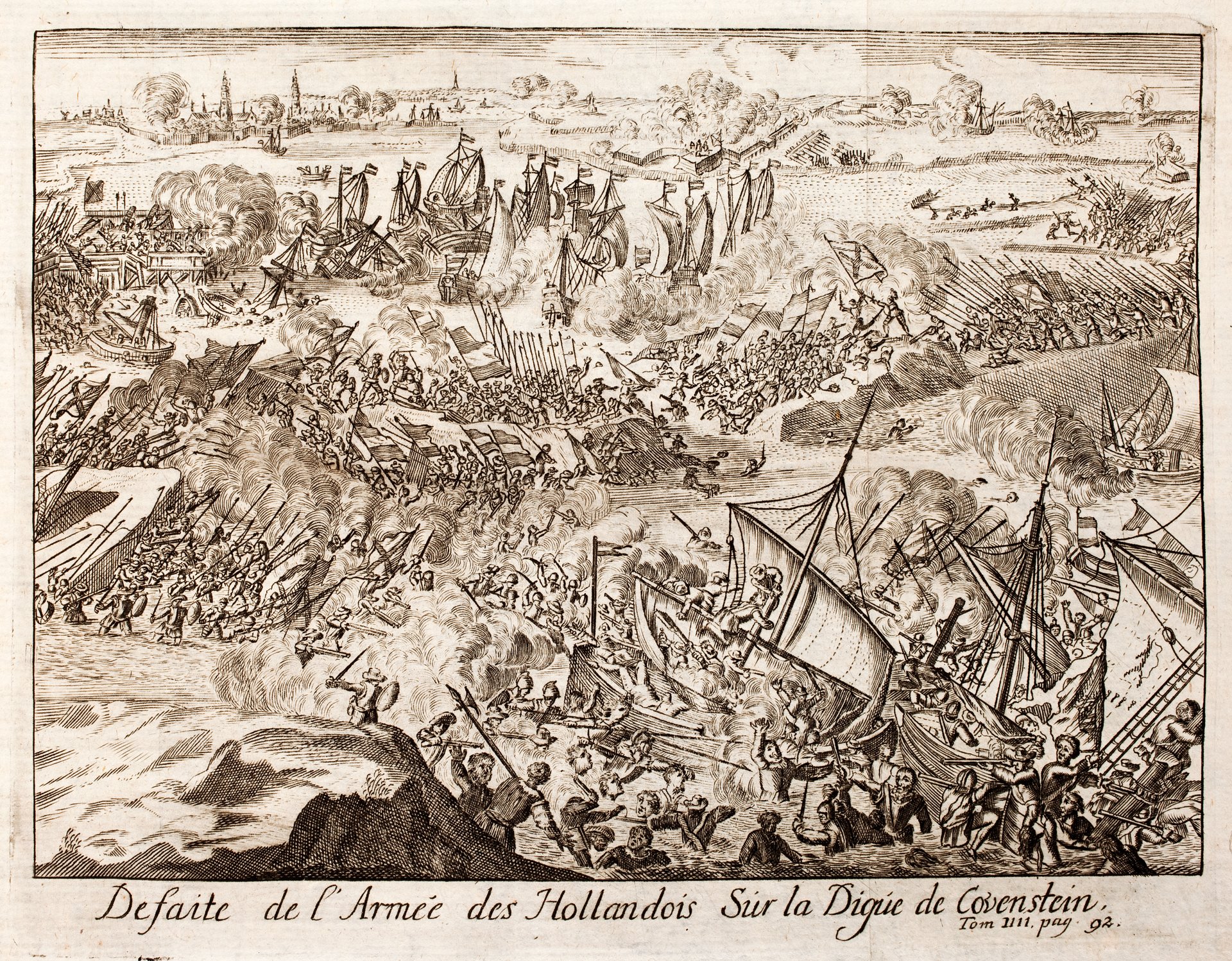
He chose to starve the city by closing the Scheldt River. The fort at Lillo, downstream, had refused to fall, so Farnese decided to build a bridge instead. Two new forts went up on opposite banks at a bend in the river: Saint-Mary on the Flemish side, Saint-Philip on the Brabant side. Between them, his engineers drove tree trunks deep into the riverbed, lashed them with iron chains, laid plank parapets packed with clay to stop musket balls. Where the river ran too deep for piles, thirty-two ships were chained side-by-side as a floating bridge, each one armed with two cannons. Ravelins jutted out for flanking fire. Pikemen-tipped rafts called "floaters" guarded the approaches. The whole structure ran 2,400 feet from bank to bank and was completed on 25 February 1585. The Italian engineer Federigo Giambelli answered with floating bombs, hollowed-out ships packed with gunpowder and gravestones and iron, the most ambitious of which detonated on the night of 4 April 1585 with a blast that hurled stones a mile, killed roughly eight hundred Spaniards, and made the earth tremble inside the besieged city. It is sometimes called one of the largest pre-industrial explosions in history. But the Dutch fleet meant to exploit the breach never came, and Farnese rebuilt the bridge within days.
Famine and Surrender
By midsummer, with the bridge holding and the supply routes severed, hunger inside the city walls became unbearable. The Catholic minority pressed for negotiations. Philip Marnix van Sint-Aldegonde, the city's mayor and a deeply learned Protestant theologian, travelled to Farnese's headquarters in Beveren and signed the surrender on 17 August 1585. What followed surprised everyone who remembered 1576. Farnese forbade his troops from sacking the city. The Castilian regiments he stationed inside Antwerp behaved with iron discipline. There were no massacres, no rapes, no fires. Protestants were told they had four years to settle their affairs, sell their houses, collect their debts, and choose: convert or leave. The terms were considered generous, and they were. They were also devastating. Antwerp's population dropped from one hundred thousand to forty thousand in the years that followed. The Dutch blockade of the Scheldt remained in place, sealing off the city's access to the sea, and would not be lifted until 1795.
Two Cities, One Migration
Imagine, for a moment, what those four years looked like for a printer's family on the Kammenstraat, or for a diamond cutter whose grandfather had set up shop near the cathedral. You knew the city as ancestrally as you knew your own hands. You had to negotiate the sale of a press, or a shop, or a half-built warehouse, to neighbours who might or might not pay. You had to decide which children went first, which apprentices could be brought along, which books and tools would survive the journey. Many of them ended up in Amsterdam, a smaller Protestant city in the United Provinces that suddenly received an extraordinary influx of money, expertise and contacts. The capital that had flowed through Antwerp now flowed through Amsterdam. The diamond industry left and never came back. The printing trade left. The Sephardic Jewish community, which had found refuge in Antwerp from the Iberian Inquisitions, left too, and helped found one of the most important Jewish communities in early modern Europe. Historians still describe the migration as the founding event of the Dutch Golden Age. For Antwerp, which had been the centre of Northwestern Europe, the loss was beyond reckoning. The city kept its cathedral, its guildhouses, its memory. It would not see prosperity on that scale again for two hundred years.
From the Air
Located at 51.22N, 4.40E in the historic centre of Antwerp, around the Cathedral of Our Lady whose spire was the besieged city's central landmark. The Scheldt River runs immediately west of the medieval centre; Farnese's bridge was built downstream near Kallo, roughly 7km northwest of the cathedral. Antwerp International Airport (EBAW) is 5km southeast; Brussels Airport (EBBR) is 40km south. The original city walls have been replaced by ring boulevards (the Leien) that still trace the 16th-century footprint.