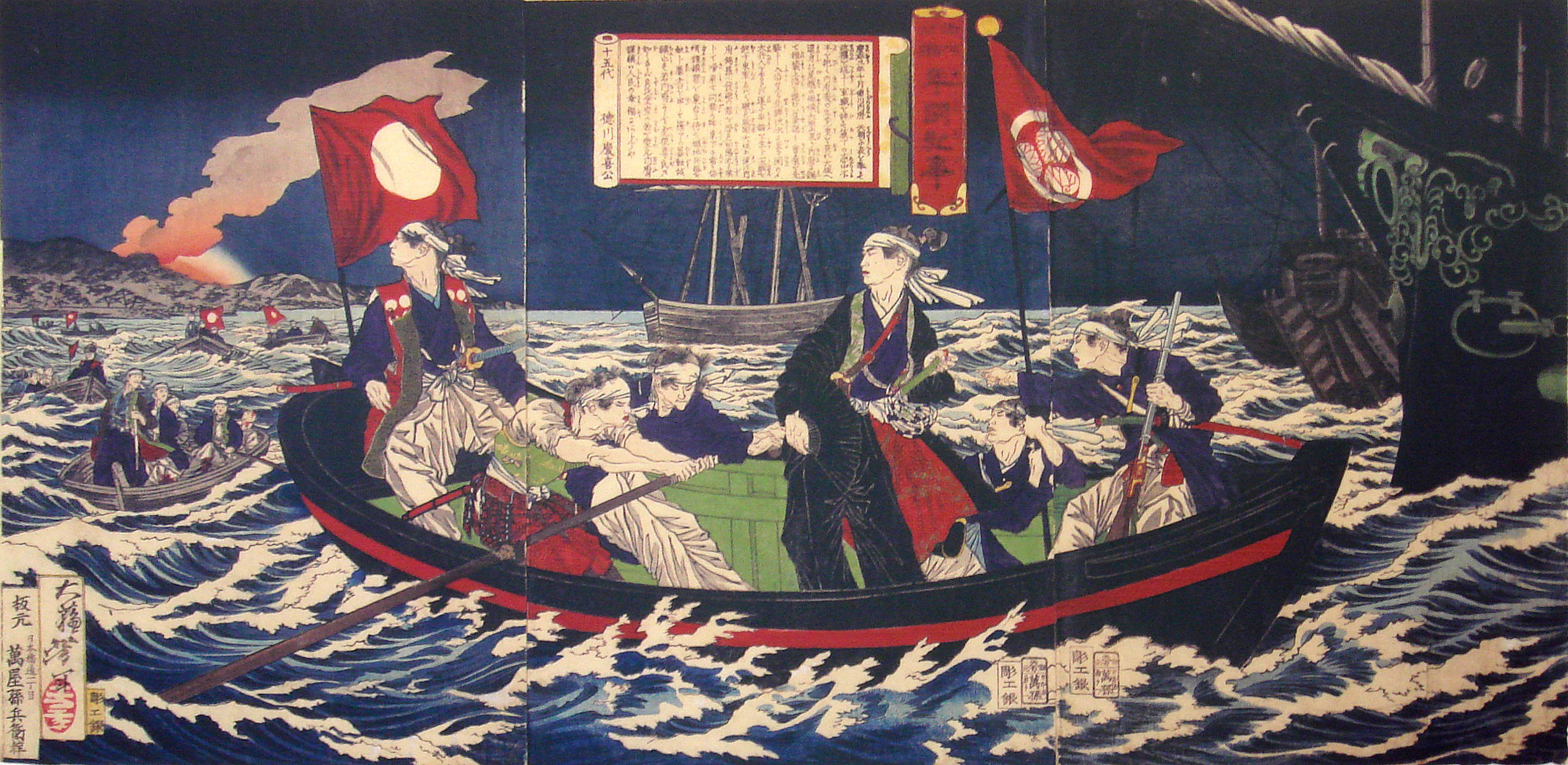
The Fall of Osaka Castle: A Shogun's Midnight Escape
The shogun promised his men he would lead them into battle personally. Instead, he ran. On the night of January 31, 1868, Tokugawa Yoshinobu -- the fifteenth and final shogun of the Tokugawa dynasty -- gathered his advisors and military commanders at Osaka Castle and declared he would take the field himself against the Imperial forces that had just routed his army at the Battle of Toba-Fushimi. It was exactly the kind of bold gesture his demoralized troops needed. Then, under cover of darkness, Yoshinobu slipped out of the castle with the lords of Aizu and Kuwana, made his way to Osaka Bay, and boarded an American warship, the USS Iroquois, to wait for his own ship to carry him back to Edo. Two days later, Osaka Castle burned. A fortress that had anchored Tokugawa authority over western Japan for more than two centuries fell without a single sword drawn in its defense.
The Fortress That Made a Dynasty
Osaka Castle was never just a military fortification. Originally built by Toyotomi Hideyoshi in 1583, the castle had been the site of the decisive Siege of Osaka in 1614-1615, the campaign that destroyed the Toyotomi clan and cemented Tokugawa dominance over Japan for the next two and a half centuries. After that siege, the Tokugawa rebuilt the castle entirely in the 1620s, raising massive granite walls -- assembled without mortar from interlocked boulders -- and a towering keep that proclaimed their supremacy over western Japan. By 1868, the castle was not merely a strategic asset. It was a symbol of the Tokugawa claim to rule, the physical embodiment of a political order that had endured since 1603. Losing it meant something far beyond losing a building.
Toba-Fushimi and the Collapse of Morale
The disaster that preceded the castle's fall was the Battle of Toba-Fushimi, fought just south of Kyoto on January 27-31, 1868. Tokugawa forces, though numerically superior, were routed by the combined armies of the Satsuma and Choshu domains, which had secured the backing of the young Emperor Meiji. The appearance of the Imperial brocade banner on the battlefield -- the nishiki no mi-hata, signaling that the Emperor had authorized military action against the Tokugawa -- shattered the shogunate's legitimacy in a single stroke. Troops who had been willing to fight for the shogun found themselves suddenly branded as enemies of the throne. Yoshinobu later admitted that once the Imperial banner appeared, he lost all will to resist. His forces fell back to Osaka Castle in disorder, looking to their commander for direction.
The Night Escape
What happened next became one of the most infamous episodes of the Boshin War. Yoshinobu summoned his commanders to the castle and announced he would personally lead the counterattack. The declaration steadied his officers. But that same night, the shogun abandoned his own fortress. Accompanied by the daimyo of Aizu and the daimyo of Kuwana, Yoshinobu made his way to the waterfront and sought passage on the shogunate warship Kaiyo Maru. The ship had not yet arrived. In a remarkable detail, the last shogun of Japan spent the night sheltering aboard the USS Iroquois, an American steam sloop anchored in Osaka Bay. The Kaiyo Maru arrived two hours later and carried the Tokugawa party northeast toward Edo. When dawn came and the troops inside the castle learned their leader had fled, resistance evaporated.
Fire and Aftermath
On February 2, 1868, pro-Imperial forces -- the Kangun -- entered Osaka Castle. The garrison had already departed. The castle was seized and set ablaze, reducing the Tokugawa-era keep and the Honmaru Palace to ruins. What had taken armies and siege engines to capture in 1615 fell in 1868 to abandonment and a match. The new Meiji government converted the charred grounds into a military barracks, erasing the castle's feudal identity and repurposing it for the modern conscript army that would replace the samurai class. The stone walls survived -- they had been built to withstand cannon fire, not symbolic gestures -- and they still stand today, the same interlocked granite boulders that the Tokugawa had raised in the 1620s. In 1931, Osaka citizens funded a ferro-concrete reconstruction of the castle tower, restoring the iconic silhouette to the city skyline.
A Castle That Outlived Its Masters
Osaka Castle has now been destroyed and rebuilt three times: by the Tokugawa after the Siege of Osaka in 1615, by fire and neglect after the Boshin War in 1868, and by civic determination in 1931. Each iteration carries the marks of its era. The current tower sits on Tokugawa-era stone foundations but wears a design that blends elements from both the Toyotomi and Tokugawa periods. From the air, the castle's concentric moats and massive stone ramparts dominate the eastern edge of central Osaka, a geometric fortress footprint visible even amid the dense urban fabric of a city of 2.7 million. The grounds are now Osaka Castle Park, one of Japan's most popular cherry blossom viewing sites. Nothing in the peaceful scene hints at the night a shogun broke his word and climbed aboard a foreign warship while his castle still stood behind him.
From the Air
Located at 34.69N, 135.53E in central Osaka. The castle's concentric moats, massive stone walls, and reconstructed tower are clearly visible from the air, set within the green expanse of Osaka Castle Park. The fortress sits on the east side of central Osaka, with the Okawa River curving to the north. Kansai International Airport (RJBB) is approximately 30 nautical miles to the south. Osaka Itami Airport (RJOO) is approximately 10 nautical miles to the north-northwest. Best viewed at 2,000-4,000 feet AGL to appreciate the concentric moat system and stone ramparts against the urban grid. Osaka Bay, where Yoshinobu fled to the USS Iroquois, is visible to the west.