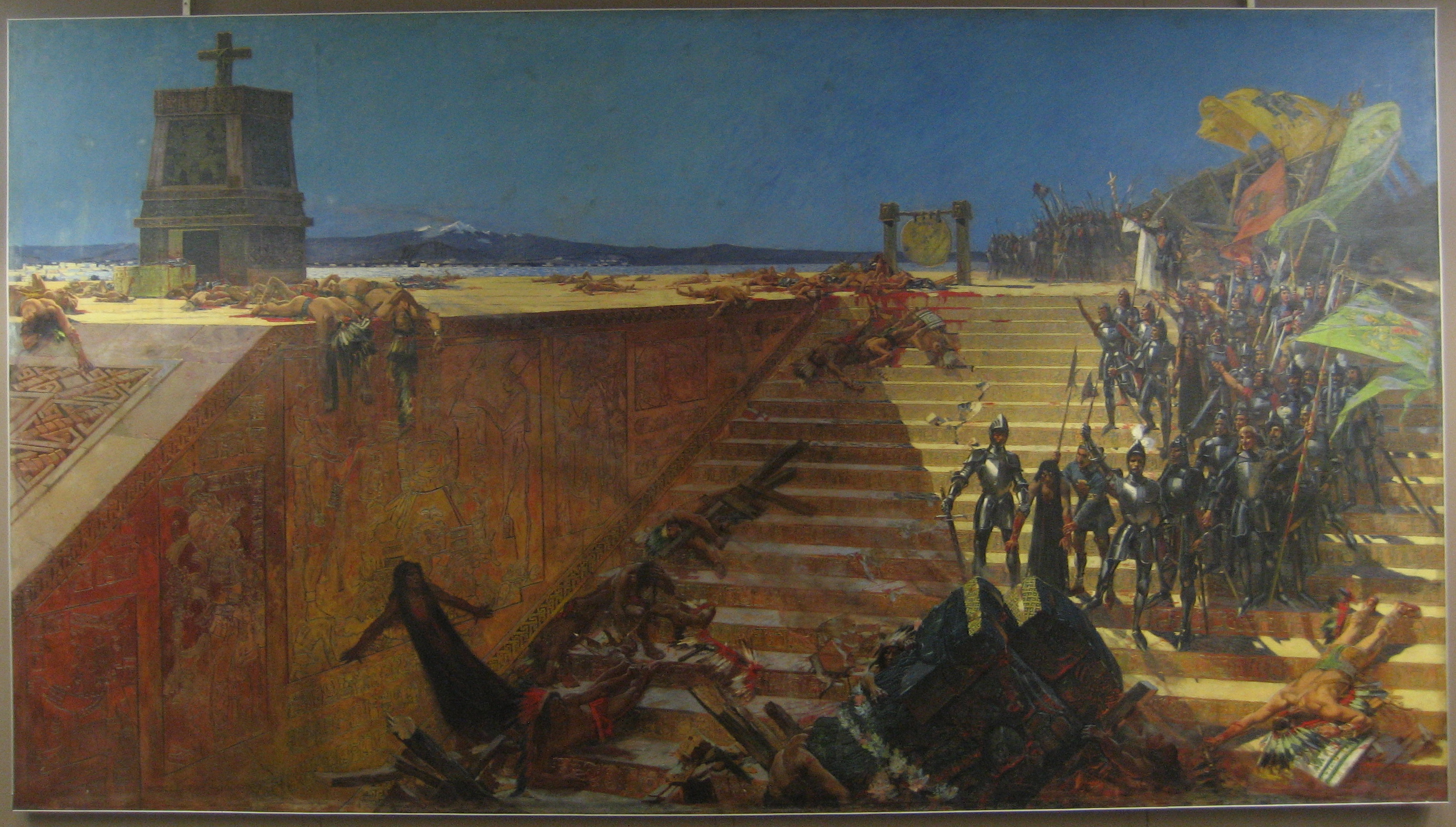
Fall of Tenochtitlan
Tenochtitlan was an island city of causeways, canals, and pyramids, home to perhaps 200,000 people - larger than any city in Spain at the time. By August 13, 1521, it was rubble. The fall of the Aztec capital was not a single battle but an 80-day siege that killed tens of thousands, most of them from disease and starvation rather than combat. What the Spanish called a conquest, scholars increasingly describe as genocide. The city that Hernan Cortes's own soldiers compared to Venice vanished so completely that its ruins lay buried beneath Mexico City for centuries, undiscovered until 1978 when electrical workers stumbled on a carved stone eight feet below street level.
A Conquistador Without Authorization
Cortes arrived on Mexico's Gulf Coast in April 1519 with 508 soldiers, 100 sailors, and 14 small cannons - a force laughably small for conquering an empire. He had been commissioned by the Governor of Cuba, Diego Velazquez de Cuellar, to explore the coast, but Velazquez revoked the mandate before Cortes even sailed. Twice, messengers arrived to depose him; twice, they were talked out of it. Once ashore, Cortes used a legal maneuver borrowed from Velazquez's own playbook: he founded the city of Veracruz, established a local government, and had himself elected magistrate, making himself answerable only to the King of Spain. An inquiry conducted in Spain in 1529 took no action against him. It was a bureaucratic coup that enabled an actual one.
Alliances Built on Resentment
Cortes did not conquer the Aztec Empire alone. He could not have. His critical advantage was the deep resentment that Aztec tributary states harbored toward their overlords. The Tlaxcalans, who had fought the Spanish to a standstill for two weeks before accepting a peace offer, became his most important allies. They had endured a century of being forced to surrender young men and women for sacrifice at the Great Pyramid of Tenochtitlan. When the Tlaxcalans saw a chance to end that cycle, they committed thousands of warriors to the Spanish cause. Xicotencatl the Elder provided Cortes with over ten thousand Tlaxcalan fighters. The conquest was, in significant part, a war between indigenous peoples, with a small Spanish force tipping a balance that had been unstable for decades.
The Massacre That Ignited the Revolt
In May 1520, while Cortes was away fighting Narvaez's forces, he left Pedro de Alvarado in command of Tenochtitlan with eighty soldiers. The Mexica had received permission to celebrate Toxcatl, their annual festival honoring Tezcatlipoca. Hundreds of nobles and warriors gathered in the temple patio, unarmed, dressed in ceremonial jewels and feathers. Alvarado stationed soldiers at every exit, then ordered the attack. The Spaniards killed the drummer first, then turned on the dancers. The massacre of unarmed celebrants - people who had been granted explicit permission to gather - turned the entire city against the Spanish. When Cortes returned, Moctezuma was forced to appeal for calm from the palace, but his authority had been fatally undermined. He was killed shortly after, either stoned by his own people or strangled by the Spanish. His brother Cuitlahuac took the throne and led a furious counterattack that drove the Spanish from the city on La Noche Triste, the Night of Sorrows, with over 800 Spanish and 2,000 Tlaxcalan dead.
The Siege
Cortes regrouped in Tlaxcala and returned with a larger force on the day after Christmas 1520. He established headquarters in Texcoco on the lakeshore and launched a methodical siege. Brigantines - small armed sailing vessels - were built, carried overland in pieces, and assembled on Lake Texcoco to control the water. The causeways were attacked simultaneously. Inside the city, smallpox was doing what Spanish steel could not. The disease, endemic in Spain for centuries, ravaged an indigenous population with no immunity, killing an estimated forty percent within a year. Cuitlahuac himself died of smallpox after ruling just eighty days. His successor Cuauhtemoc fought on, but the city was starving. After eighty days of siege, Cuauhtemoc attempted to escape by canoe and was captured by Spanish brigantines. On August 13, 1521, Tenochtitlan fell. Cortes's own lieutenant, Bernal Diaz del Castillo, recorded the aftermath with horror. The Tlaxcalan allies, unleashing centuries of hatred, carried out violence that appalled even the conquistadors.
What Was Lost
The Spanish dismantled Tenochtitlan stone by stone. Its temples were demolished, its canals filled, its lake eventually drained. The colonial city of Mexico was built directly on top of the ruins, using Aztec construction stones in its own buildings. What had been one of the largest and most sophisticated urban centers in the world - with aqueducts, floating gardens, a population rivaling contemporary Paris - was erased from the physical landscape. The human cost extended far beyond the siege: within a century, the indigenous population of central Mexico collapsed by an estimated ninety percent, primarily from epidemic disease. Today, the Templo Mayor excavation site in Mexico City's Zocalo offers a glimpse of what lies beneath - Aztec pyramids visible alongside the Metropolitan Cathedral that was built from their stones. The fall of Tenochtitlan was not just a military defeat. It was the end of a civilization.
From the Air
Located at 19.435°N, 99.131°W - the site of ancient Tenochtitlan is now the historic center of Mexico City, centered on the Zocalo (Plaza de la Constitucion). From altitude, the flat expanse of the former Lake Texcoco is visible to the east; the causeways that once connected the island city roughly correspond to modern avenues radiating from the center. The Templo Mayor excavation site is visible just northeast of the Metropolitan Cathedral. Nearest major airport is Mexico City International (MMMX/MEX). The surrounding Valley of Mexico, ringed by volcanoes, gives a sense of the enclosed basin where the Aztec capital once dominated its lake.