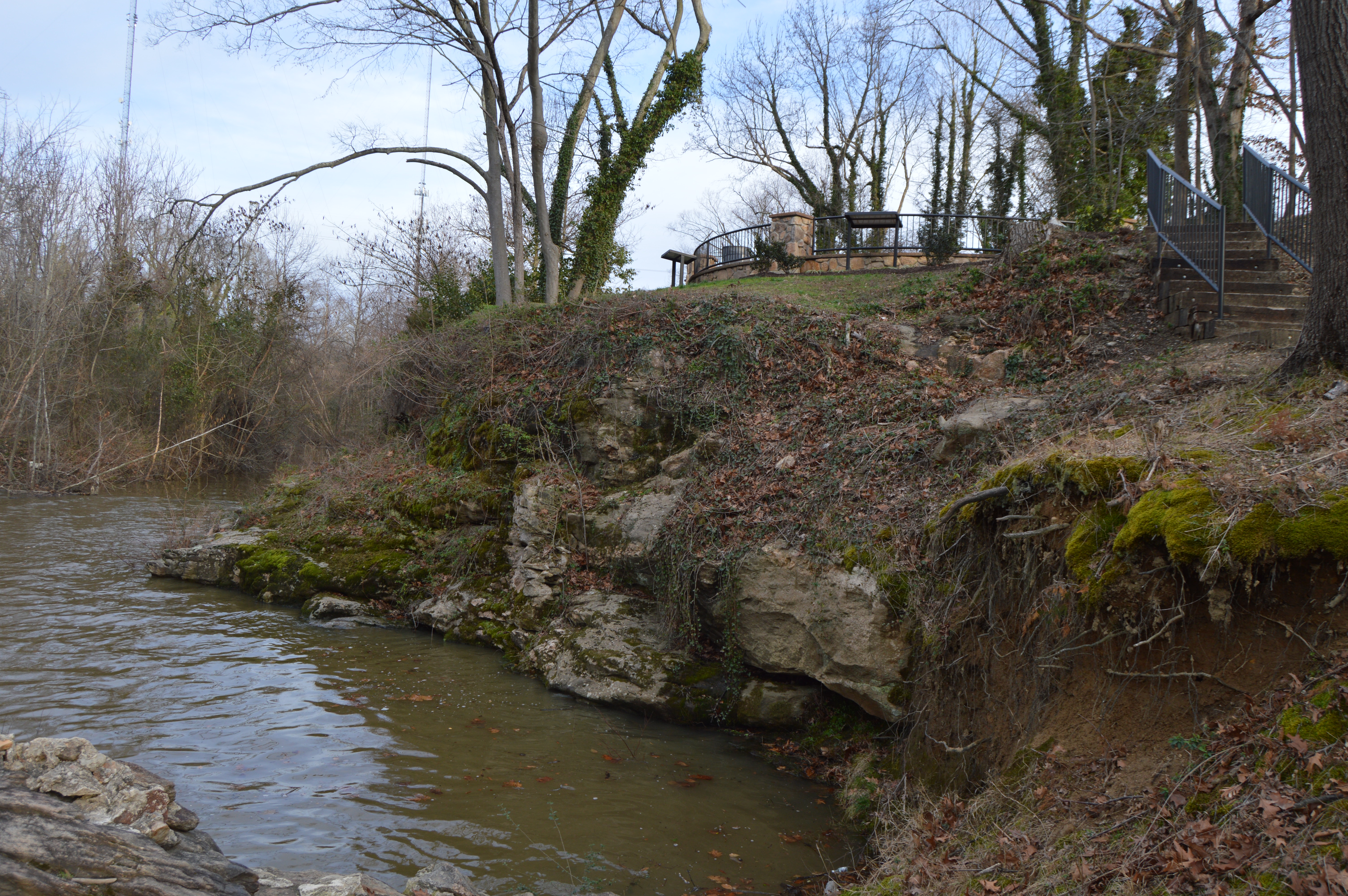
Falling Creek Ironworks
Twelve years after Jamestown's founding, in a remote outpost at the edge of English settlement, colonists fired up a blast furnace and produced the first iron ever smelted in North America. The year was 1619. The place was the confluence of Falling Creek and the James River, where ore deposits met water power and navigable waterways in one fortunate geography. Three years later, every worker at the ironworks but two was dead, the furnace smashed, and the site abandoned. It would take nearly four hundred years for anyone to find the exact spot again.
Where Ore Meets Water
The Virginia Company of London chose the location with industrial precision. Virginia's terrain shifts along the north-south fall line, where the sandy coastal plain of the Tidewater gives way to the rocky, hilly Piedmont. South of present-day Richmond, the James River runs almost due south, parallel to and just east of this geological boundary. On the west bank, Piedmont terrain held iron ore deposits, while the river below remained navigable all the way to the Chesapeake Bay. Falling Creek, a local tributary tumbling downhill into the James, provided the water power needed to run bellows and hammers. It was an ideal combination: raw materials, energy, and a shipping route in one compact stretch of Virginia wilderness. Beginning in 1619, the colonists established the Falling Creek Ironworks, the first iron production facility anywhere in North America.
A Colony's Desperate Gamble
The Virginia Company needed the ironworks to succeed. Since the first settlers arrived at Jamestown on May 14, 1607, the colony had lurched from crisis to crisis. Disease, starvation, and conflict with Native Americans killed most colonists in the first five years. After 1612, tobacco gave the colony its first profitable export, and plantations began spreading along the James River toward the fall line. But tobacco alone could not sustain a colony that had to import every nail, tool, and cooking pot from England. Iron production would mean self-sufficiency, a colony that could build as well as grow. The ironworks at Falling Creek was one of the most remote outposts from Jamestown, pushed to the frontier because that was where the ore lay. Surviving records indicate the furnace produced some quantity of iron, though whether it reached full production before disaster struck remains unknown.
The Morning of March 22
On March 22, 1622, the Powhatan Confederacy under Chief Opechancanough launched coordinated surprise attacks on nearly every English settlement along the James River. Jamestown itself was spared only because a converted Powhatan man warned the colonists the night before. Other outposts were not so fortunate. At Falling Creek Ironworks, 27 people were killed, including two women and three children. Only two colonists survived. The attackers destroyed the facilities completely. The massacre killed roughly a third of all English colonists in Virginia and ended the ironworks operation permanently. Sir Thomas Dale's nearby development at Henricus, one of the most progressive settlements in the colony, was evacuated in the aftermath. The dream of colonial iron production at Falling Creek died that morning.
Ghosts of Industry
The site did not stay quiet forever. From 1750 to 1781, Archibald Cary operated a forge on the same ground, taking advantage of the same ore and water power the original colonists had identified. That forge, too, met a violent end when Benedict Arnold's forces destroyed it during the American Revolutionary War. Later attempts to revive iron production at the site failed, and gradually the exact location of the original furnace was lost to the landscape. For generations, historians knew roughly where the ironworks had been but could not pinpoint the remains.
The Creek Gives Up Its Secret
Heavy rains in the late summer of 2006 eroded the bank of Falling Creek and exposed old timbers that were part of the original furnace structure. Early in 2007, a Chesterfield County Department of Utilities employee who happened to be an amateur archaeologist spotted them. The discovery confirmed what geophysical surveys had suggested since 1999, when Archaeo-Physics LLC detected a large magnetic anomaly consistent with the fired hearth of a blast furnace. Archaeological teams from the Archaeological Society of Virginia, the College of William and Mary, and other organizations had conducted limited excavations over the years, and the creek bank erosion finally revealed what they had been searching for. Today, the site in Chesterfield County sits near Drewry's Bluff, another landmark on this stretch of the James River. The furnace remains are believed to be still buried in the creek bank, a piece of North America's earliest industrial ambition waiting to be fully uncovered.
From the Air
Falling Creek Ironworks is located at 37.44N, 77.44W in Chesterfield County, Virginia, near the confluence of Falling Creek and the James River. The site is approximately 8 miles south of downtown Richmond along the western bank of the James. From the air, follow the James River south from Richmond and look for Falling Creek entering from the west, just north of Drewry's Bluff. The site is close to I-95 and the Defense Supply Center Richmond. Nearest airports: Richmond International (KRIC) approximately 14 nm east; Chesterfield County Airport (KFCI) approximately 9 nm southwest. Best viewed at 1,500-2,500 ft AGL following the James River south from the Richmond fall line.