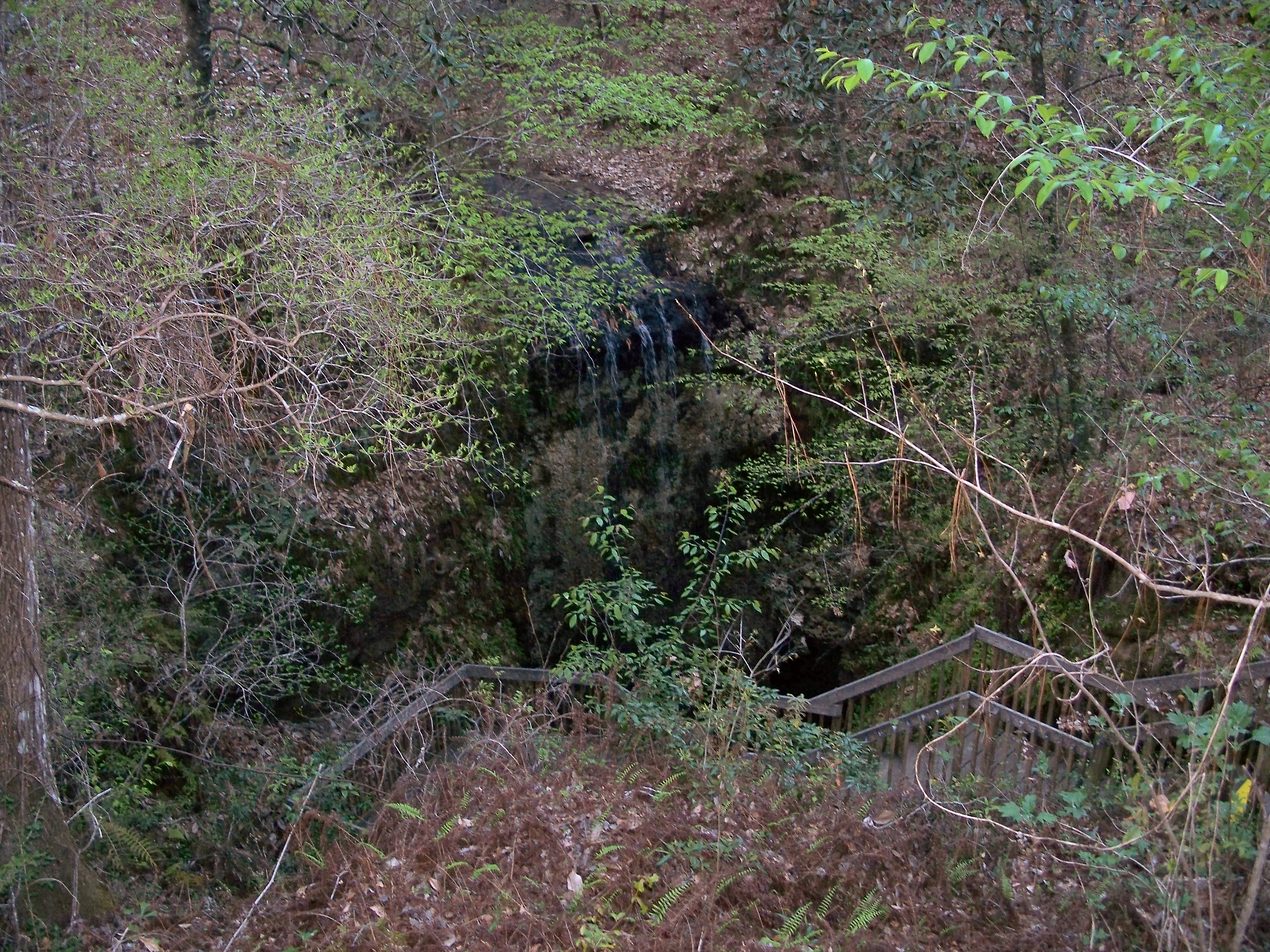
Falling Waters State Park
Florida is not supposed to have waterfalls. The state's highest natural point barely clears 345 feet above sea level, and most of the landscape is relentlessly, famously flat. Yet three miles south of Chipley in the Florida Panhandle, a stream of water steps off a limestone ledge and free-falls 73 feet into a cylindrical sinkhole 100 feet deep and 20 feet wide. This is Falling Waters, the state's tallest waterfall, and the strangest part is not the drop itself but what happens at the bottom: the water vanishes. It disappears into a cavern at the base of the sink, flowing into an underground passage whose final destination has never been determined.
Limestone and Vanishing Acts
Falling Waters State Park sits atop a bed of limestone that has been dissolving for millennia. Rainwater, slightly acidic from absorbing carbon dioxide in the atmosphere, seeps through the porous rock, widening cracks into fissures, fissures into caverns, caverns into the sinkholes that pockmark the 171-acre park. The waterfall itself is fed by springs dependent on rainfall -- in dry spells the cascade slows to a trickle; after heavy rains it gathers force. A paved trail and boardwalk lead visitors to the rim of Falling Waters Sink, where they peer down into the cylindrical pit and watch the water plunge into darkness. The park's Sinkhole Trail winds past additional sinkholes draped in ferns and shaded by towering hardwoods, each one a window into the Swiss-cheese geology beneath the surface.
Layers Beneath the Surface
The land within the park boundaries shows evidence of human habitation stretching back roughly 5,000 years, with numerous sites identified from the Weeden Island period, which spanned approximately 450 to 1000 AD. A 2007 archaeological dig led by the University of West Florida uncovered artifacts between 1,000 and 1,500 years old -- bits of pottery, arrowheads, and what may be the only cave painting ever found in Florida. During the Civil War era, a gristmill operated on the site, powered by the waterfall's flow into Falling Waters Sink. By 1891, a distillery had replaced the mill, taking advantage of the same water source. The Washington County Development Authority deeded the land to the state in 1962, and park facilities like picnic pavilions and restrooms went up soon after, transforming a site of industry into one of recreation.
The Highest Campground in the Flatlands
The main campground at Falling Waters occupies one of the highest hills in the entire state of Florida, a distinction that speaks less to the hill's grandeur than to just how flat everything else is. Twenty-four campsites sit equipped with electricity, fresh water, picnic tables, grills, and clotheslines -- the kind of practical comforts that keep families returning year after year. A small lake within the park permits swimming and fishing. Park rangers host campfire circles where they give interpretive talks about the geology and history of the sinkholes, sometimes accompanied by slide shows. The campfire programs are a Falling Waters tradition, a reminder that state parks serve not just as preserves but as classrooms, places where the landscape itself becomes the lesson.
A Waterfall That Defies Expectations
Visitors come to Falling Waters expecting something modest -- after all, it is Florida. What they find instead resets their assumptions about the state. The boardwalk descent along huge trees and fern-covered sinkholes feels more like Appalachian trail than Gulf Coast flatland. The waterfall, when running strong, produces a sound that echoes off the walls of the cylindrical sink, a reverberating rush that seems impossibly out of place in the Panhandle's pine-and-palmetto country. The mystery of where the water goes after it disappears underground adds a layer of wonder that no interpretive sign can fully resolve. Geologists know the water enters the Floridan Aquifer system, one of the most productive groundwater sources in the world, but its exact path through the limestone labyrinth below remains unmapped and unknown.
From the Air
Located at 30.73N, 85.53W in the Florida Panhandle, three miles south of Chipley. The park covers 171 acres of rolling, wooded terrain that stands out from the surrounding flat agricultural land. The sinkhole and waterfall are not visible from altitude, but the dense tree canopy of the park contrasts with surrounding cleared fields. Nearest airport is Tri-County Airport (KBCR), approximately 5nm northwest of Chipley. Northwest Florida Beaches International Airport (KECP) at Panama City Beach lies roughly 30nm to the south. The terrain here is higher than typical Florida -- the campground sits on one of the highest hills in the state.