Fallingwater
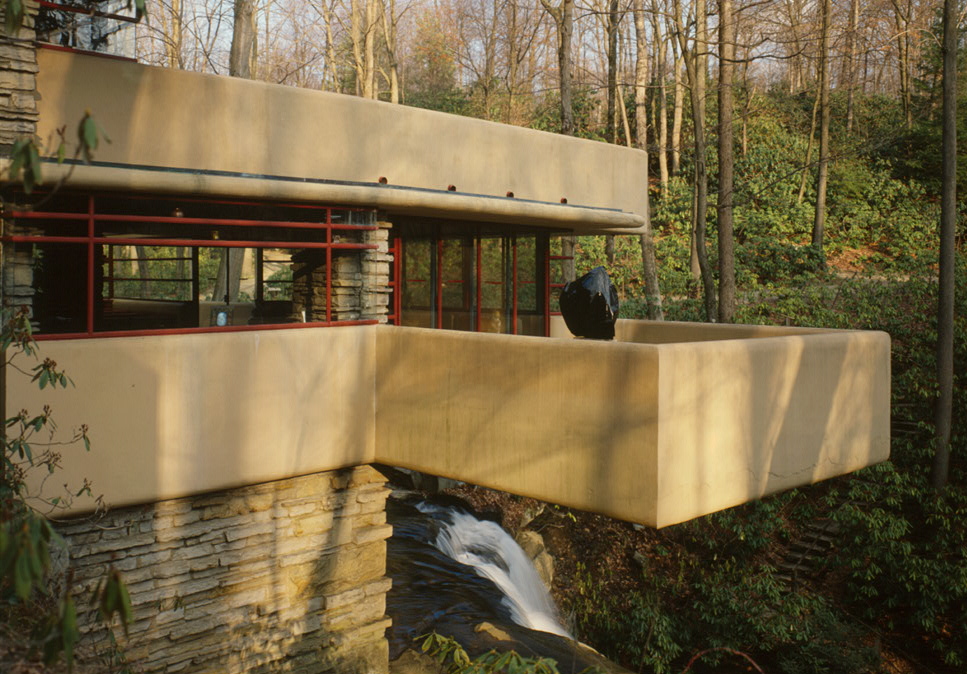
The Kaufmanns wanted a house with a view of the waterfall. Frank Lloyd Wright gave them a house on top of it. When Edgar Kaufmann Sr. commissioned Wright to design a weekend retreat at Bear Run in Pennsylvania's Laurel Highlands in 1934, he expected a home facing the falls from across the stream. Wright had other ideas. He placed the house directly over the cascade, cantilevering reinforced concrete terraces out into the air above the water so that Bear Run flows beneath the living room floor. The result, completed in 1937, became the most discussed modern house in the world -- a building where nature and architecture are so intertwined that the sound of falling water fills every room.
A Department Store Patron
Edgar J. Kaufmann Sr. was the president of Kaufmann's Department Store in Pittsburgh, one of the city's most prominent businessmen. He had established a summer retreat at Bear Run for his employees as early as 1916, and up to a thousand workers used the camp each summer. When the employees stopped coming, the Kaufmanns bought the property in July 1933. Their son, Edgar Jr., had been studying with Wright at Taliesin and introduced his parents to the architect's work. In 1922, the Kaufmanns had built a simple cabin on a nearby cliff -- nicknamed the "Hangover" -- with no electricity, plumbing, or heating. Now they wanted something grander. Wright visited the Bear Run site in December 1934. Nine months later, when Kaufmann called to say he was driving out to see the designs, Wright reportedly drew the entire floor plan from memory in the two hours before his client arrived.
Concrete Over the Falls
Fallingwater is built of locally quarried sandstone, reinforced concrete, steel, and plate glass. The design's defining feature is the series of cantilevered terraces that extend outward from a central stone chimney with no visible support at their far ends. The first floor contains the main entrance, living room, two outdoor terraces, and kitchen. Four bedrooms and additional terraces occupy the upper stories. Wright designed most of the built-in furniture himself. The house sits above Bear Run, a tributary of the Youghiogheny River, with an upper falls where the main house is positioned. Contrary to a common misconception, the stream does not pass through the house -- it flows beneath it. A layer of buff and gray sandstone from the Pottsville Formation underlies the site, and the forest canopy hangs over the building, making Fallingwater surprisingly hard to spot from a distance.
The Cracks Appeared Immediately
Fallingwater was fighting gravity from the start. During construction, cracked concrete and sagging terraces signaled structural problems. Wright's bold cantilevers pushed reinforced concrete beyond its comfortable limits. The terraces began to deflect downward almost as soon as they were poured, and the issue only worsened over decades of freeze-thaw cycles and the relentless humidity from the waterfall below. By the late 1990s, the structural defects were severe enough to threaten the building's survival. A major renovation in the late 1990s and early 2000s addressed the sagging terraces and poor drainage, using post-tensioned steel cables threaded through the concrete to pull the cantilevers back toward level. The house that defied engineering conventions needed engineering to save it.
From Weekend Retreat to World Heritage
The Kaufmanns used Fallingwater as their weekend home, and in 1939 Wright designed an L-shaped guest wing connected to the main house by a curved outdoor walkway, adding a carport and servants' quarters. Edgar Kaufmann Jr. continued using the house after both parents died. In 1963, he donated Fallingwater to the Western Pennsylvania Conservancy, which opened it for public tours in July 1964 and built a visitor center in 1979. The grounds include a small mausoleum for Edgar and Liliane Kaufmann with doors designed by the sculptor Alberto Giacometti. Edgar Jr. was cremated after his death, and his ashes were spread around the property. Fallingwater is designated a National Historic Landmark and was inscribed as part of "The 20th-Century Architecture of Frank Lloyd Wright" World Heritage Site -- one of only eight Wright buildings to receive that distinction.
Hidden in the Forest
One of Fallingwater's most surprising qualities is how invisible it is. Unlike grand country estates that command hilltops and sight lines, Fallingwater sits in a narrow stream valley beneath a dense forest canopy. You hear the waterfall before you see the house. The site was once part of a Freemason country club from Pittsburgh, developed in the 1890s, which went bankrupt by 1913. The grounds held a clubhouse, a Baltimore and Ohio Railroad station, and 13 other buildings -- all gone now. Today the Western Pennsylvania Conservancy maintains the surrounding acreage, and Ohiopyle State Park and Fort Necessity National Battlefield lie to the south. The house draws visitors from around the world, but the experience of arriving remains intimate: a walk through the woods, the sound of water growing louder, and then the sudden revelation of concrete and stone suspended impossibly above the cascade.
From the Air
Fallingwater is located at 39.906N, 79.468W in Stewart Township, Fayette County, Pennsylvania, in the Laurel Highlands of the Allegheny Mountains. The house sits in a narrow, heavily forested stream valley at approximately 1,300 feet elevation and is largely hidden by tree canopy, making it challenging to spot from the air. The nearest airports are Connellsville Airport (KVVS) about 15 nautical miles to the west and Latrobe Arnold Palmer Regional Airport (KLBE) about 25 nautical miles to the northwest. Fort Necessity National Battlefield is approximately 10 miles to the south. Look for Bear Run joining the Youghiogheny River near PA Route 381. Best viewed at low altitude (1,500-2,500 feet AGL) in late autumn when leaf cover is minimal.