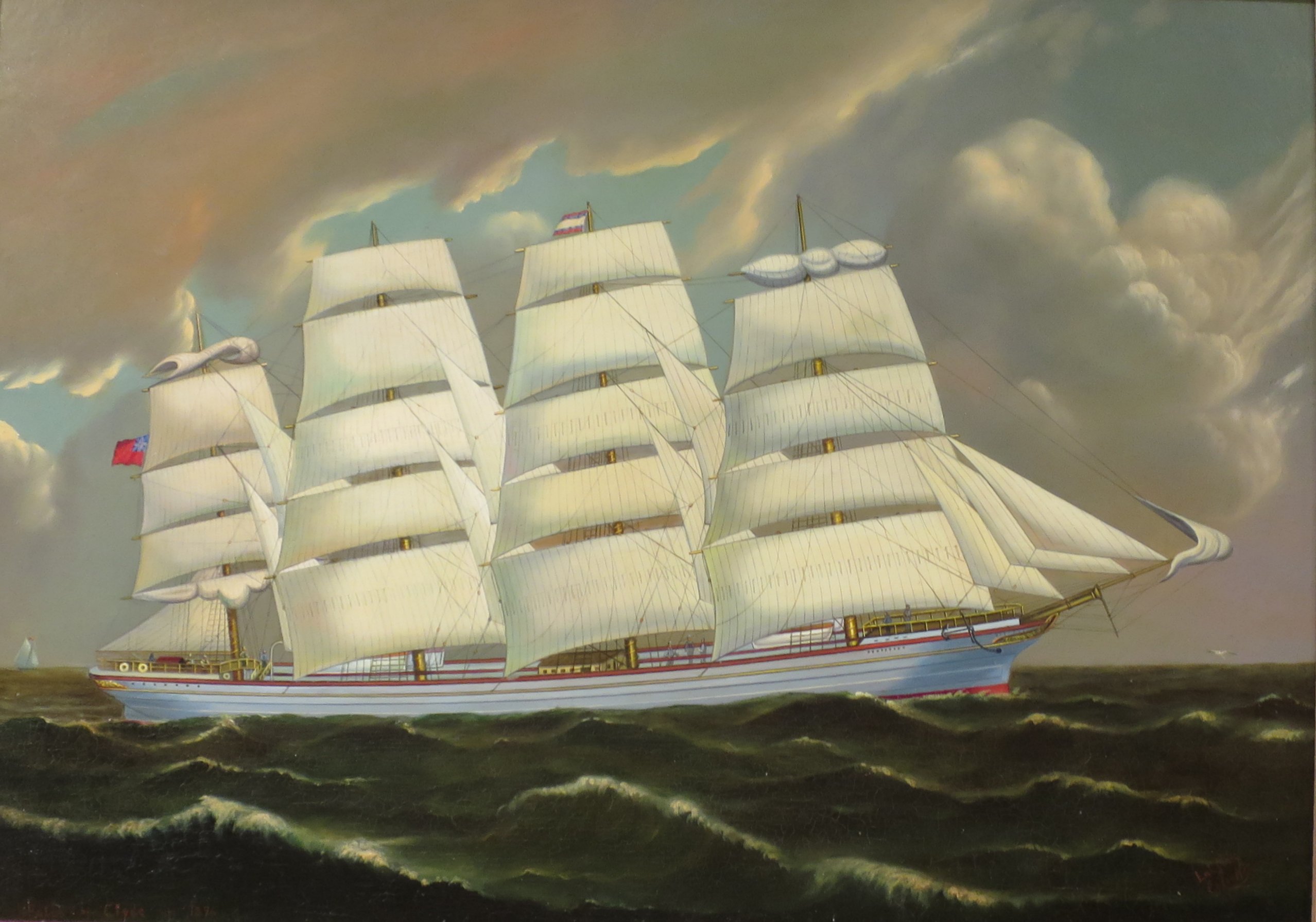
Falls of Clyde (ship)
In the early morning hours of October 15, 2025, the Hawaii Department of Transportation towed Falls of Clyde out of Honolulu Harbor and sank her in 12,500 feet of water, 25 miles south of Oahu. She went down stern first. It was a quiet ending for a ship that had been many things across 147 years -- a British merchantman on the India trade, a Hawaiian passenger vessel carrying sugar and general cargo, a sail-driven oil tanker, a rusting museum piece, and finally, a cause that nobody could quite save. She was the last surviving iron-hulled, four-masted full-rigged ship on earth, and the last sail-driven oil tanker. Both records sank with her.
Built on the Clyde, Bound for the World
Russell and Company built Falls of Clyde in Port Glasgow, Scotland, launching her as the first of nine iron-hulled four-masted ships for Wright and Breakenridge's Falls Line. Named after the waterfalls on the River Clyde and built to the highest classification -- Lloyd's Register A-1 -- she was meant for worldwide trade. Her maiden voyage took her to Karachi and British India, and for six years she worked the India trade before becoming a tramp ship, hauling lumber, jute, cement, and wheat between ports in Australia, California, New Zealand, and the British Isles. After twenty-one years under the British flag, Captain William Matson of the Matson Navigation Company bought her for $25,000 in 1899 and sailed her to Honolulu. When the Republic of Hawaii was annexed by the United States in 1900, Congress passed a special act allowing the foreign-built ship to fly the American flag.
Sugar, Passengers, and Oil
Matson rigged Falls of Clyde down as a barque to reduce crew costs, replacing yards on the jigger mast with more manageable fore-and-aft sails. He added passenger quarters, a deckhouse, and a charthouse. Between 1899 and 1907, she made over sixty voyages between Hilo and San Francisco, averaging seventeen days each way, carrying general merchandise westbound, sugar eastbound, and passengers in both directions. She earned a reputation as fast and commodious. In 1907, the Associated Oil Company purchased her and performed a conversion no one would ever repeat: they turned a sailing ship into a bulk oil tanker. Ten large steel tanks were fitted into her iron hull, with a pump room and boiler forward of an oil-tight bulkhead. She carried 19,000 barrels of oil under canvas -- a pairing of wind power and petroleum that existed for a brief, unrepeatable moment in maritime history.
Decades of Decline
By the late twentieth century, Falls of Clyde had been retired and parked at a Honolulu pier under the care of the Bishop Museum. Hurricane Iwa seriously damaged her in 1982. She was designated a U.S. National Historic Landmark in 1989, but the designation could not substitute for money. In 2008, the Bishop Museum announced plans to scuttle her unless an endowment could be raised. A nonprofit group, Friends of Falls of Clyde, took ownership and secured $350,000 from the Robert J. Pfeiffer Foundation, but hoped-for federal grants never materialized. Year after year, dry-dock repairs were deferred. In 2016, the Hawaii Department of Transportation revoked her mooring permit at Pier 7, citing safety risks. A Glasgow-based campaign tried to bring her home to Scotland, and HDOT accepted their bid in 2021, but the contract collapsed by May 2022 when conditions went unmet. Artifacts and fixtures had long since disappeared.
Twelve Thousand Feet of Water
Stripped of her National Historic Landmark status in December 2024 and removed from the National Register of Historic Places earlier that year, Falls of Clyde had exhausted every reprieve. On October 15, 2025, tugboats pulled her from Honolulu Harbor for the last time. Workers filled her hull with water using hoses at a deepwater site 25 miles south of Oahu. She sank stern first into 12,500 feet of Pacific Ocean. In Glasgow, the BBC reported anger from those who had spent years trying to bring the ship home. The ship that once appeared as a filming location in Hawaii Five-O and Magnum, P.I. during her long, stationary years at Pier 7 was gone. She was scuttled not because no one cared, but because not enough people cared at the same time, with enough resources, in the same place. Maritime preservation is expensive, and the Falls of Clyde is a cautionary tale of what happens when a landmark outlasts the institutions willing to maintain it.
From the Air
Coordinates: 21.1518°N, 158.0041°W (scuttling site, 25 miles south of Oahu in deep water -- nothing visible at the surface). The ship's former berth at Pier 7 in Honolulu Harbor is near Aloha Tower at approximately 21.3069°N, 157.8652°W. Nearby airports: Daniel K. Inouye International (PHNL). The scuttling site is in open ocean with no surface markers.