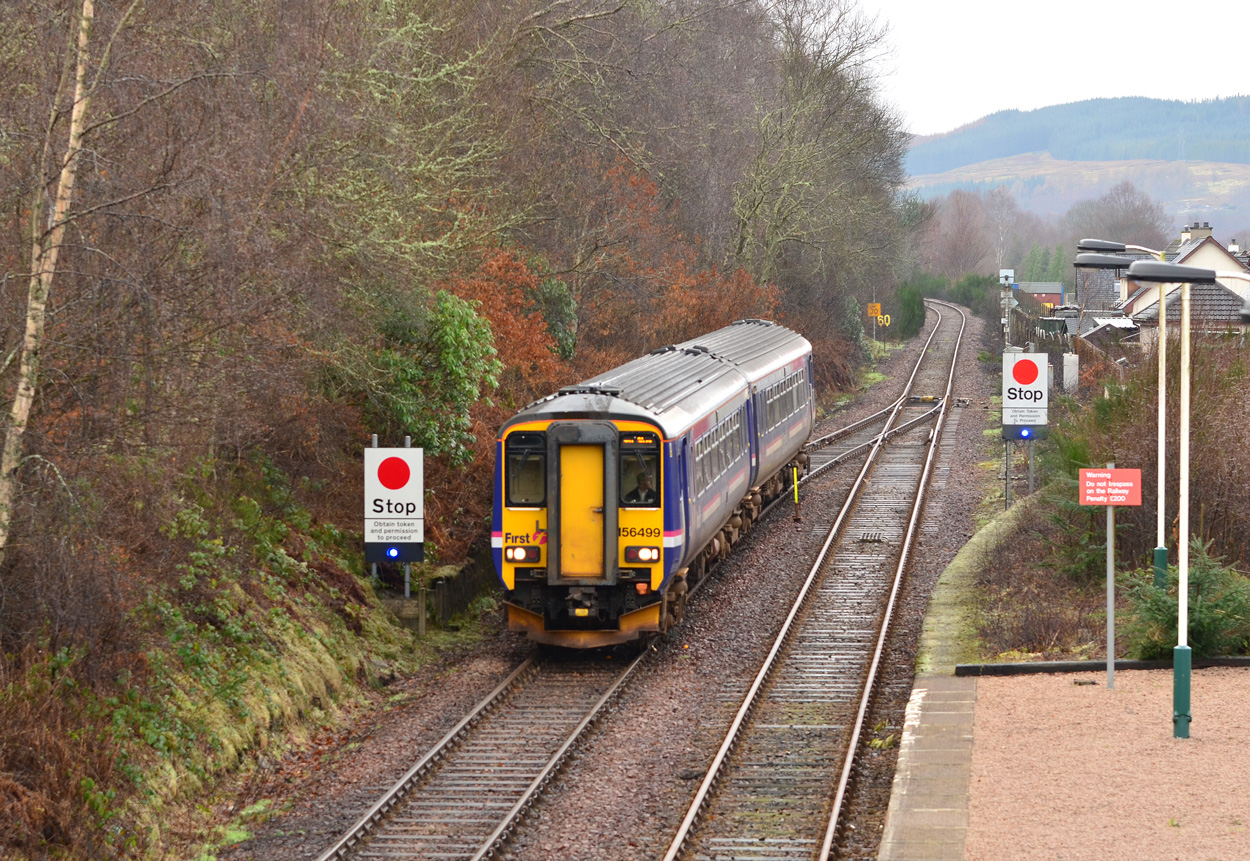
Falls of Cruachan derailment
Angus McColl was the guard on both trains. On 5 April 1997, a rockfall derailed a passenger service near Falls of Cruachan station on the West Highland Line. Thirteen years later, on 6 June 2010, boulders from the slopes of Ben Cruachan struck the Glasgow-to-Oban train at almost exactly the same site, derailing it again. McColl was on duty both times. The 2010 incident left one carriage hanging over a fifty-foot embankment, sixty passengers evacuated with minor injuries, a brief fire from spilled engine oil, and the A85 road and railway closed for a week. No one was killed. The mountain, indifferent to schedules and safety systems, had simply done what it has always done.
Where the Mountain Meets the Line
The West Highland Line runs through the Pass of Brander at the foot of Ben Cruachan, one of Argyll's highest peaks at 1,126 metres. The stretch of track near Falls of Cruachan station is prone to rockfalls from the mountain's slopes. The geology is straightforward: steep gradients, fractured rock, and the freeze-thaw cycles of Highland weather combine to loosen boulders that roll or slide onto the railway below. The majority of incidents occur in summer and autumn, often triggered by sheep scrabbling on the slopes and dislodging small stones that disturb larger ones. It is a problem that has been recognized since the line opened in 1880. One year later, on 17 August 1881, a moving boulder struck a train. The railway company's response was ingenious and, in its own way, beautiful.
The Trip Wire Solution
In 1882, the Callander and Oban Railway installed a purely mechanical warning system: a screen of ten thin wires strung horizontally across the mountainside, connected to seventeen pairs of semaphore signals. If a boulder large enough to endanger a train broke through the wire screen, the signals would automatically set to danger. When the system was first installed, any unsafe boulders below the screen were physically wired back to it. The system operates independently of the radio signalling used elsewhere on the line -- a Victorian solution that relies on nothing more sophisticated than the tensile strength of wire and the pull of gravity. It worked for decades. But the 2010 derailment occurred at a point where the track was not protected by the trip wire system, and the boulders that struck the train came from a section of slope that the original engineers had not wired.
Sixty Passengers, Fifty Feet
The 2010 derailment left the leading carriage of the two-car train in a precarious position on the embankment above the A85 road. Lubricating oil from a damaged engine crankcase spilled onto the sleepers and ignited, but the train conductor and a passenger put out the fire with hand extinguishers before it could spread. Firefighters from Oban, Arrochar, Dalmally, and Inveraray responded, along with a Major Incident Unit from Clydebank and a Heavy Rescue Vehicle from Easterhouse. Diesel leaked from a ruptured fuel tank, keeping crews on standby through the night. Both the road and the railway were closed for a week. The recovery operation, estimated at 100,000 pounds, required a crane to be brought to the site -- which in turn required the A85 to be strengthened to support its weight. On 11 June, five days after the derailment, the crane lifted the fallen carriage from the embankment.
The Mountain's Long Memory
Following the 2010 incident, Network Rail cleared vegetation and removed loose rocks from the slopes above the railway. The Rail Accident Investigation Branch opened an inquiry. But the fundamental problem remains: Ben Cruachan is a mountain, and mountains shed rock. The Victorian trip wire system addressed the most dangerous section of the route, but the mountain is larger than any single engineering solution. The West Highland Line, widely considered one of the most scenic railway journeys in Britain, runs through landscape that is actively, slowly, and occasionally violently in motion. Angus McColl, the guard who served on derailed trains at the same location thirteen years apart, understood something about this stretch of track that no safety report can fully capture: the mountain does not know the railway is there. It will keep sending stones down its slopes, as it has for millennia, regardless of timetables, trip wires, or the trains that pass beneath.
From the Air
Located at 56.40N, 5.12W in the Pass of Brander on the West Highland Line, at the foot of Ben Cruachan (1,126m) in Argyll. The railway and A85 road run through the narrow pass between the mountain and Loch Awe. Nearest airport is Oban Airport (no ICAO code); nearest major airports are Glasgow (EGPF) and Inverness (EGPE). Best viewed at 3,000-5,000 feet. Falls of Cruachan station and the Cruachan Power Station are nearby landmarks.