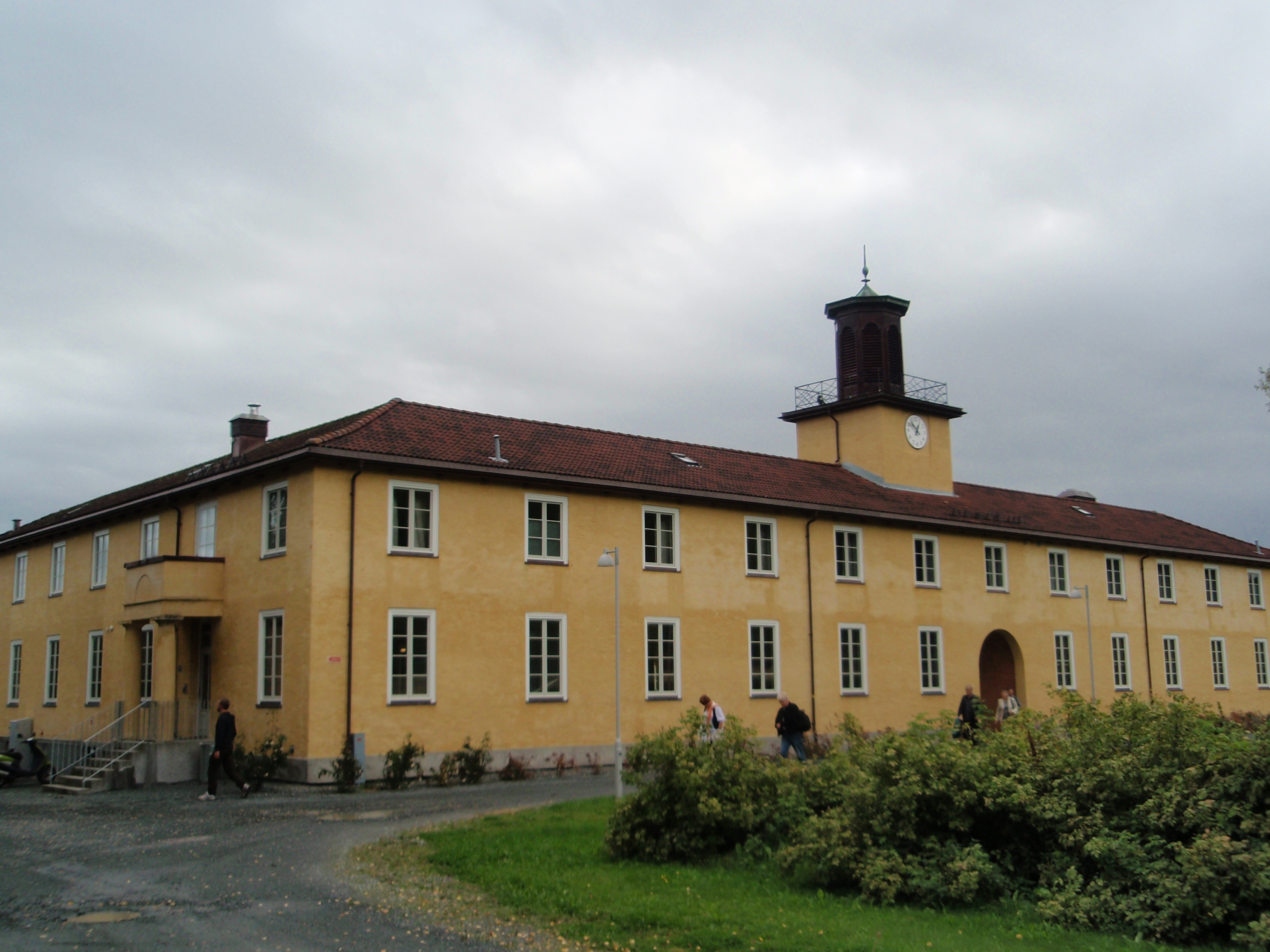
Falstad Concentration Camp
Before the war, it was a place meant to reform troubled boys through education and Christian virtue. The brick buildings at Falstad, arranged around a central courtyard in the village of Ekne, had been a boarding school since 1895, rebuilt twice after fires. In September 1941, those same walls became a Nazi prison camp, and the forest to the south became a place from which no one returned.
From Schoolhouse to Prison
The Nazis first visited Falstad in August 1941, considering it for the Lebensborn program, which sought to increase the 'Aryan' population. They found it unsuitable for that purpose but quickly recognized another use. Within weeks, 170 Danish men who had refused forced labor with the Todt Organisation became the camp's first prisoners. In a grim irony, these initial inmates were made to build the barbed wire fences and watchtowers that would confine those who came after them. Falstad fell under the authority of Gerhard Flesch, the regional security police commander in Trondheim, who treated it as his personal prison. The camp grew steadily, with barracks rising southeast of the main building, three watchtowers scanning the grounds, and a commander's residence across the river. At least 4,500 prisoners from thirteen countries would pass through Falstad before liberation, though the true number may never be known, since camp authorities burned their records as the war ended.
The Forest of Falstadskogen
South of the camp stood a forest that the commanders turned into an execution ground. On 7 March 1942, the first shots were fired there: four Jewish men, Abel Lazar Bernstein, David Isaksen, Wulf Isaksen, and David Wolfsohn, along with Olav Sverre Benjaminsen, were killed. A Yugoslav prisoner of war named Ljuban Vukovic was forced to become the forest's grave digger. He survived, and his testimony would prove crucial in postwar trials. The worst single atrocity came on 6 October 1942, when Nazi authorities imposed martial law across central Norway. At least 204 people were killed in Falstadskogen that day: 170 non-Norwegian prisoners and 34 Norwegian political prisoners. More than 150 unnamed prisoners of war were also shot in the forest over the course of the war. As the end approached in May 1945, camp authorities tried to hide the evidence, exhuming bodies and sinking roughly 25 of them in the nearby fjord.
Lives Held and Lost
Daily existence at Falstad was defined by forced labor that was often deliberately pointless, designed to degrade rather than produce. Guards like Edward F. Lambrecht, whom prisoners called Gråbein (Grayleg) after the Norwegian word for wolves, were notorious for casual brutality. Forty-seven Jewish men were imprisoned at Falstad at various times; at least eight were murdered there, while others were deported to Auschwitz. Among those killed in November 1942 were Moritz Abrahamsen, Kalman Glick, and Herman Schidorsky. Toralf Berg, a Norwegian resistance fighter, was executed in February 1943. Despite the horror, a change in camp command during the summer of 1943 brought somewhat improved conditions for those who remained. Of the six commandants who ran Falstad during the war, none were prosecuted for war crimes in Norway, though several subordinate officers faced justice. Gerhard Flesch was sentenced to death. Oscar Hans, who commanded the firing squads, received a death sentence later commuted by Norway's Supreme Court.
A Place That Remembers
After liberation, Falstad briefly served to hold those who had collaborated with the Nazis, under the name Innherrad Forced Labour Camp. Then, between 1951 and 1992, the buildings returned to education, operating as a school for people with intellectual disabilities. In August 2000, the Falstad Centre Foundation was established as a national institution for documenting the history of wartime imprisonment, humanitarian law, and human rights. The effort to find and identify the dead continues. The original estimate of 202 victims in Falstadskogen is now considered too low. Efforts to exhume, identify, and properly bury the remains go on, a process made harder by the camp authorities' attempts to destroy the evidence in those final days of the war. The brick buildings still stand in the quiet village of Ekne, overlooking the Trondheim Fjord. The forest still stands to the south. Both carry the weight of what happened there.
From the Air
Located at 63.69°N, 11.04°E in the village of Ekne, Levanger Municipality, along the Trondheim Fjord in central Norway. The rectangular brick buildings are visible from altitude, with the forest of Falstadskogen extending south of the complex. Nearest major airport is Trondheim Airport Værnes (ENVA), approximately 60 km southwest. Altitude recommendation: 3,000-5,000 feet for context of the fjord setting.