Fanny Bay
Nobody knows who Fanny was. The name appeared on British Columbia maps in 1913, was officially adopted in 1923, and traces back to British Admiralty charts drawn from Royal Navy Captain G.H. Richards's surveys in the 1860s. But if Richards knew the identity of his Fanny, he kept it to himself. One geographer claimed the bay was named for a sea captain who lived nearby. Locals insist Captain George Vancouver named it in 1792, though his journals describe only the opposite shore. The mystery endures, and the community of 921 people on Baynes Sound seems perfectly content to let it.
Oyster Country
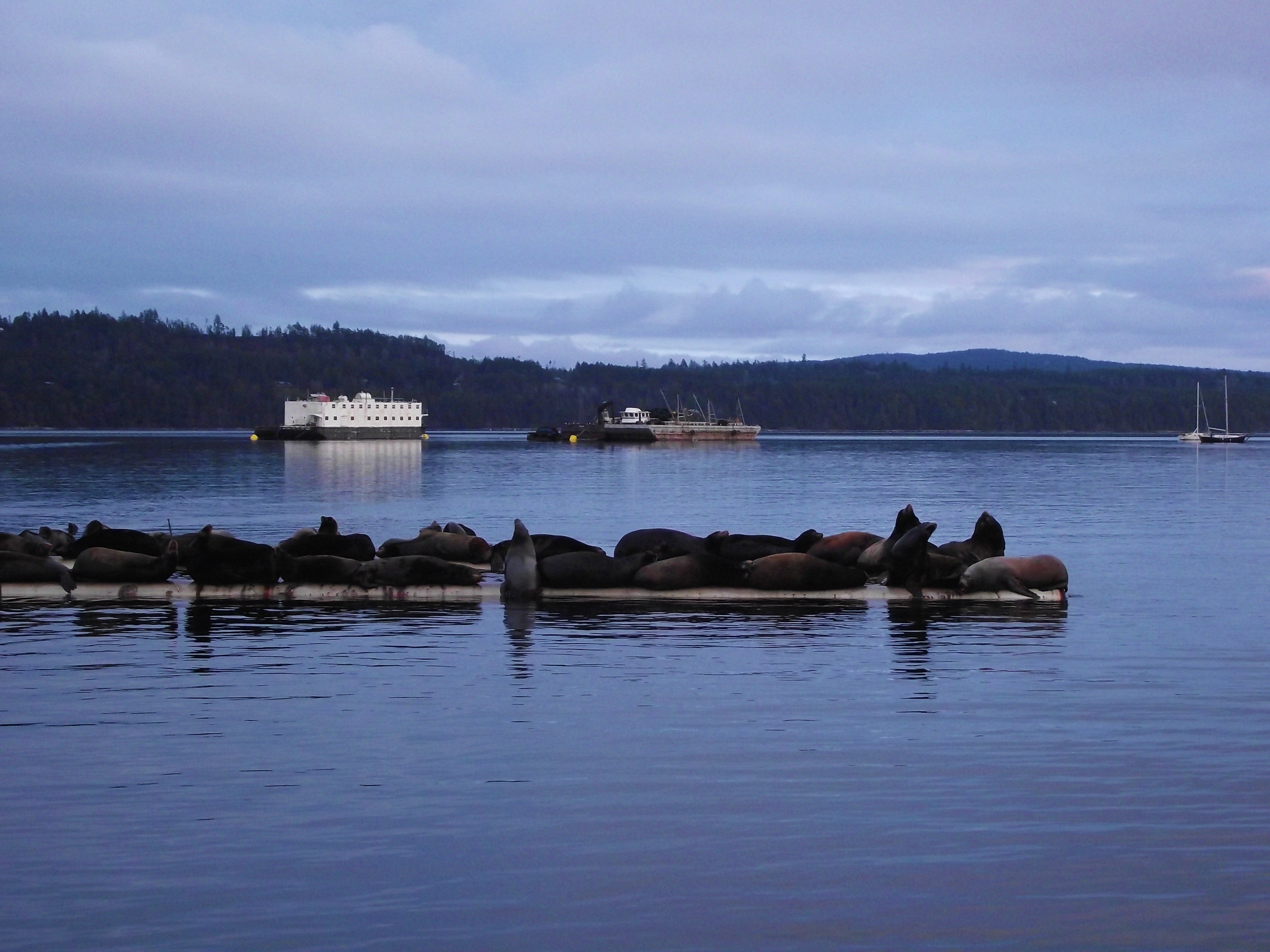
Fanny Bay is oyster country. Pacific oysters were first introduced here as early as 1912 or 1913, with additional seedings around 1925. The cold, nutrient-rich waters of Baynes Sound proved ideal for shellfish cultivation, and today the bay produces Pacific oysters, manila clams, savoury clams, and mussels for both domestic and global markets. The Fanny Bay oyster has become something of a brand -- plump, briny, and sweet, with a clean finish that reflects the pristine waters of Vancouver Island's east coast. Oyster boats work the sound, and processing facilities line the shore, giving the community an industrial character that belies its small population. Sea lions congregate near the processors, drawn by the same abundance that sustains the local economy.
The Logging Camp That Vanished
In the early twentieth century, Eikichi Kagetsu incorporated the Deep Bay Logging Company, which operated timberlands in both Deep Bay and at least 3,000 acres in Fanny Bay. The company built a settlement for its workers: split-cedar houses, a water system, and a school. The labor force was predominantly Japanese-Canadian, though a peculiar racial restriction of the era -- it was illegal for Japanese people to operate steam machines -- meant that Caucasian workers had to be hired specifically for that purpose. During World War II, the Canadian government's internment of Japanese Canadians swept through Fanny Bay. Kagetsu's property and businesses were confiscated, and the logging company was eventually sold to the H.R. MacMillan Export Company at a loss. The settlement that Kagetsu built disappeared. What had been a thriving community was erased by wartime policy.
The FBI and Other Landmarks
The Fanny Bay Inn -- affectionately abbreviated as the FBI -- has been a fixture on the Island Highway since 1938. For decades it has operated as a pub and local gathering spot, hosting live music, jam sessions, and the kind of conversations that happen in small-town bars where everyone recognizes everyone else. The inn celebrated its 80th anniversary in 2018, having outlasted countless changes in the community around it. Until 2005, another local landmark operated from an even more unlikely venue: Brico, a restaurant inside a pulled-ashore barge. The community also once hosted Wacky Woods, an outdoor art installation in the forest created by artist George Sawchuk, featuring political and surrealist works touching on topics from old-growth logging to the war in Afghanistan. Sawchuk died in 2012, and Wacky Woods closed in 2018 when the property was sold.
A Name Without an Answer
The mystery of Fanny Bay's name is, in its own way, the most telling thing about the place. It is small enough that a single unexplained name can become the subject of persistent local debate, yet connected enough -- through its oysters, its highway, its sound -- to matter to the wider world. Ships Point, a smaller community within Fanny Bay, has its own fire department. There is a community school, a government wharf, and a fire hall. The Island Highway runs through, connecting Fanny Bay to Nanaimo to the south and Comox to the north. People stop for oysters, stay for the pub, and leave wondering about the name. It is a place defined as much by what remains unknown as by what is plainly visible: the sound, the shellfish, and the quiet persistence of a community that has weathered war, dispossession, and the slow passage of time.
From the Air
Located at 49.49N, 124.81W on Baynes Sound, east coast of Vancouver Island. Fanny Bay is visible as a small coastal settlement along the Island Highway between Nanaimo and Comox. Baynes Sound separates Vancouver Island from Denman Island, and oyster farming operations are visible in the shallow waters. Nearest airports include Comox Valley Airport (CYQQ) to the north and Nanaimo Airport (CYCD) to the south.