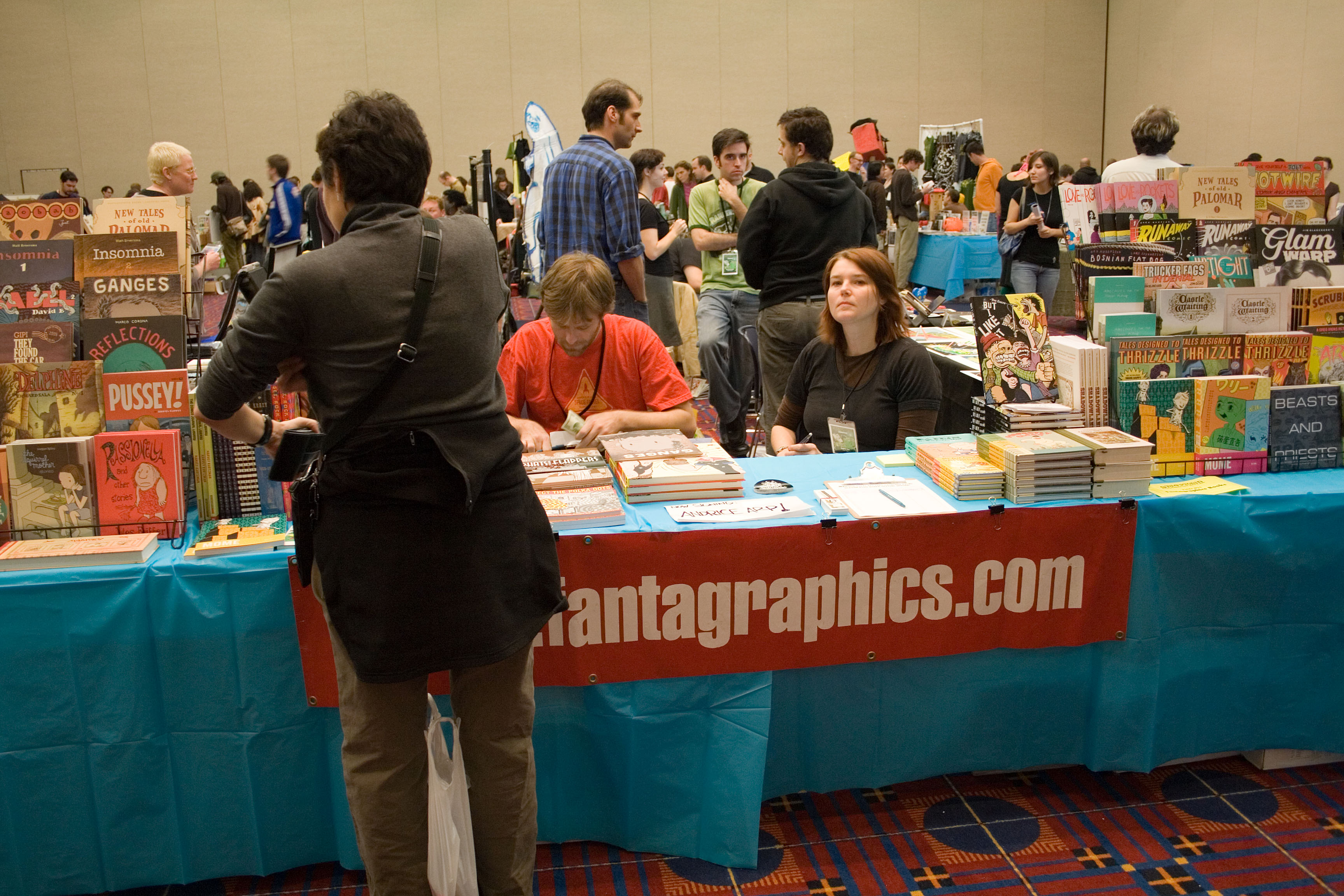
Fantagraphics
In 1977, a young man named Kim Thompson joined a struggling comics publishing outfit run out of College Park, Maryland, by Gary Groth and Michael Catron -- and by 1978 had poured his inheritance into it to keep it from going bankrupt. The company's entire operation at that point was a renamed adzine called The Comics Journal, and Thompson's money kept the lights on. Nearly half a century later, Fantagraphics has published Love and Rockets, Ghost World, The Complete Peanuts, Palestine, and My Favorite Thing Is Monsters, won more Eisner and Harvey Awards than most publishers dream of, and operates a bookstore and gallery in Seattle's Georgetown neighborhood. Thompson died of lung cancer in 2013, but the company he helped build remains one of the most influential publishers in the history of American comics.
The Journal That Became a Publisher
Fantagraphics was founded in 1976, and for its first three years, publishing comics was not the point. Groth and Catron had taken over The Nostalgia Journal and transformed it into The Comics Journal, a magazine of news, interviews, and sharp criticism that treated comic books as a serious art form when almost nobody else did. The company moved from Washington, D.C., to Stamford, Connecticut, to Los Angeles, perpetually chasing lower costs and better logistics. In 1979, Fantagraphics began publishing actual comics, starting with Jay Disbrow's The Flames of Gyro. The breakthrough came in 1982 with Love and Rockets by the Hernandez brothers, Jaime and Gilbert, a series that blended punk rock energy, magical realism, and Chicano culture into something comics had never seen. From there, Fantagraphics built a roster of critically acclaimed titles including Dan Clowes's Eightball, Peter Bagge's Hate, Chris Ware's Acme Novelty Library, and Charles Burns's Black Hole.
The Awards They Gave and the Awards They Won
From 1985 to 1987, Fantagraphics coordinated the Jack Kirby Awards for achievement in comic books through its magazine Amazing Heroes. When a dispute over ownership erupted in 1987 between Fantagraphics and employee Dave Olbrich, the compromise split the prize into two new awards: the Eisner Awards, managed by Olbrich, and the Fantagraphics-managed Harvey Awards, named for cartoonist Harvey Kurtzman. Fantagraphics then proceeded to win both awards prolifically. Chris Ware's Acme Novelty Library alone took home Eisner Awards for Best Continuing Series, Best Coloring, and Best Publication Design across multiple years. Dan Clowes won Best Writer/Artist repeatedly. Emil Ferris's My Favorite Thing Is Monsters swept four Eisners in 2018. The Harvey Awards were equally generous: Love and Rockets won Best Continuing or Limited Series in 1989, 1990, and 1992, while The Comics Journal earned Best Biographical, Historical, or Journalistic Presentation nearly every year from 1990 through 2006.
Keeping the Lights On with Unlikely Revenue
Fantagraphics nearly went broke more than once. A 1998 crisis forced layoffs and a restructuring of The Comics Journal from eight issues a year to a larger semi-annual format supported by a new website. What kept the company solvent during its leaner periods was, improbably, pornography. The Eros Comix imprint, launched in 1990, published adult-oriented comics and manga translations that sold well enough to subsidize the literary titles that won all the awards but moved fewer copies. By the late 1990s, even the Eros line had lost its profitability, and publication of new material diminished. The imprint quietly faded; its titles no longer appear on the Fantagraphics website. Meanwhile, the company's archival reprint projects became a financial and critical lifeline. The Complete Peanuts, designed by cartoonist Seth, won Eisner Awards in 2005 and 2007 and Harvey Awards in 2005, 2007, 2008, and 2009. Fantagraphics also published definitive collections of Krazy Kat, Little Nemo, Popeye, Prince Valiant, and the complete Carl Barks Disney Library.
Georgetown and Beyond
In 1989, Fantagraphics relocated from Los Angeles to the Maple Leaf neighborhood of Seattle, and it has remained in the city ever since. In 2006, the company opened Fantagraphics Bookstore and Gallery in Seattle's Georgetown neighborhood, a gritty, art-friendly district south of downtown where the storefront shares space with Georgetown Records. The store serves as a gathering point for the alternative comics community and hosts signings, readings, and gallery shows. In August 2020, the company rebranded from Fantagraphics Books to simply Fantagraphics, adopting a compact new logo featuring a stylized ink pen nib and a torch. In 2023, the publisher began reprinting comics from Atlas Comics under license from Marvel Comics, and in 2025 launched a hardcover series called Lost Marvels. After nearly fifty years, the company that started as a renamed adzine in Maryland has become an essential institution, the publisher of record for both the American comics underground and the medium's most celebrated archival heritage.
From the Air
Fantagraphics is headquartered in Seattle at approximately 47.549N, 122.317W, in the Georgetown neighborhood south of downtown. From the air, Georgetown sits between Interstate 5 and the Duwamish Waterway, south of the stadiums and just north of Boeing Field. The Fantagraphics Bookstore and Gallery is on Airport Way South. Nearest airports: Boeing Field/King County International (KBFI) 1nm south, Seattle-Tacoma International (KSEA) 8nm south.