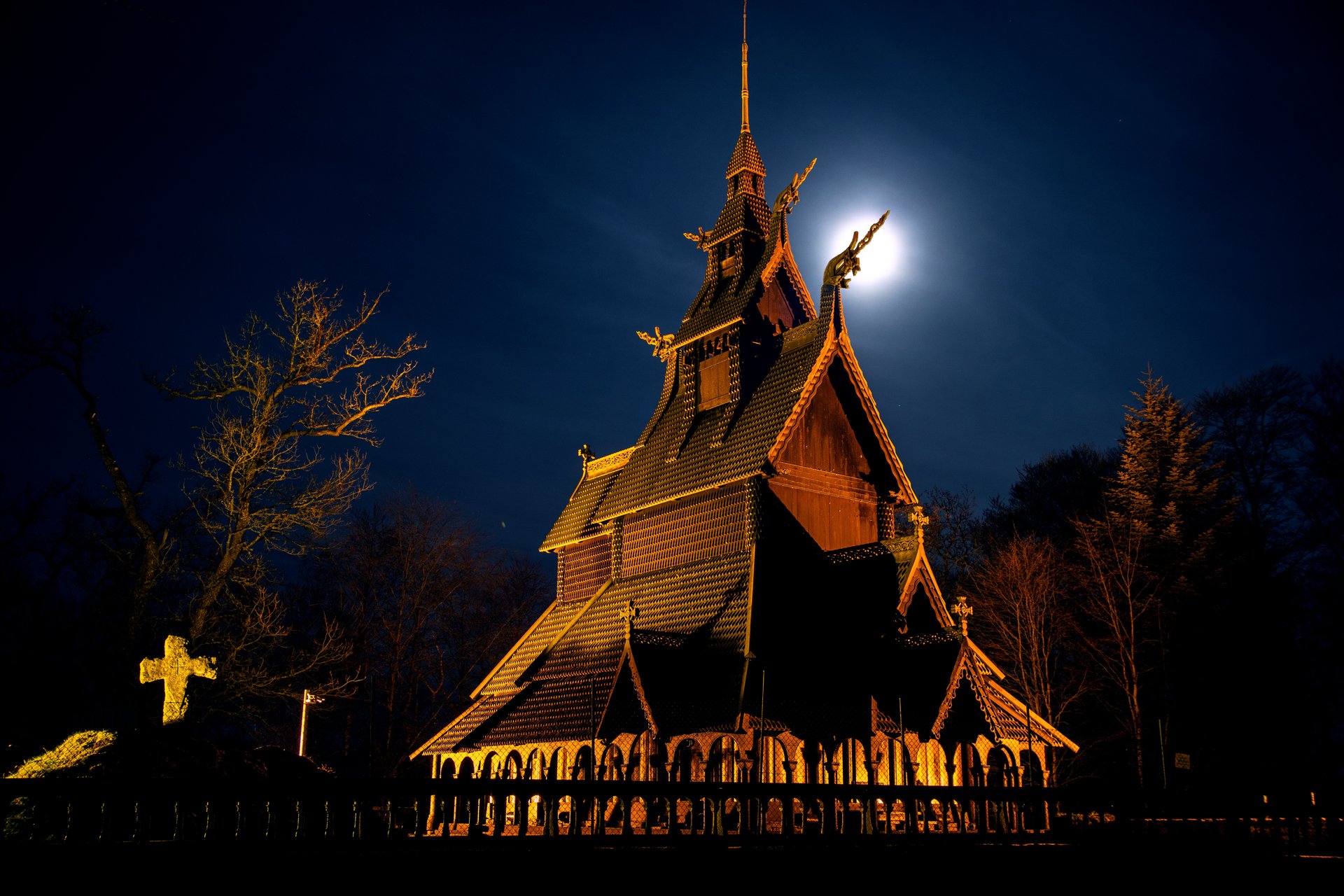
Fantoft Stave Church
The photograph on the cover of the 1993 Burzum EP Aske -- Norwegian for "ashes" -- shows a blackened skeleton of timber against a gray sky. That charred shell was Fantoft Stave Church, and the image became an icon of the Norwegian black metal scene's campaign of arson against the country's historic churches. What it does not show is the deeper story: a building originally raised around 1150 in a fjord village, saved from demolition in 1883 by a consul who moved it piece by piece across western Norway, and then rebuilt again after the fire. Fantoft has been destroyed and resurrected twice. Few buildings have fought so hard to exist.
From the Fjord to the City
Fantoft Stave Church was originally built around 1150 at Fortun, a village near the inner end of Sognefjord, Norway's longest and deepest fjord. For over seven centuries, it served its small community. But by the 1870s, hundreds of Norway's medieval stave churches faced demolition as congregations outgrew them and replacement churches were built. In 1879, a new Fortun Church was constructed, and the old stave church was marked for destruction. Consul Fredrik Georg Gade intervened, purchasing the building and having it disassembled and transported to Fana, near Bergen, in 1883. It was reconstruction as preservation -- every timber numbered, the entire structure reassembled on new ground. A stone cross from Tjora in Sola Municipality was placed outside.
Night of June 6
On June 6, 1992, Fantoft Stave Church burned to the ground. The fire was initially attributed to lightning or electrical failure. It was, in fact, arson -- the first in a series of church burnings carried out by members of Norway's early black metal music scene. In 1994, Varg Vikernes of the one-man band Burzum was convicted of burning three other churches and a chapel in Bergen and Oslo. He was also charged with the Fantoft fire, but the jury voted not guilty. The presiding judges called the acquittal an error but did not overturn it. The charred remains of the church were photographed and used as the cover art for Vikernes's Aske EP, turning an act of cultural destruction into an album cover.
Built a Third Time
Reconstruction began soon after the fire and took six years to complete. Craftsmen worked to replicate the original structure -- the dragon-headed gables, the layered rooflines, the dark timber walls characteristic of Norway's stave church tradition. The rebuilt church reopened in the late 1990s. Since 1997, a security fence has surrounded the building, a precaution that would have been unthinkable before the arsons. The fence is a quiet acknowledgment that the threat to Norway's wooden heritage comes not only from time and weather but from people.
The Weight of Wood
Norway once had perhaps a thousand stave churches. Fewer than thirty medieval examples survive today. Fantoft is not among them -- it is a reconstruction, twice removed from its original form. Yet it preserves something essential about the tradition: the vertical mast construction that gives stave churches their name, the interplay of Christian architecture with older Norse decorative motifs, the intimate scale of worship in a land of vast landscapes. Standing inside, surrounded by dark wood and the smell of tar, the fact that these particular timbers were cut in the 1990s rather than the 1100s matters less than you might expect. The form persists. The craftsmanship is real. What Fantoft demonstrates is not authenticity but determination -- the refusal to let an 850-year-old architectural idea disappear.
From the Air
Located at 60.34N, 5.35E in the Fana borough of Bergen. Bergen Airport Flesland (ENBR) is approximately 10km to the southwest. The church sits in a wooded area south of Bergen's city center. From the air, look for the distinctive multi-tiered dark timber stave church surrounded by security fencing in a suburban-forested setting. Best viewed below 2,000 feet. The surrounding area is residential Bergen with forested hills.