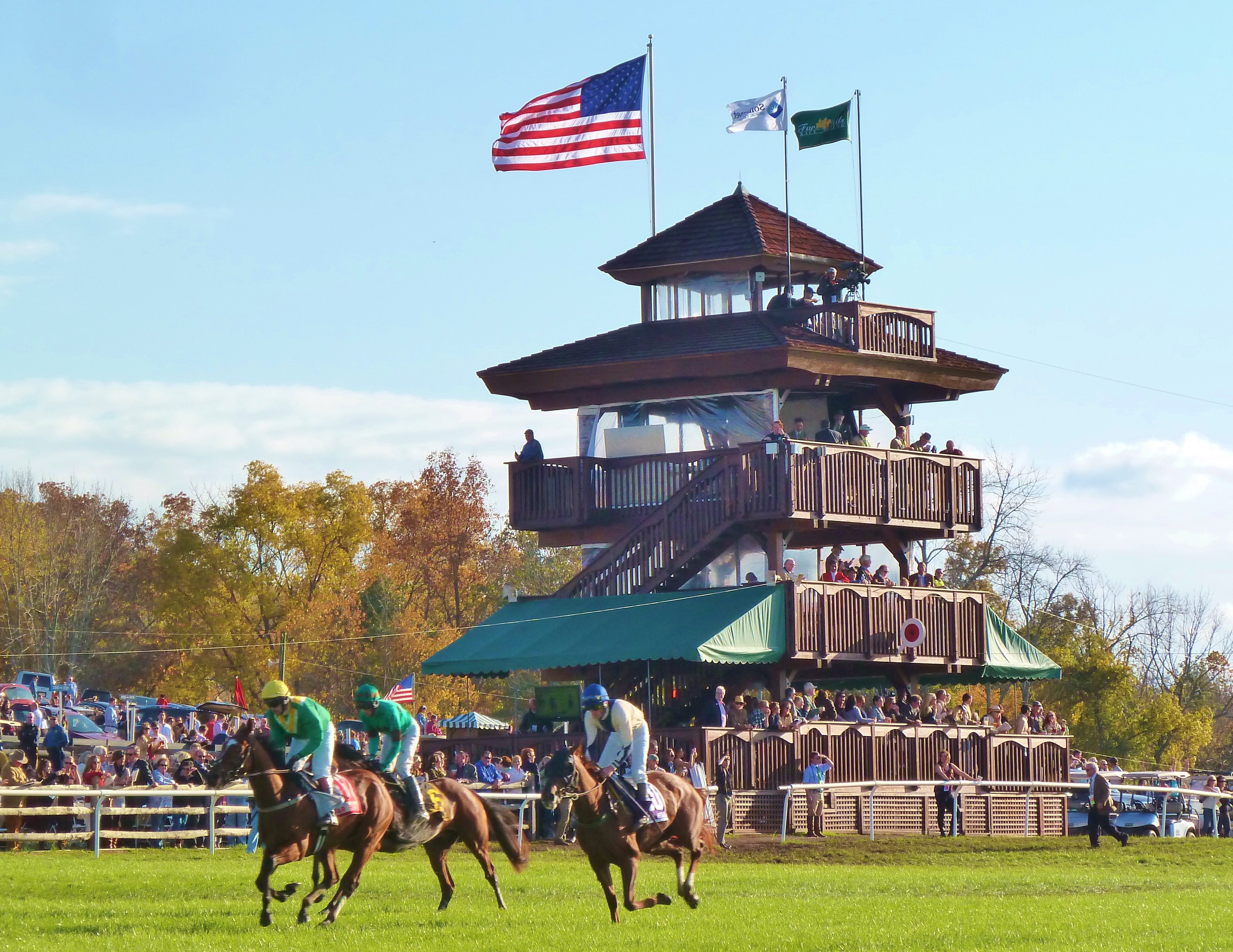
Far Hills Races
Every October, a rolling stretch of Somerset County farmland transforms into something that feels imported from the English countryside. Tens of thousands of spectators spread blankets, uncork bottles, and arrange picnic spreads of startling ambition while thoroughbreds hurl themselves over timber fences at thirty miles per hour. The Far Hills Races have been running since the 1920s, making this one of the oldest and most prestigious steeplechase meetings in America. It is simultaneously a serious horse racing event and a social spectacle unlike anything else in New Jersey.
A Century Over the Fences
The Far Hills Race Meeting dates back to 1921, when steeplechase racing still drew the sporting aristocracy of the eastern seaboard. The event grew through the decades into the premier fixture on the American steeplechase calendar. The 100th running, delayed from 2020 to 2021 by the COVID-19 pandemic, was the first to receive national television coverage, broadcast on FS2 with Larry Collmus calling the action. By the 2022 meeting, the American Grand National had become the day's centerpiece, a Grade 1 hurdle race carrying a purse of $250,000. That year, the veteran Snap Decision finally captured the title after years of near-misses, winning in a finish that had the crowd on its feet. The course itself has produced legendary performances: in 2000, All Gong set the course record at 4:53.80, a mark that still stands. McDynamo won the Breeders' Cup Steeplechase here in consecutive years, returning in 2004 after eleven months of recovery from hock surgery to defeat Hirapour in front of an estimated 45,000 spectators.
The Tailgate as Art Form
What sets Far Hills apart from other race meetings is the spectacle beyond the track. Attendance typically ranges from 25,000 to 45,000, and the parking areas become an open-air exhibition of competitive picnicking. Elaborate canopied setups appear with linen tablecloths, candelabras, and multi-course meals that would embarrass many restaurants. Over 40 major corporations reserve entertainment tent spaces each year, turning their patches of grass into branded hospitality zones. The festive atmosphere grew so exuberant that in 2013, the Far Hills Race Meeting Association banned attendees from bringing alcohol through the general admission gates. The previous year's event had produced at least 28 arrests for public urination, underage drinking, and disorderly conduct. Parimutuel wagering was not introduced until 2018, a reminder that for many attendees, the horses have always been secondary to the scene.
Racing for a Cause
Beneath the party atmosphere runs a serious philanthropic current. Since the 1950s, proceeds from the race meeting have funded the Steeplechase Cancer Center at Somerset Medical Center, with cumulative donations exceeding $17 million by 2009. The partnership has been transformative for the medical center, enabling it to offer comprehensive cancer treatment services to New Jersey residents who might otherwise travel hours for care. In 2007, the Race Meeting Association directed a portion of its proceeds to the New York Heroes Fund, established to support emergency workers and victims of the September 11 attacks. The charity dimension gives the event a weight that its boisterous reputation might obscure. Corporate sponsors do not just come for the entertainment tents; they come because Far Hills has built a model where revelry and generosity reinforce each other.
The Somerset Hills Stage
Far Hills, New Jersey, is one of the wealthiest small communities in America, tucked into the gently rolling terrain of the Watchung Mountains' western foothills. The landscape of horse farms, stone walls, and winding lanes provides a natural backdrop for steeplechase racing, a sport born in the Irish and English countryside. The race course itself sits in open terrain that allows spectators to see much of the action without screens or grandstands, giving the event an intimacy that larger flat-track venues cannot replicate. From the air, the transformation is visible each October: a patchwork of white tents and parked cars materializing in fields that spend the other eleven months in quiet pastoral use. The event's persistence for over a century in this same landscape speaks to a deep connection between place and tradition in the Somerset Hills.
From the Air
Located at 40.69°N, 74.63°W in Far Hills, Somerset County, New Jersey. The race grounds are visible as open fields in the rolling Somerset Hills. Nearest airports include Morristown Municipal Airport (KMMU, 12 nm NE) and Somerset Airport (KSMQ, 8 nm SE). Best viewed at 2,000-3,000 ft AGL. During the October race meeting, look for the distinctive white tent clusters and large parking areas in otherwise pastoral fields.