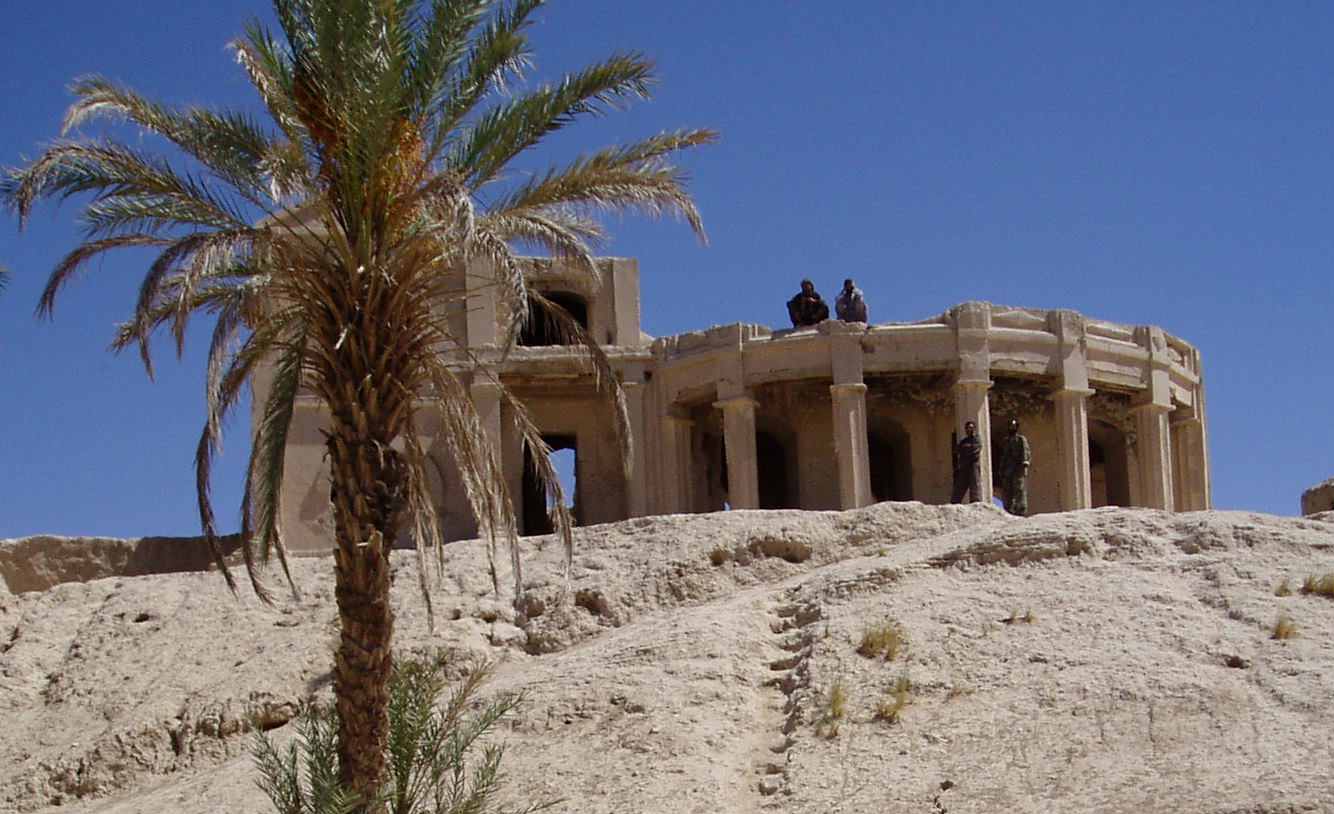
Farah Citadel
Alexander the Great renamed this city out of paranoia. Arriving in November 330 BC, he discovered that his companion Philotas had conspired to assassinate him, and so he rechristened the Drangian capital as Prophthasia -- Greek for 'Anticipation.' The name did not survive the centuries, but the fortress above the city did. Massive earthen walls, 50 feet high and stretching a full kilometer from corner to corner, still rise from a low hill just steps from Farah's main bazaar. Locals call it Shar-e-Farahdun. Outsiders have called it the Citadel of Alexander. Its true builders remain unknown, which may be the most honest thing about a place that has outlived every empire that claimed it.
Empires Layered in Mud
The citadel's origins disappear into at least 2,500 years of contested history. Some attribute it to Alexander; others point to Zoroastrian warriors serving Darius the Great, who reigned from 522 to 486 BC. Renovations built atop ancient foundations have blurred the timeline further, each layer of mud brick belonging to a different century and a different ambition. What is clear is that by the time Alexander arrived, Drangiana was a well-organized province of the Achaemenid Empire, governed by a satrap named Barsaentes who controlled both Drangiana and neighboring Arachosia. Alexander replaced him with his own man, Arsames, and moved on toward Kandahar. The citadel remained.
A Province That Changed Hands Like Currency
After Alexander's death fractured his empire, Drangiana passed to Seleucus I Nicator and his successors, who held it for more than a century. Scholars believe it was here, in this remote province, that followers of Zarathustra gathered to reassemble their sacred text, the Avesta -- a quiet act of cultural survival amid imperial upheaval. Around 184 BC, the Graeco-Bactrians seized the region, but their control lasted barely a generation before the Parthians absorbed it. The Parthians fared little better. By 128 BC, the Sacae -- Central Asian nomads who had already devastated the Graeco-Bactrian kingdom -- swept through and took Drangiana for themselves. The province became known as Sacastane, a name that eventually softened into Sistan, which the region still carries today.
Silk, Spices, and Arms Depots
For much of its long life, the citadel served as a waypoint on the Silk Road network linking Persia to India. Textiles, spices, and treasures passed through its gates or along the routes it guarded. That role as a strategic node persisted across millennia, taking a darker turn in the 1980s when Mujahideen fighters commandeered the fortress as an arms depot during the Soviet-Afghan War. Their legacy is still present in the most literal sense: the citadel's expansive interior remains littered with unexploded ordnance, making exploration both alluring and genuinely dangerous. Rusting Soviet-era vehicles sit among the ancient walls, an unintentional exhibit spanning two very different kinds of empire.
Mud Walls and Modern Picnics
The construction of the citadel mirrors the homes still built in Farah today. Domed ceilings and thick mud walls create a natural climate system, keeping rooms cool in the brutal summer heat and warm during the cold desert winters. It is an architecture of practicality rather than grandeur, shaped by the same materials and the same climate across two and a half millennia. Today the fortress belongs to no army and serves no strategic purpose. Shepherds guide their flocks across the grounds where soldiers once stood watch. Families spread blankets for picnics inside walls that Alexander may have walked past. A proposal to restore the site has been submitted to Afghanistan's Ministry of Information and Culture, but for now the citadel endures the way it always has -- through the stubbornness of its own construction.
From the Air
Located at 32.38°N, 62.11°E on the western edge of Farah City, Afghanistan. The citadel's kilometer-wide footprint and raised earthen walls are visible from moderate altitude against the flat desert surroundings. Nearest airport: Farah Airport (OAFR), approximately 5 km south. Terrain is arid and flat with the citadel prominently elevated on a low rise. Best viewed at 3,000-5,000 feet AGL. Caution: active unexploded ordnance within the site.