Farhad Tarash
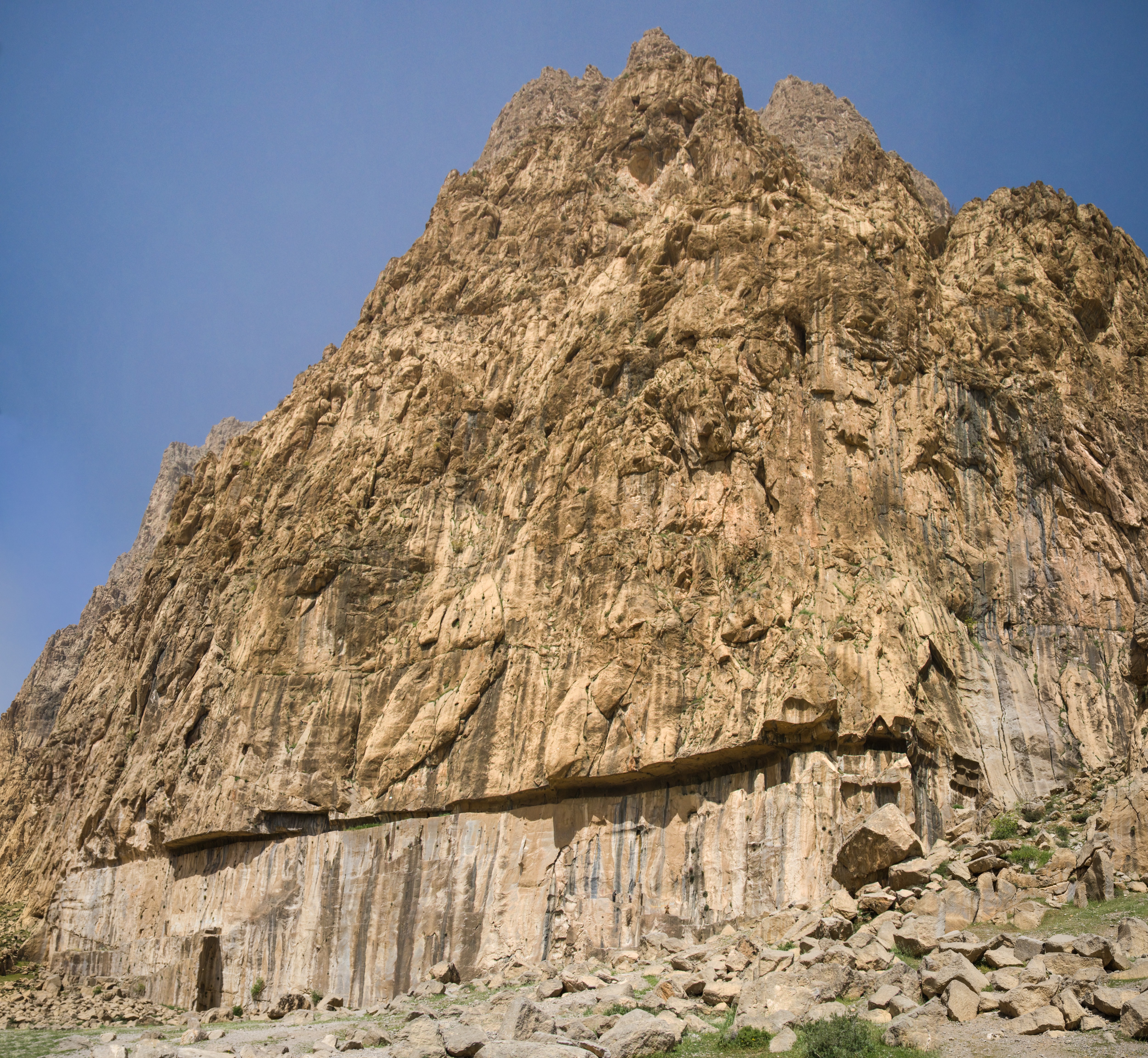
Nobody knows what it was supposed to become. That is the strange truth of the Farhad Tarash, a 200-meter-wide expanse of polished rock face on Mount Behistun in western Iran. Thirty meters high, backed by a retaining wall stretching 150 meters, it is the largest worked rock surface in the country. Someone, at some point in antiquity, invested enormous labor into smoothing this cliff to a mirror finish. Then they stopped. The result is a monument to ambition interrupted, a canvas prepared for a masterpiece that was never painted.
A Puzzle Written in Stone
Scholars have debated the Farhad Tarash's purpose since the early nineteenth century, and no two experts have agreed. Henry Rawlinson, the British officer who deciphered the nearby Behistun Inscription, believed the smoothed surface was meant to serve as the rear wall of a palace for the Sasanian king Khosrow II, who ruled from 590 to 628 CE. He thought it would have been decorated with a relief of Semiramis, the legendary Assyrian queen. Leonard William King and Reginald Campbell Thompson saw it similarly, envisioning a Sasanian royal palace. But A. V. Williams Jackson pushed the date back by a millennium, arguing this was a planned inscription site for Darius the Great of the Achaemenid Empire. Ernst Herzfeld agreed with the Achaemenid theory but refused to pin down a date. The honest conclusion, reached by later scholars including Erich Schmidt, is that the Farhad Tarash was a surface prepared for something grand, but what that something was remains unknown.
The Lover Who Carved a Mountain
Local tradition offers a more romantic explanation. The name itself reveals the legend: Farhad Tarash means "Farhad's Carving." In the poet Nizami Ganjavi's twelfth-century epic Khosrow and Shirin, Farhad is a stonecutter of superhuman talent who falls desperately in love with the princess Shirin. King Khosrow, his rival, sets Farhad an impossible task to win her hand: carve a channel through solid mountain rock to carry milk. Farhad, driven by love, very nearly completes it. According to Nizami, who died in 1209, Farhad accomplished three monumental works at Behistun: the milk channel, a passage cut through the mountain, and a portrait of Shirin herself. Miniature paintings from the fifteenth through twentieth centuries depict Farhad laboring on the mountainside with Shirin watching from horseback. In one Safavid-era miniature from around 1550, the smoothed rock slab is clearly visible behind the lovers, linking the real geological feature to the literary tradition.
An Iwan That Rivals Ctesiphon
In the 1970s, architect W. Salzmann offered a different theory after conducting detailed examinations of the cliff face. He concluded that a massive terrace thirty meters high was planned here, and that a colossal iwan was to be hollowed out of the rock. An iwan is the great arched hall that defines Sasanian architecture, and Salzmann believed this one was designed to rival the Taq-e Kasra at Ctesiphon, the largest single-span vault of the ancient world and the ceremonial centerpiece of the Sasanian royal capital. Reliefs were to be carved on either side. If Salzmann was right, the Farhad Tarash represents one of the most ambitious architectural projects ever attempted in the ancient Near East, abandoned before the first arch was cut. The Encyclopedia Iranica notes that his hypothesis aligns with earlier palace theories and with the possibility of a fire temple built against the cliff, but acknowledges that conclusive proof remains elusive.
Scattered Evidence on the Hillside
Just beyond the polished surface, several hundred dressed stone blocks lie scattered across the hillside. European travelers recorded them for centuries without understanding their significance. It was not until the archaeologist Heinz Luschey examined the blocks that anyone connected them to the Farhad Tarash itself. Luschey determined that the stones were cut from the same rock as the smoothed cliff face, confirming that serious construction work had been underway here. Whatever the builders intended, they had progressed beyond mere surface preparation to the cutting and shaping of structural elements. The blocks sit where they were left, as if the masons put down their tools one afternoon and never returned. Combined with the polished cliff, they make Mount Behistun not just a repository of finished monuments like the Behistun Inscription, but a place where ancient ambitions are preserved in their incompleteness.
A Thousand Years of Wonder
The Farhad Tarash has drawn visitors and scholars for over a millennium. The medieval geographer Istakhri, who died in 957, wrote about it. Yaqut al-Hamawi, the great encyclopedist who died in 1229, recorded it in his geographical dictionary. European travelers and archaeologists continued the tradition from the nineteenth century onward. Today, the site is registered as a national heritage monument of Iran. What makes it compelling is not what it tells us but what it withholds. Unlike the nearby Behistun Inscription, which Darius the Great used to broadcast his conquests in three languages, the Farhad Tarash communicates nothing except the scale of what was planned. It is a blank page in a mountain, waiting for a story that will never be written.
From the Air
Located at 34.39N, 47.43E on Mount Behistun in Kermanshah Province, western Iran. The smoothed cliff face is visible on the mountain's southern flank, near the famous Behistun Inscription. Best viewed from 3,000-5,000 feet AGL approaching from the south. The nearest significant airport is Kermanshah (OICC/KSH). The Zagros Mountains create turbulent conditions; early morning flights offer the best visibility. The ancient Silk Road caravan route passes through the valley below.