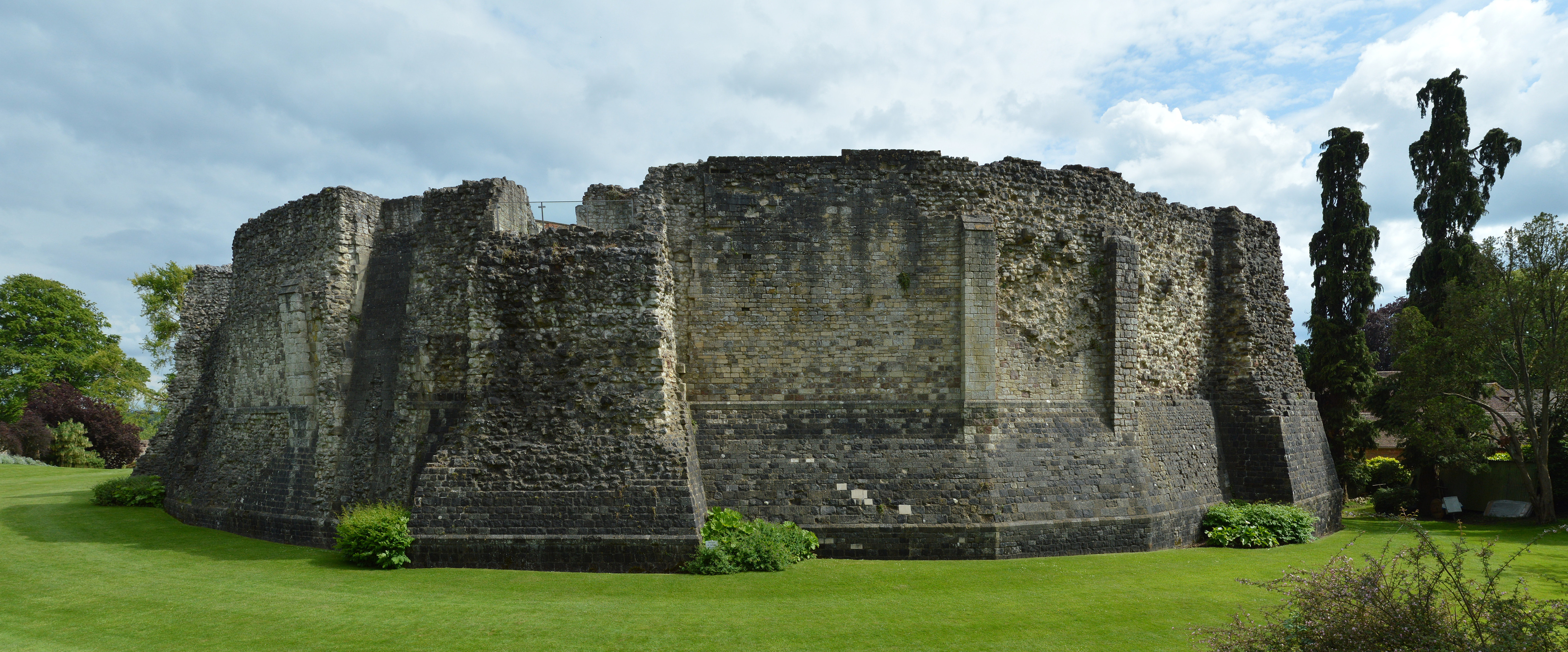
Farnham Castle
There is a Catholic church in Farnham, Surrey, dedicated to Joan of Arc. The reason is not that Joan ever visited England -- she was burned in Rouen in 1431 -- but that the man who presided over her trial lived up the hill at Farnham Castle. Cardinal Henry Beaufort, Bishop of Winchester, made the castle his residence in the early 15th century. Eight hundred years of bishops lived in this hilltop fortress, and the guilt of one of them gave the town below its most unexpected landmark.
A Grandson's Fortress
Henri de Blois, grandson of William the Conqueror and Bishop of Winchester, built Farnham Castle in 1138. It was one of several castles he raised during the Anarchy, the civil war between King Stephen and the Empress Matilda that tore England apart for nearly two decades. Henry II, who eventually won the throne, slighted the castle in 1155 -- demolishing it as punishment for the bishop's role in the conflict. But the bishopric rebuilt it in the late 12th and early 13th centuries, this time in stone that has endured. The massive motte was formed around the foundations of a Norman tower and then enclosed by a shell keep with buttress turrets. A triangular inner bailey holds domestic buildings that have been modified, extended, and rebuilt across nine centuries.
Royal Visitors and Burning Stables
Farnham Castle attracted a long procession of distinguished visitors, not all of whom brought good luck. Mary I stayed here in the days before her wedding to Philip of Spain in July 1554, a marriage that would prove deeply unpopular with her subjects. When King James I, Anne of Denmark, and the Prince of Wales visited in July 1609, the stables caught fire and burned down. The castle was slighted again after the English Civil War in 1648, though Bishop George Morley rebuilt substantial parts of the residence in the 17th century. A letter from 1594 mentions that white clay was dug from Farnham Park to make drinking vessels used by lawyers at the Inner Temple in London -- a small detail that illuminates how even a bishop's estate served practical purposes beyond its ecclesiastical role.
The Art of Disappearing
During the Second World War, Farnham Castle found an entirely unexpected purpose: it became the Camouflage Development and Training Centre of the Royal Engineers. Within the medieval walls, artists, designers, and even the stage magician Jasper Maskelyne were trained in the arts of military camouflage. The surrealist painter Roland Penrose taught techniques for concealing military installations, and Julian Trevelyan, another artist, helped develop deception methods that would be deployed across the war's theaters. The marriage of art and military deception was one of the war's more creative innovations, and Farnham Castle -- with its layered history of being built, demolished, rebuilt, and disguised -- was a fitting venue.
Nine Centuries of Occupation
Farnham Castle has been in almost continuous occupation since the 12th century, making it one of the most consistently inhabited historic buildings in southern England. The bishops of Winchester used it until the 20th century, when a garden was established within the shell keep. The Office of Works took custodianship in 1933, and since 1962 the castle has served as an intercultural training and conference centre. With help from the Heritage Lottery Fund, the keep and Bishop's Palace have undergone complete renovation, reopening in 2010 with exhibitions covering nine hundred years of the castle's history. English Heritage maintains guardianship of the keep, where entry is free. The castle sits in five acres of gardens overlooking the town of Farnham, its curtain walls and flanking towers a reminder that bishops in medieval England wielded temporal as well as spiritual power.
From the Air
Located at 51.22N, 0.80W on a hilltop overlooking the town of Farnham, Surrey. The castle and its keep are visible from moderate altitude amid the green Surrey landscape. Nearest airports include Farnborough Airport (EGLF) approximately 7nm east and Blackbushe Airport (EGLK) approximately 7nm northeast. Best viewed at 1,500-2,500 ft AGL.