.jpg)
Fashoda Incident
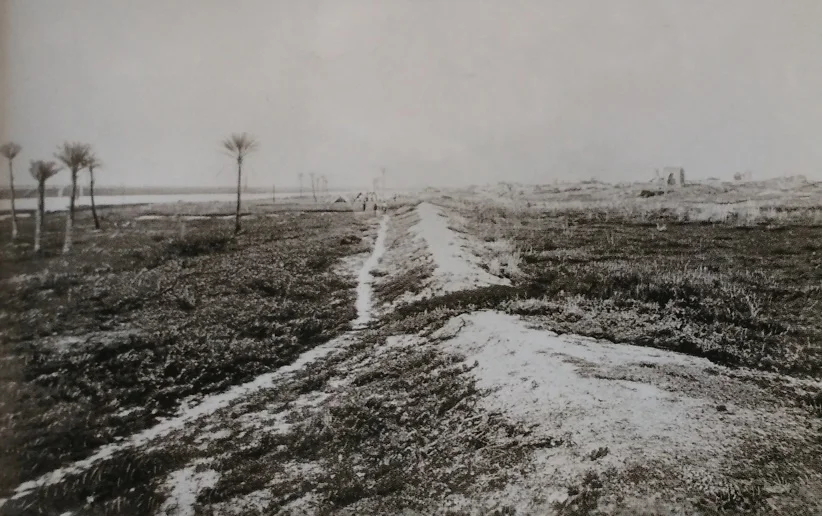
The Shilluk had been here for centuries when Jean-Baptiste Marchand arrived on the White Nile in July 1898 with 120 men and a collapsible steamboat. The Egyptian army had founded the fort at Fashoda in 1855, in a boggy spot where one of the few landings was possible. By the 1870s it was a market town. When Marchand arrived, the fort was deserted and in ruins. The Shilluk remained - farming, fishing, trading, doing whatever Shilluk people had always done on the river. That the map-makers in Paris and London, and eventually the war-rooms of two continental empires, spent four months negotiating over this piece of Shilluk country without consulting the Shilluk at all - this is the part of the Fashoda Incident that the incident's chroniclers almost never get to.
The Kingdom at the Crossing
Fashoda sits in the heart of the Shilluk kingdom, one of the oldest continuously-functioning political institutions in this part of Africa. The kingdom is organized around the reth, a sacred king whose lineage the Shilluk trace back to their founding ancestor Nyikang. Shilluk society is structured through settlements along the White Nile, a cattle-based economy, and ritual practices that connect the reth to the land in a way that European observers found difficult to translate. Wilhelm Junker, who visited in 1876, described Fashoda as 'a considerable trading place... the last outpost of civilization, where travellers plunging into or returning from the wilds of equatorial Africa could procure a few indispensable European wares from the local Greek traders.' Junker's 'civilization' stopped at the Shilluk boundary. The Shilluk, of course, had no such doubts about their own civilization. They were a political tradition going back to the late fifteenth century, and one of the older continuously functioning monarchies in the region.
Two Lines on a Continent
Draw a line from Cape Town to Cairo - the British imperialist Cecil Rhodes's dream - and another from Dakar to French Somaliland on the Red Sea - the French equivalent - and the lines cross in eastern South Sudan near Fashoda. That geometric accident gave the town a strategic importance that had nothing to do with what the town actually was. The French project, approaching from Brazzaville, aimed to stake a French claim to the upper Nile that would break Britain's monopoly on Egypt and Sudan. The British project, approaching from the north after the reconquest of Sudan, aimed to secure the Nile from its source to its mouth. The Shilluk were not consulted. The Shilluk kingdom, which had its own alliances and treaties and foreign relations, was ignored entirely.
The Small Room Where It Almost Happened
Marchand's expedition left Brazzaville in a borrowed Belgian steamer. They steamed up the Ubangi to its head of navigation, then marched overland - 100 tons of supplies on porters' heads, including the disassembled parts of a collapsible steel steamboat with a one-ton boiler. They reached Fashoda on 10 July 1898 and raised the French flag. Kitchener, fresh from his victory over the Mahdist forces at Omdurman, arrived at Fashoda in September wearing an Egyptian Army uniform. He insisted on raising the Egyptian flag at some distance from the French flag. The two commanders met on friendly terms. The crisis was not at Fashoda; the crisis was in Europe. The Royal Navy drafted war orders. Newspapers in Paris and London inflamed. Théophile Delcassé, the new French foreign minister, said resignedly of the British: 'They have soldiers. We only have arguments.'
The Shilluk, Meanwhile
While European editors wrote leaders about national honor, the Shilluk community at Fashoda continued its daily rhythms. The fishermen went to the nets. The cattle moved between wet-season and dry-season pastures. The reth held court at the sacred village upriver. Kings had come to Fashoda before - Egyptian garrisons, Mahdist rebels, assorted foreign traders - and the Shilluk kingdom had survived them all by doing what deep, old polities do: letting the passing empire have the fort, keeping the actual kingdom somewhere else. The Shilluk lost none of their territory at Fashoda. They lost, instead, visibility. The 1899 Anglo-French Convention drew a line between French and British spheres of influence on the watershed between the Nile and Congo. A Shilluk had as much say in where that line went as a Sioux had in the Louisiana Purchase.
What the Bridge in Lyon Commemorates
The French withdrew on 3 November 1898. Marchand took the long route home via Abyssinia and Djibouti rather than accept the quick steamer down the Nile. In France, Fashoda became a wound - 'Fashoda syndrome,' a foreign-policy reflex of asserting French influence where British influence encroached, is still discussed by diplomatic historians. In Britain, Fashoda became a triumph. Together, the two reactions opened the door to the 1904 Entente Cordiale that would bind France and Britain against Germany in the coming world war. In 1904, the town was officially renamed Kodok, and it is Kodok today in South Sudan. In Lyon, a 116-meter road bridge over the Saône, completed in 1959, is named for Kitchener and Marchand - the two men who did not fight here. No one has yet proposed a bridge named for the Shilluk reth, who watched the whole thing from a village the European commanders never bothered to visit.
From the Air
Fashoda (modern Kodok) lies at approximately 9.89°N, 32.11°E on the west bank of the White Nile in Upper Nile State, South Sudan. From cruise altitude, the Nile here reads as a broad channel with distinctive wetland margins - this is where the White Nile moves between the main Sudd to the south and the drier country to the north. The town itself is small; the ruins of the Egyptian fort have been reabsorbed into river-edge settlement. Nearest airport: Malakal Airport (ICAO: HSSM), about 60 km to the south. Regional hubs: Juba International (ICAO: HSSJ), Khartoum International (ICAO: HSSS). Dry season (November-April) offers best visibility.
Nearby Stories
- Doleib Hill 35 km away
- Upper Nile University 57 km away
- 2025 Nasir clashes 124 km away
- 2012 Talodi Antonov An-26 crash 146 km away
- Nasir, South Sudan 154 km away
- Ruweng Administrative Area 181 km away
- Sudanese Conflict in South Kordofan and Blue Nile 245 km away
- Jebel Moya 374 km away