Fasilides
In 1636, an Ethiopian emperor chose an unremarkable spot in the northern highlands, declared it his capital, and began building castles. Within a generation, Gondar was a city of forty-four churches, stone bridges, and a fortified royal compound that European travelers would later compare to Camelot. The emperor was Fasilides, born in 1603, a man who unified his fractured realm by doing something counterintuitive: he shut the doors to the outside world. He expelled the Jesuits, severed contact with Europe, forged alliances with Islamic sultanates, and turned Ethiopia inward for two centuries. The castles he left behind in Gondar -- now a UNESCO World Heritage Site known as Fasil Ghebbi -- remain the most visible evidence of an African empire that needed no European blueprint.
A Throne Won Through Abdication
Fasilides came to power through an unusual chain of events. His father, Emperor Susenyos I, had converted to Catholicism under Jesuit influence and attempted to impose the Roman faith on a country deeply rooted in Ethiopian Orthodox Christianity. The result was civil war. Tens of thousands died in religious conflict before Susenyos, recognizing the catastrophe he had caused, abdicated in 1632 in favor of his son. Fasilides had been proclaimed emperor once before, in 1630, during a revolt led by Sarsa Krestos, but the earlier claim had not held. When his father finally stepped aside, Fasilides moved immediately. He restored the Ethiopian Orthodox Church to its official status, requested a new abuna from the Patriarch of Alexandria, and began confiscating Jesuit lands. The Catholic missionaries were exiled first to Fremona, then expelled entirely from the empire. By 1665, Fasilides ordered the remaining Catholic religious texts -- the 'Books of the Franks' -- burned.
The Castles of Gondar
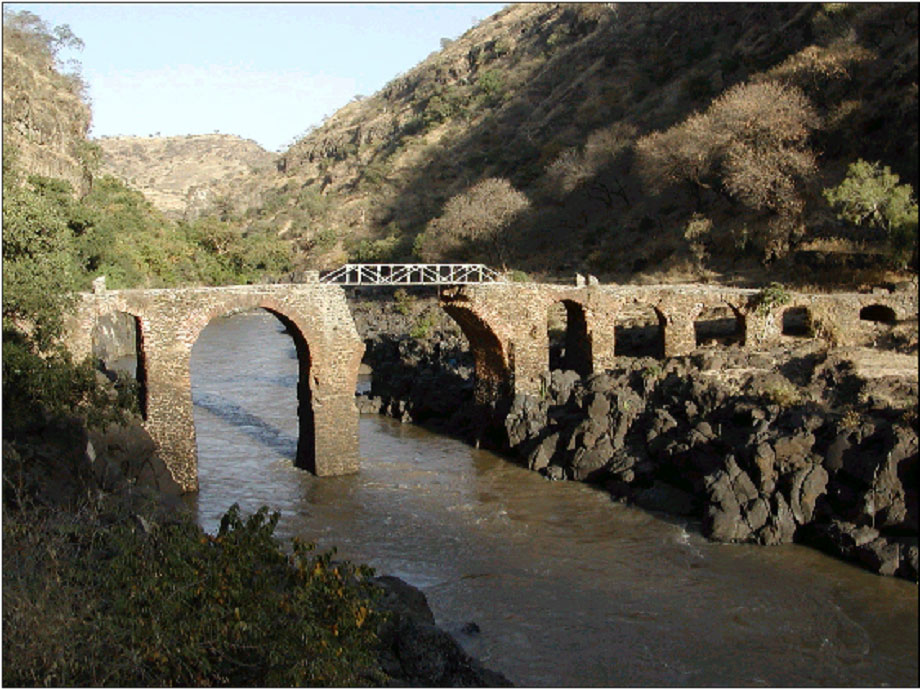
Fasilides founded Gondar in 1636, though whether a settlement existed there before his arrival remains unknown. What is certain is the scale of his ambition. He commissioned the first structures of what became Fasil Ghebbi, the royal enclosure whose towers, battlements, and banquet halls would be expanded by his successors into a compound unlike anything else in sub-Saharan Africa. He built at least six of Gondar's legendary forty-four churches, including Adababay Iyasus and Gemjabet Mariyam. Beyond the capital, he constructed seven stone bridges across Ethiopia, most famously the Sebara Dildiy over the Blue Nile -- so many that Ethiopians came to attribute every old bridge in the country to him. He also rebuilt the Cathedral Church of St. Mary of Zion at Axum, the holiest site in Ethiopian Christianity. His version, now called the 'Old Cathedral,' still stands beside the newer cathedral erected by Haile Selassie centuries later.
Diplomacy by Exclusion
Having expelled the Europeans, Fasilides turned to Ethiopia's Muslim neighbors. He formed security pacts with surrounding Islamic sultanates and opened diplomatic channels with the Safavids, Ottomans, Mughals, and the Imams of Yemen -- a striking pivot for a Christian emperor. Between 1642 and 1647, he attempted to establish a new trade route through the port of Beylul, bypassing Ottoman-controlled Massawa. He wrote to the Imam of Yemen seeking support for the project. The Yemenis, assuming Fasilides was interested in converting to Islam, sent an embassy to Gondar in 1646. When they realized his motives were purely commercial, their enthusiasm evaporated and the scheme collapsed. In 1664, Fasilides dispatched envoys to India to congratulate Aurangzeb on his accession to the Mughal throne, bearing gifts of enslaved people, ivory, horses, zebras, and silver pistols. The isolation he imposed on European contact would last more than two hundred years.
Rebellion, Imprisonment, and a Shared Coffin
Fasilides spent much of his reign suppressing revolts. The Agaw rebellion in Lasta, inherited from his father's time, required regular punitive expeditions into the mountains. The first, in 1637, went badly -- at the Battle of Libo, his soldiers panicked and the Agaw leader Melka Kristos briefly seized the throne. Fasilides recovered, called in reinforcements from the governors of Semien and Begemder, and crushed the uprising. Subsequent campaigns into the Agaw highlands proved devastating, with much of Fasilides' own army perishing from famine and cold in the mountains. When his son Dawit rebelled in 1666, Fasilides revived the ancient practice of confining troublesome royals to a mountaintop prison at Wehni. He died the following year at Azezo, five miles south of Gondar, and was buried in the monastery of St. Stephen's on Daga Island in Lake Tana. When explorer Nathaniel T. Kenney was later shown the emperor's remains, he found a smaller mummy sharing the coffin -- Fasilides' seven-year-old son Isur, smothered in a crush of people who had gathered to pay homage to a new king.
From the Air
Fasilides' legacy is centered on Gondar at 12.60N, 37.47E, but his coordinates in this entry reference the Fasil Ghebbi compound at approximately 11.22N, 37.88E. The castles are visible from low altitude in the northern Ethiopian highlands. Gondar's Azezo Airport (HAGN) lies nearby. Terrain rises above 2,000 meters; mountain weather and afternoon convective activity are common. Lake Tana, where Fasilides is buried on Daga Island, is visible to the southwest.