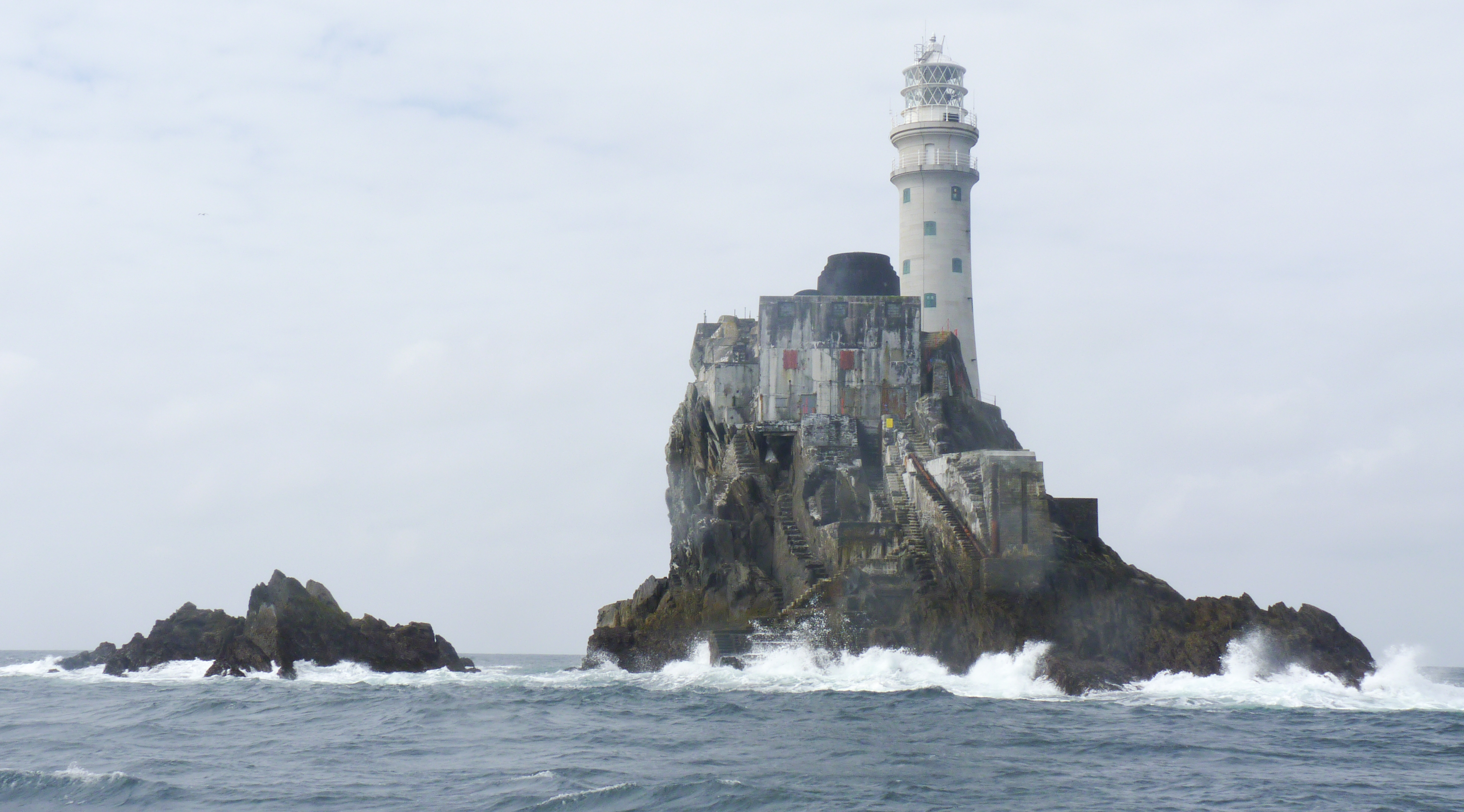
Fastnet Lighthouse
They called it Ireland's Teardrop. For hundreds of thousands of emigrants sailing west in the 19th century, Fastnet Rock was the last fragment of Ireland they would ever see -- a clay-slate fang rising 30 metres from the Atlantic, 13 kilometres off the Cork coast. The lighthouse that stands on it today, 54 metres of dovetailed Cornish granite, is the second to be built here and the tallest in Ireland. It took seven years to construct and has survived rogue waves, gale-force winds, and more than a century of Atlantic punishment. Fastnet is not just a navigational aid. It is a monument to the stubbornness required to put a permanent light on a rock that the ocean clearly wants back.
The First Light
The motivation for building on Fastnet came from tragedy. In November 1847, the American sailing packet Stephen Whitney struck nearby West Calf Island in thick fog, killing 92 of her 110 passengers and crew. An earlier lighthouse on Cape Clear Island, built in 1818, had proved inadequate. Construction of the first Fastnet lighthouse began in 1853, and it produced its first light on New Year's Day, 1854. Designed by George Halpin and built of cast iron lined with brick, the tower stood 63 feet tall with a 27-foot lantern structure on top. Its oil-burning lamp produced 38 kilocandelas -- feeble by modern standards, when lighthouses typically produce 1,300. Almost immediately, the sea began testing it. Gales shook the tower so violently that crockery flew from tables. A cask of water lashed to the gallery 133 feet above high water was washed away. Engineers filled the lower floors with solid material and added a stone casing around the base. None of it was enough.
Building in Granite
By 1891, the Commissioners of Irish Lights had decided the iron tower was not sufficiently powerful for what was, effectively, the first landfall for ships crossing the Atlantic. The decision was reinforced when a gale on 27 November 1881 carried away the entire upper section of the nearby Calf tower and broke the glass of Fastnet's lantern on the same day. The replacement would be built in stone. Designer William Douglass and supervising engineer James Kavanagh began work in 1897. Kavanagh personally set every one of the 2,047 dovetailed blocks of Cornish granite, each weighing between one and three tons, transported to the rock aboard a specially built steamship called the Ierne. The first course of stone sits six inches below the high-water mark, and the first ten of the 89 courses are built directly into the living rock. The tower cost nearly 90,000 pounds and entered service on 27 June 1904.
A Rogue Wave and Automation
The second lighthouse proved far more resilient than the first, but the Atlantic never stopped trying. In 1985, a rogue wave estimated at 157 feet struck the tower -- a figure so extraordinary that it was initially doubted, though subsequent analysis confirmed that such waves are possible in the shallow waters off southwest Ireland. The original paraffin light was replaced with an electric one in 1969. By March 1989, the lighthouse was fully automated, monitored via a UHF telemetry link to Mizen Head and controlled from the Irish Lights centre at Dun Laoghaire. Today Fastnet produces a 0.14-second white flash every five seconds, visible for 27 nautical miles, with a power of 2,500 kilocandelas. Its radar beacon transmits the Morse code letter G. The fog signal was permanently shut down in January 2011.
The Turning Mark
Fastnet Rock has a second life in the world of offshore sailing. The Fastnet Race, one of the classic ocean yacht races, follows a 695-nautical-mile (approximately 1,287-kilometre) course from Cowes on the Isle of Wight, around Fastnet Rock, and back to Cherbourg in France. Before 2021, the finish was in Plymouth. The rock also serves as a mark for local races from sailing centres at Schull, Baltimore, and Crookhaven along the West Cork coast. For these sailors, Fastnet is both waypoint and test -- rounding it means committing to the full exposure of the open Atlantic before turning for home. The rock itself remains uninhabited. Its only permanent resident is the light, flashing its five-second rhythm into the darkness, visible long before the rock itself appears on the horizon.
From the Air
Fastnet Rock and its lighthouse are located at 51.39N, 9.60W, approximately 6.5 km southwest of Cape Clear Island and 13 km from the County Cork mainland. The lighthouse tower (54m tall) is visible from considerable distance in clear conditions. Cork Airport (EICK) is about 100 km to the east. Kerry Airport (EIKY) is approximately 85 km to the northwest. Cape Clear Island, Mizen Head, and the rugged West Cork coastline provide visual navigation references. The rock is the most southerly point of Ireland.