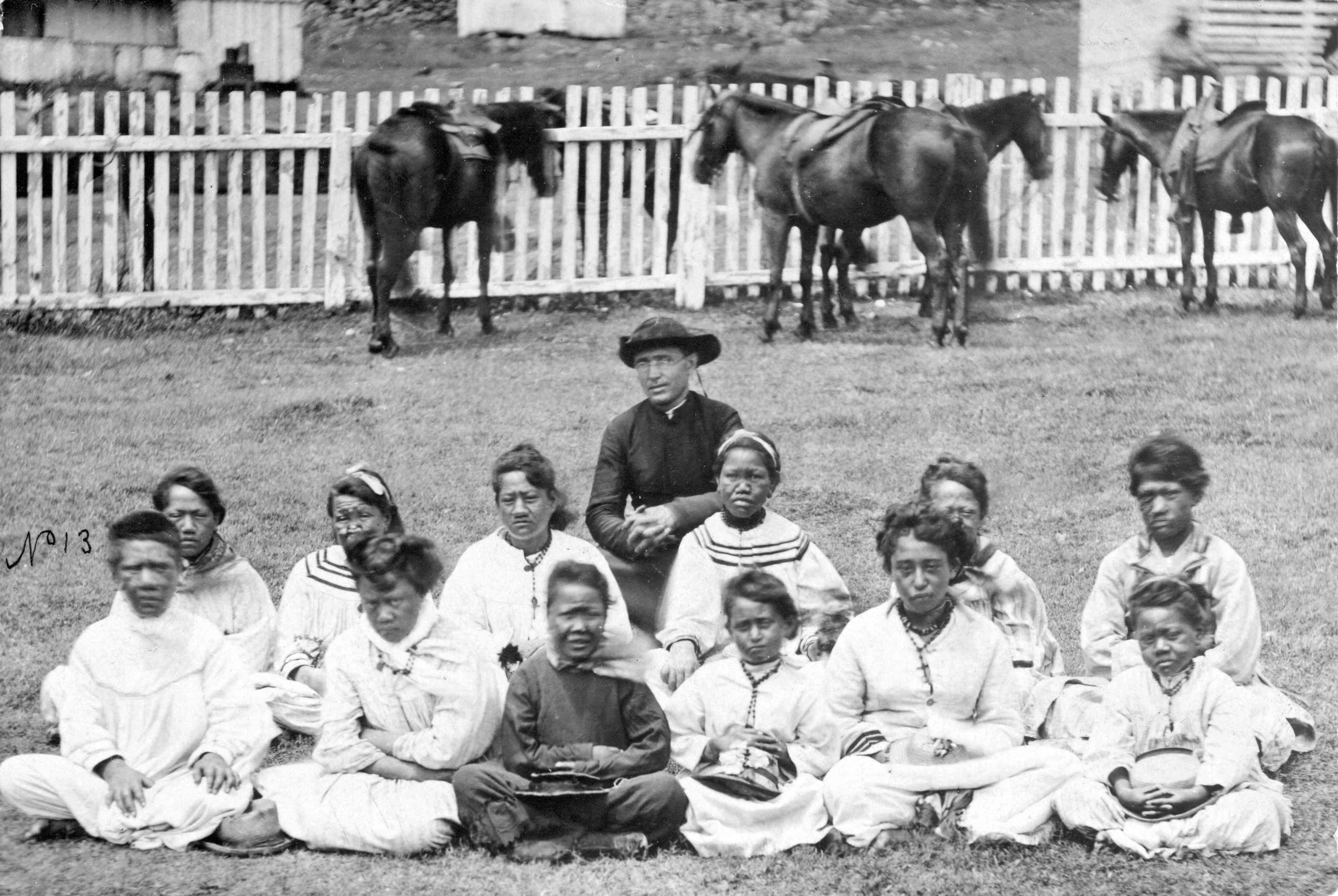
Father Damien
He was not supposed to go. The mission assignment to the Sandwich Islands belonged to his older brother, Father Pamphile, who fell ill before the ship sailed. Jozef De Veuster, a 23-year-old from the Flemish village of Tremelo who had quit school at 13 to work on the family farm, took his brother's place. He arrived in Honolulu in 1864, was ordained a priest, and nine years later volunteered for a posting that no one else wanted: the leprosy settlement at Kalaupapa, on the isolated north coast of Molokai. He would spend the remaining sixteen years of his life there, building churches, coffins, and a community among people the rest of the world had abandoned.
From Tremelo to the Edge of the World
Born on January 3, 1840, the youngest of seven children, Jozef De Veuster grew up in rural Flemish Brabant. At 18, he entered the novitiate of the Congregation of the Sacred Hearts of Jesus and Mary at Leuven and took the religious name Damien, after a fourth-century physician and martyr. When his brother's illness opened the door to Hawaii, the young novice seized it. He reached Honolulu in 1864 and spent his first years as a parish priest on the Big Island before the Kalaupapa settlement drew his attention. The Hawaiian government had been exiling people diagnosed with leprosy to this remote peninsula since 1866, sending them across rough seas and abandoning them behind cliffs that rose over 2,000 feet. By 1873, when Damien arrived, the settlement had become a place of despair, with inadequate food, shelter, and medical care.
Sixteen Years Among the Exiled
Damien did not just minister to the settlement's residents. He built with them. He constructed houses, a church, an orphanage, and a water system. He bandaged wounds, dug graves, and built coffins with his own hands. He organized farms and established law and order in a community that had descended into what some contemporaries described as lawlessness. Over the decades of the settlement's operation, more than 8,500 men, women, and children were sent to Kalaupapa and declared legally dead by the Hawaiian government. Damien gave them something the law had stripped away: the sense that they were still members of a community. He was not alone in this work. Mother Marianne Cope brought six Franciscan sisters to Hawaii to serve people with leprosy, and physician Arthur Albert St. Mouritz worked at the settlement from 1884 to 1887, advancing understanding of how the disease spread.
The Diagnosis He Expected
In 1884, Damien discovered that he had contracted leprosy. The diagnosis was not a surprise; he had lived in close contact with patients for over a decade, sharing pipes, eating together, and touching open sores while dressing wounds. He refused to leave for treatment. Robert Louis Stevenson, who visited Molokai in 1889, later wrote a famous open letter defending Damien's character against a Protestant minister in Honolulu who had questioned his morals and methods. Stevenson called Damien dirty, headstrong, and bigoted, but also heroic beyond question. Damien died on April 15, 1889, at the age of 49. His body was originally buried on Molokai before being transferred to Belgium in 1936. His right hand was later returned to Kalaupapa and reinterred beside his original grave.
The Greatest Belgian
The road to sainthood took more than a century. Pope Paul VI declared Damien venerable in 1977. Pope John Paul II beatified him in 1995, and Pope Benedict XVI canonized him on October 11, 2009. Two miracles were attributed to his intercession: the recovery of a French nun from an intestinal illness in 1895, and the remission of a Hawaiian woman named Audrey Toguchi from terminal liposarcoma after she prayed at his grave on Molokai. In 2005, Flemish public television viewers voted Damien the Greatest Belgian in history. His statue stands on the steps of the Hawaii State Capitol, and a replica occupies a place in the National Statuary Hall in the U.S. Capitol. President Barack Obama, upon Damien's canonization, said he gave voice to the voiceless and dignity to the sick. Schools, hospitals, and HIV/AIDS clinics across the world now bear his name.
What Remains at Kalaupapa
The Kalaupapa National Historical Park preserves the settlement where Damien lived and died. A handful of former patients, all elderly, still reside on the peninsula. The park limits visitors to 100 per day, and every guest must have a sponsor. The steep trail down the cliffs, with its 26 switchbacks, remains closed to the general public. Mule rides were suspended in 2018 after a lease dispute, and after a landslide later that year and the COVID-19 pandemic, trail-based tours never resumed. Since September 2025, guided visits are available again — but only by small plane from Honolulu, through the Kalaupapa Saints Tour. Mother Marianne Cope, who continued the work after Damien's death, was canonized in 2012. Joseph Dutton, a Civil War veteran who came to Molokai in 1886 to assist Damien and stayed for 44 years, has had his cause for sainthood formally opened. The peninsula remains one of the most isolated places in Hawaii, accessible mainly by small plane. It is quiet, green, and hauntingly beautiful, a place where suffering was transformed into something that people still travel across oceans to understand.
From the Air
Father Damien's Kalaupapa settlement is located at approximately 21.18N, 156.95W on the north coast of Molokai. The Kalaupapa Peninsula is clearly visible from the air as a flat, green projection below towering sea cliffs. Kalaupapa Airport (PHLU) serves the peninsula with scheduled flights from Molokai Airport (PHMK) and Honolulu (PHNL). The settlement lies at sea level, backed by cliffs exceeding 2,000 feet. Saint Philomena Church, built by Damien, is visible near the center of the settlement.