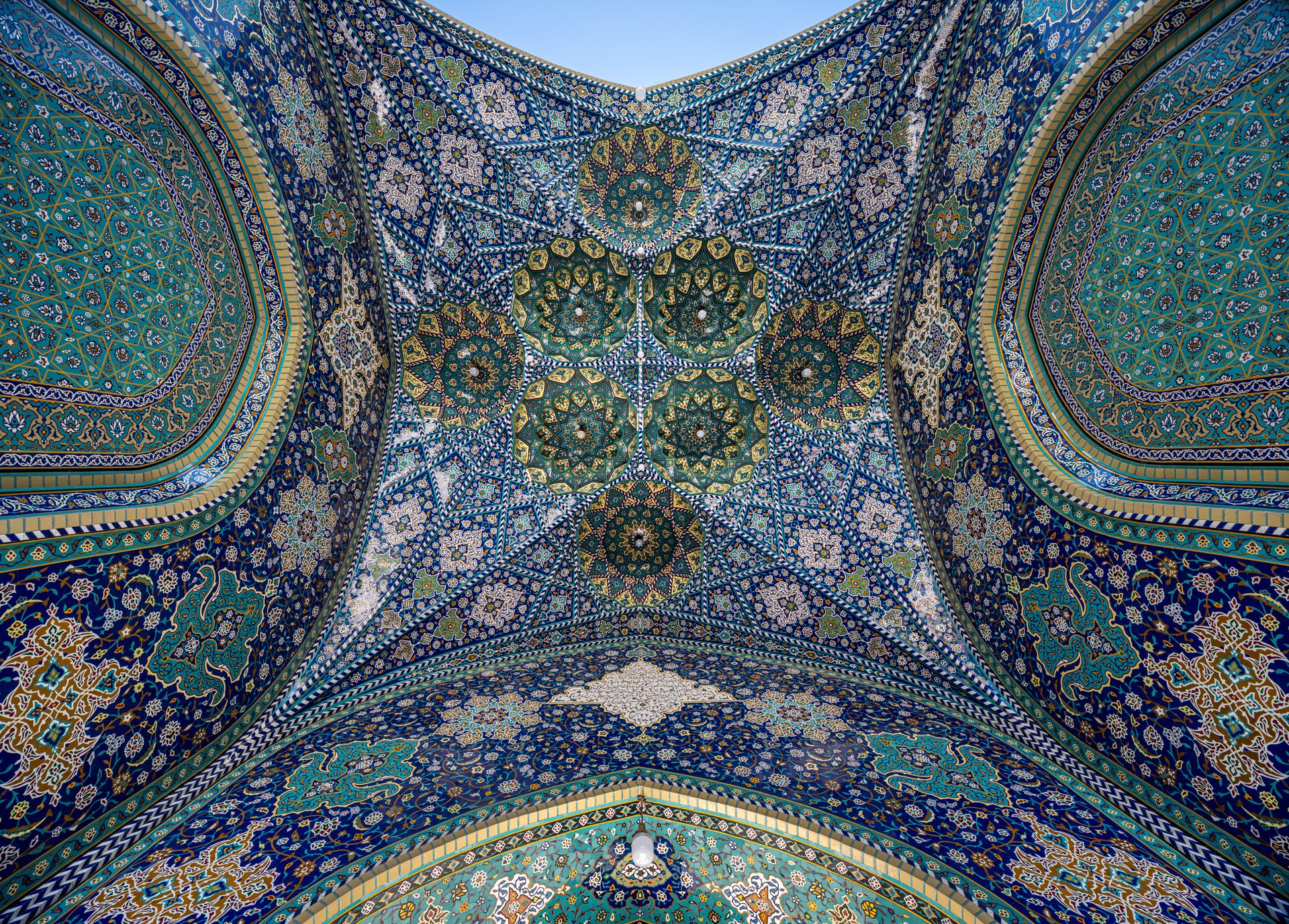
Fatima Masumeh Shrine
The golden dome catches the light from miles away, a beacon above the low skyline of Qom. Beneath it rests Fatima bint Musa, sister of the eighth Shia Imam Ali al-Rida and daughter of the seventh Imam Musa al-Kazim. Her shrine has transformed this central Iranian city into one of the most sacred destinations in Shia Islam -- ranked after Najaf, Karbala, Mashhad, Samarra, and Kadhimiya. Millions arrive each year seeking intercession, healing, and forgiveness within walls that shimmer with mirror work and tilework accumulated across dynasties.
A Woman Honored as a Saint
In Shia Islam, female relatives of the Twelve Imams can be venerated as saints, a distinction that elevates them above ordinary mortals in the spiritual hierarchy. Fatima Masumeh -- "the Pure One" -- holds this status. Her tomb began modestly, covered with a bamboo canopy. Over centuries, it grew into a complex spanning 38,000 square meters, incorporating a burial chamber, three courtyards, and three large prayer halls named Tabatabaei, Bala Sar, and A'dham. The architecture layers centuries of patronage: Safavid tilework, Qajar-era expansion, and modern mirror-glass decoration known as ayeneh-kari that fractures light into thousands of fragments across interior walls and ceilings.
The Pilgrims' City
Qom exists in relationship to this shrine. The city has remained deliberately conservative and traditional, maintaining what its residents consider a pious environment suitable for pilgrims. Men and women travel here seeking cures for ailments, solutions to personal problems, and forgiveness of sins. Many miracles are reported at the shrine, documented in a special administrative office within the complex and sometimes published in the shrine's monthly newspaper, the Payam-e Astan. The constant flow of pilgrims has attracted dozens of seminaries and religious schools to the surrounding streets, making Qom one of the most important centers of Shia theological learning in the world.
Dynasties Beneath One Roof
The shrine is not Fatima Masumeh's alone. Also buried within the complex are three daughters of the ninth Imam Muhammad al-Taqi, six members of the Safavid dynasty, eleven members of the Qajar dynasty, and numerous political figures, scholars, and clerics. In a quieter corner lies the tomb of Parvin Etesami, one of modern Iran's most acclaimed poets, who died in 1941. Her measured, precise verse -- often addressing social injustice and the condition of women -- shares sacred ground with centuries of royal and religious power. The shrine functions as both a spiritual center and a national necropolis, its courtyards accumulating the dead of successive Iranian eras.
Sacred Symbol, Political Instrument
The shrine's significance has never been purely spiritual. Ayatollah Khomeini used images of the Fatima Masumeh Shrine on posters, currency, and stamps during the 1979 Islamic Revolution, transforming it into a symbol of the new political order. The gesture was calculated: by linking revolutionary authority to one of Shia Islam's most revered sites, Khomeini claimed spiritual legitimacy for a political upheaval. The shrine's role as both a devotional destination and a political emblem continues to define Qom's place in Iranian national life. There are more burial places of the Imams' relatives in Iran than there are for the Imams themselves, but none command the devotion -- or the political weight -- of this golden-domed mausoleum in the heart of Qom.
From the Air
The Fatima Masumeh Shrine is located at 34.64°N, 50.88°E in the center of Qom, Iran. The golden dome is a prominent visual landmark visible from considerable distance and altitude. Qom lies approximately 150 km south of Tehran. Nearest major airport is Imam Khomeini International Airport (OIIE), roughly 100 km north. Best viewed at 4,000-8,000 ft. The shrine complex and its surrounding seminary buildings form a distinctive cluster in the urban core.