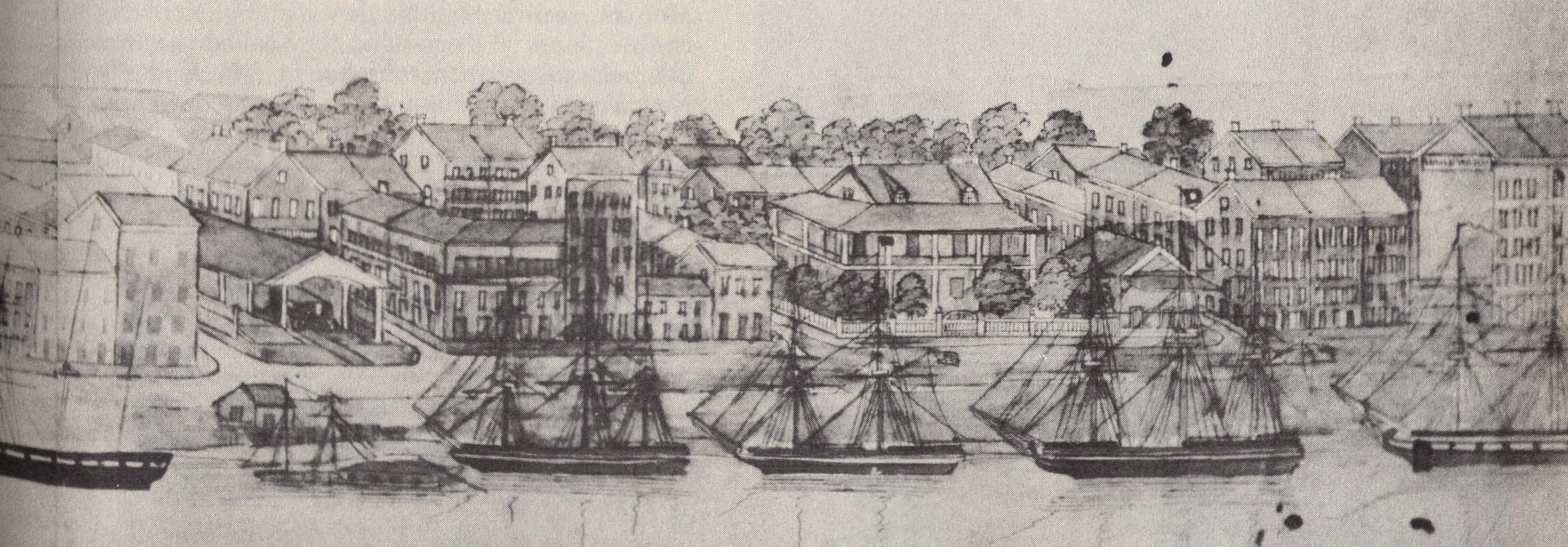
Faubourg Marigny
Ferdinand LaMothe was a teenager with a strict Creole grandmother and a secret. He would slip out of her house just off Elysian Fields Avenue, cross into the red-light district of Storyville, and sit down at whatever piano would have him. The world would come to know him as Jelly Roll Morton, one of the founders of jazz. His grandmother's neighborhood -- the Faubourg Marigny -- had been producing musicians like him for decades, and it has never stopped. Sidney Bechet, Danny Barker, Paul Barbarin, and Lizzie Miles all called these streets home, drawn by the same mix of affordability, diversity, and creative ferment that still defines the Marigny today.
A Creole Gambler's Subdivision
The neighborhood owes its existence to Bernard de Marigny, a Creole landowner who subdivided his plantation in 1806 and sold the lots at prices modest enough to attract a broad mix of buyers. They went so quickly that he extended the development four years later. The wide central boulevard he laid out was named Elysian Fields Avenue, after the Champs-Elysees in Paris, and it became the first street in the New Orleans area to stretch from the riverfront all the way to Lake Pontchartrain. In 1831, the Pontchartrain Railroad -- nicknamed "Smoky Mary" -- began running its tracks down the center of Elysian Fields, pulling development further along the avenue. By the 1830s, the neighborhood was filling with Louisiana Creoles of color and German immigrants, creating a cultural blend that would define the Marigny for generations.
From Little Angola to Frenchmen Street
The Marigny has known both neglect and rebirth. By the mid-twentieth century, the neighborhood around Washington Square had deteriorated so badly that locals nicknamed it "Little Angola," after Louisiana's notorious state penitentiary. After Hurricane Betsy in 1965, displaced Filipino Americans settled in the area, adding another thread to the neighborhood's multicultural fabric. The real transformation came in the 1980s, when profiteering tied to the 1984 World's Fair drove long-term French Quarter residents across Esplanade Avenue into the Marigny. Frenchmen Street emerged from this migration as one of the city's premier destinations for live music -- a stretch of clubs, restaurants, and late-night venues that locals consider the authentic alternative to Bourbon Street. The New Orleans Center for Creative Arts built its riverfront campus here, anchoring the neighborhood's identity as a place where music is made, not just consumed.
Shotgun Houses and Caribbean Arches
Walking the Marigny's streets is an education in New Orleans architecture. Creole cottages sit beside shotgun houses, their facades painted in colors that range from sunflower yellow to deep violet. The architectural vocabulary borrows from colonial French and Spanish traditions but carries unmistakable Caribbean inflections -- louvered shutters, wrought-iron galleries, and deep overhangs designed for a climate where shade is survival. The New Marigny Historic District, added to the National Register of Historic Places in 1994, preserves parts of the 7th and 8th wards along with the Faubourg Saint Roch and Faubourg Saint Claude. On St. Roch and Elysian Fields avenues, longstanding live oaks canopy the sidewalks above houses being steadily renovated. The Marigny Opera House, a performing arts center adapted from a former Catholic church, captures the neighborhood ethos: nothing here stays one thing for long.
Weathering the Storm
When Hurricane Katrina struck in August 2005, the Faubourg Marigny's geography offered a measure of protection. The section closest to the Mississippi River sat at high enough elevation to escape the catastrophic flooding that devastated much of the city. The lower-lying areas of New Marigny did flood, but not as deeply as neighborhoods farther from the river, and many of the nineteenth-century raised houses were elevated enough that floodwaters caused limited damage even several blocks inland. Volunteers set up a free community kitchen and goods-exchange camp in Washington Square that ran for months after the storm. The official reopening was delayed because the Marigny shared a ZIP code with more badly damaged areas, but once residents were allowed back, the neighborhood rebounded quickly. The Marigny's Mardi Gras traditions -- homegrown, neighborhood-scale celebrations with handmade costumes and walking krewes -- resumed as acts of cultural defiance, proof that the community had survived.
From the Air
Located at 29.965N, 90.055W along the Mississippi River in New Orleans, immediately downriver (east) of the French Quarter. The neighborhood is bounded by Esplanade Avenue to the west and the river's distinctive crescent bend to the south. Nearest airport is Louis Armstrong New Orleans International (KMSY), approximately 12 nm west. Lakefront Airport (KNEW) is about 6 nm north. The triangular Marigny area between Esplanade and Elysian Fields avenues is visible from 2,000-3,000 ft AGL, recognizable by its dense grid of narrow streets contrasting with the broader French Quarter blocks to the west.