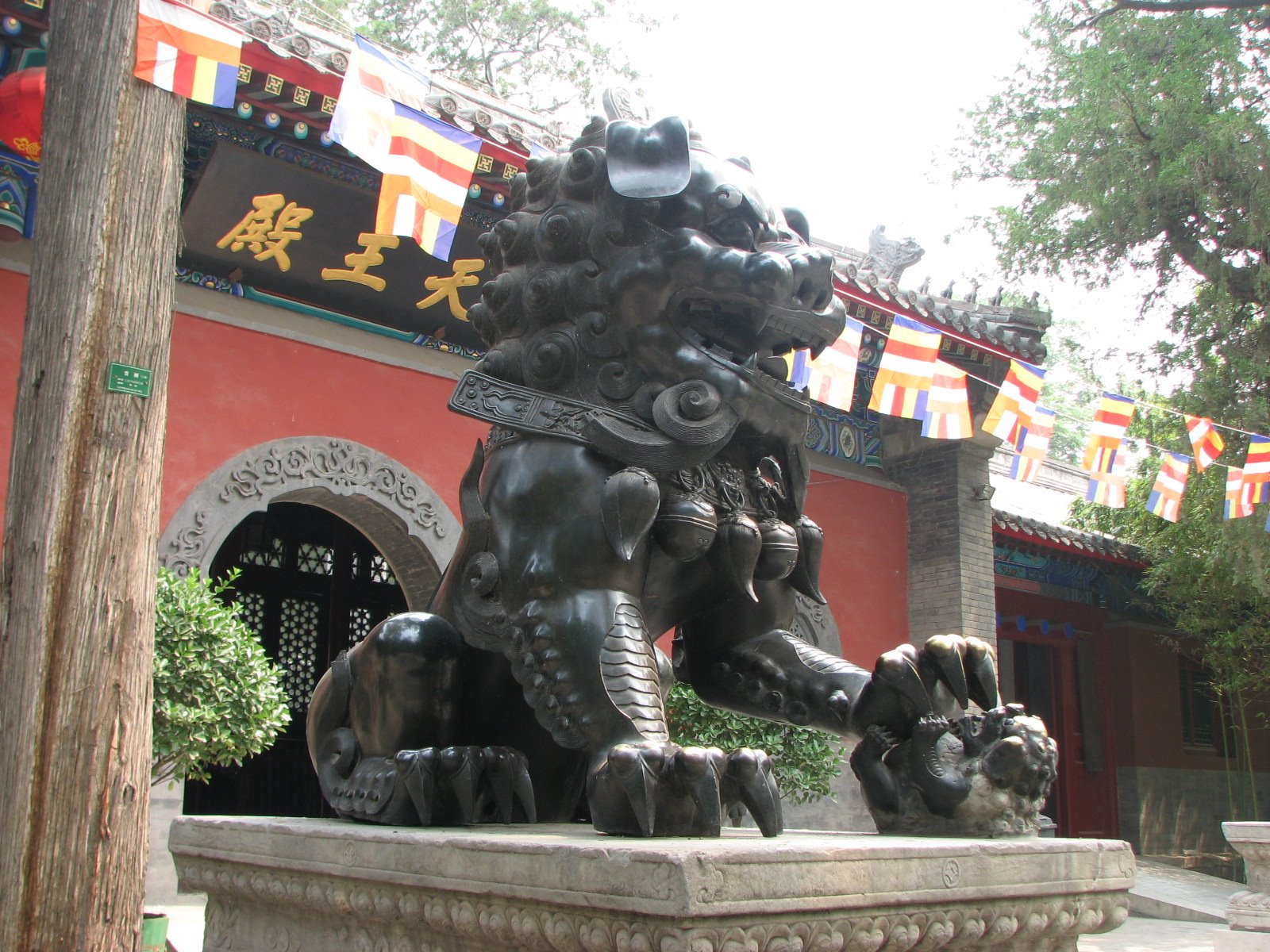
Fayuan Temple
Emperor Taizong of Tang built the Fayuan Temple in 645 not to celebrate a victory but to mourn the soldiers who died achieving one. His campaign against Goguryeo, the Korean kingdom that resisted Tang expansion, had been costly, and the temple he commissioned in what is now southwestern Beijing was named Minzhong, meaning "to mourn the loyal." Nearly fourteen centuries later, the temple still stands in the southwest quarter of central Beijing, one of the city's oldest surviving religious sites, its halls sheltering Buddhist statuary that spans from the Eastern Han dynasty to the Qing.
From Memorial to Monastery
The temple's origins as a military memorial give it an unusual character among Beijing's Buddhist sites. Most temples were founded for devotional purposes or imperial prestige. The Fayuan Temple began as an act of grief. Emperor Taizong, one of China's most celebrated rulers, was not accustomed to acknowledging the cost of his ambitions, but the Goguryeo campaign had extracted a price he felt compelled to mark. Over the centuries, the memorial function faded and the devotional one deepened. The temple was rebuilt during the Zhengtong era (1436-1449) of the Ming dynasty, receiving the architectural form it largely retains today. Its 6,700 square meters hold a compact but remarkable concentration of Buddhist art and sacred architecture.
A Gallery of Centuries
What makes the Fayuan Temple extraordinary is not its age alone but the range of Buddhist art it contains. The Main Hall houses statues of the Flower Adornment School's three saints: Vairocana, Manjusri, and Samantabhadra. But the Hall of Great Compassion is where the temple's artistic significance reaches its peak. Here, among carved stones and artistic masterpieces, stand some of the most valuable Buddhist statues in China. A pottery seated Buddha from the Eastern Han dynasty (25-220) is nearly two thousand years old. A pottery-bottle Buddha from the Eastern Wu dynasty (229-280) is equally rare. A stone Buddha from the Tang dynasty (618-907) and a steel-cast Guanyin statue round out a collection that traces Chinese Buddhist sculpture across its formative centuries.
Symmetry and Silence
The temple's architecture follows the traditional Chinese Buddhist layout with precision. Buildings march along a central axis, arranged in bilateral symmetry: the Gate of Temple flanked by Bell Tower and Drum Tower, then the Heavenly King Hall, the Main Hall, the Hall of Great Compassion, and the Sutra Hall. This progression from outer gate to inner sanctum is designed to create a deepening sense of sacred space, each courtyard quieter and more contemplative than the last. The temple also houses a significant collection of Buddhist texts from the Ming and Qing dynasties, manuscripts that represent centuries of scholarly devotion to Buddhist doctrine.
Literature and Legacy
The Fayuan Temple has resonated beyond the religious sphere. Taiwanese writer Li Ao, who was nominated for the Nobel Prize in Literature, set his novel "Martyrs' Shrine: The Story of the Reform Movement of 1898 in China" against the backdrop of this temple. The novel, also known simply as "Fayuan Temple," tells the story of the Hundred Days' Reform, the failed attempt to modernize Qing dynasty China that ended with the execution of six reformers. Li Ao's choice of the Fayuan Temple as his setting was deliberate: a place founded to commemorate soldiers who died for an emperor's ambition became the literary backdrop for intellectuals who died for a nation's future. The parallel between military sacrifice and political martyrdom gives the temple a double weight of meaning.
From the Air
Located at 39.88N, 116.36E in the southwest quarter of central Beijing, within Xicheng District. The temple sits in a dense urban neighborhood south of the main east-west thoroughfares. Beijing Capital International Airport (ZBAA) is approximately 30 km to the northeast. Beijing Daxing International Airport (ZBAD) is about 40 km to the south. From the air, the temple compound is identifiable as a traditional courtyard complex amid modern buildings.