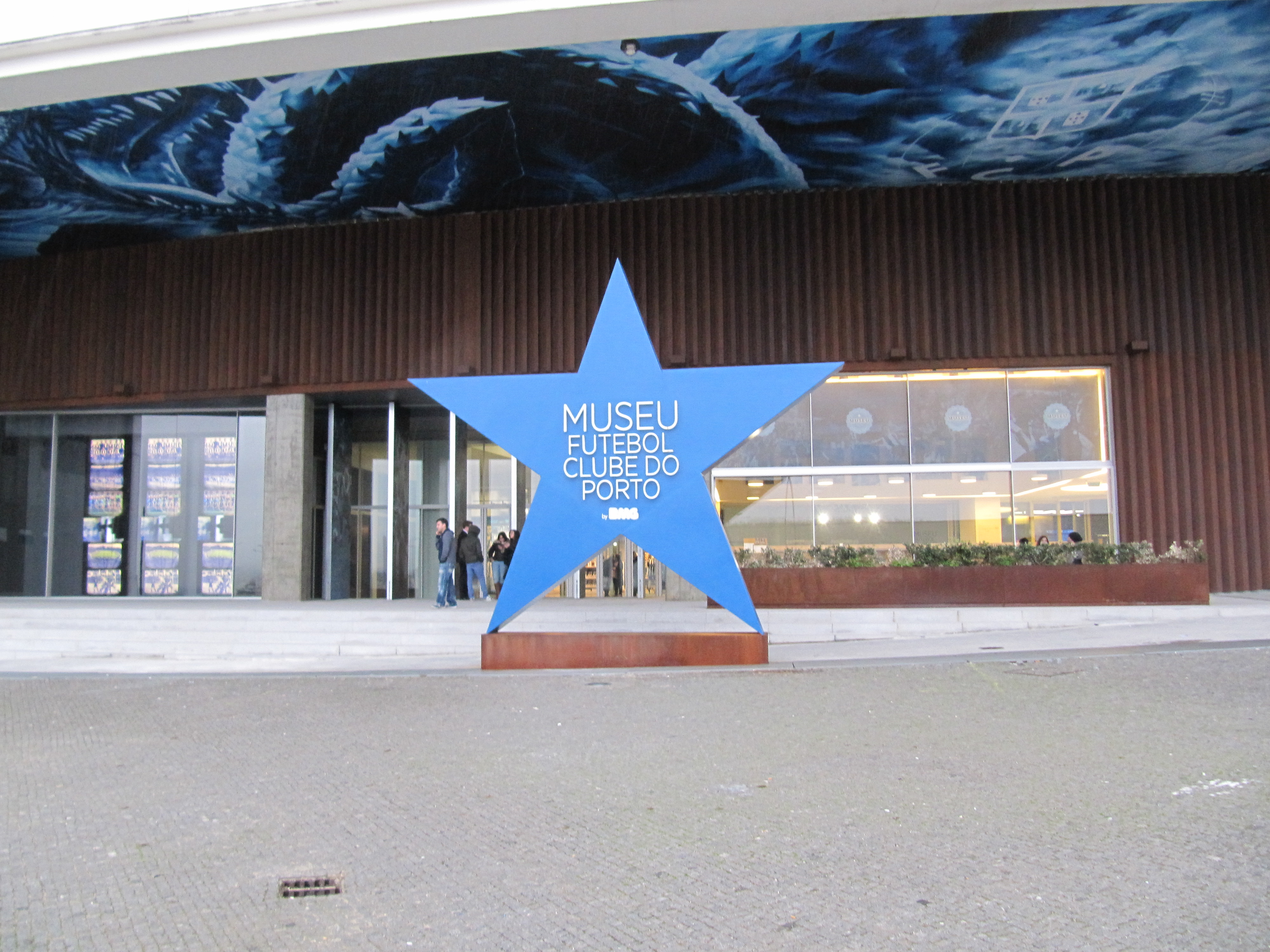
FC Porto Museum
In 1893, a wine trader named Antonio Nicolau de Almeida founded a football club in Porto. The game had arrived in the city through English workers, and Almeida saw something in it worth organizing. A hundred and twenty years later, FC Porto had accumulated more domestic titles than any other Portuguese club and seven international trophies. On September 28, 2013 -- the club's 120th anniversary -- the FC Porto Museum opened beneath the east stand of the Estadio do Dragao, giving that history a permanent home in nearly 8,000 square meters of exhibition space.
A Dragon's Welcome
Visitors arriving at the museum entrance are greeted by an artwork that sets the tone for what follows. The Valquiria Dragao -- Dragon Valkyrie -- is an exclusive sculpture by Portuguese artist Joana Vasconcelos, known internationally for her large-scale works that blend industrial materials with craft traditions. This piece incorporates actual club textiles and trophies into its structure, merging the decorative arts with football heritage. It is a bold statement of intent: this is not a room full of glass cases. The museum was conceived and constructed by Sibina Partners of Barcelona and MUSE of London, and their design philosophy prioritizes immersion over passive observation.
27 Ways to Relive a Century
The museum is organized into 27 thematic areas, each built around interactive and technological elements rather than static displays. Touch-screen computers show match footage and historical highlights. Original shirts, photographs, and memorabilia trace the club's evolution from its founding to the present. The coverage extends beyond football to FC Porto's handball, basketball, and roller hockey sections, reflecting a sporting culture broader than a single pitch. The central exhibition space is dominated by the club's silverware -- a gleaming array of domestic league titles and cup trophies surrounding the seven international prizes. For Porto supporters, this room is the emotional core of the building: physical proof of what the club has achieved against richer, larger rivals.
More Than a Trophy Room
The museum includes an auditorium, a club store, a coffeehouse, and spaces for educational programs and temporary exhibitions. It was recognized by the Portuguese Museology Association (APOM) with their Innovation and Creativity Award in 2015, and nominated for the European Museum of the Year Awards in 2016. These honors place it in conversation with cultural institutions far removed from sport, acknowledging that the FC Porto Museum does something that many club museums do not: it tells a story with genuine curatorial ambition, using the tools of modern museum design rather than simply accumulating memorabilia.
Under the Dragon's Wing
The Estadio do Dragao itself, which opened in 2003 for Euro 2004, provides the museum's physical frame. The 50,000-seat stadium replaced the old Estadio das Antas and was designed by Portuguese architect Manuel Salgado. Positioning the museum beneath the east stand was a deliberate choice: visitors can combine the museum experience with a stadium tour that takes them through the tunnel, the dressing rooms, and pitchside. The stadium's name -- Dragao, the dragon -- references the mythical creature on the club's crest, and the dragon motif runs through both the building and the museum's visual identity. For a club founded by a wine trader who saw potential in an imported English game, the scale of what now surrounds his legacy is staggering.
From the Air
Located at 41.16N, 8.58W in the eastern part of Porto, Portugal. The Estadio do Dragao is a major stadium clearly visible from altitude, with the museum located beneath the east stand. Nearest airport is LPPR (Francisco Sa Carneiro, ~12 km northwest). The stadium sits near the VCI ring road and is served by the Estadio do Dragao metro station on the Porto Metro. The Douro River and Porto's historic center lie approximately 2 km to the southwest.