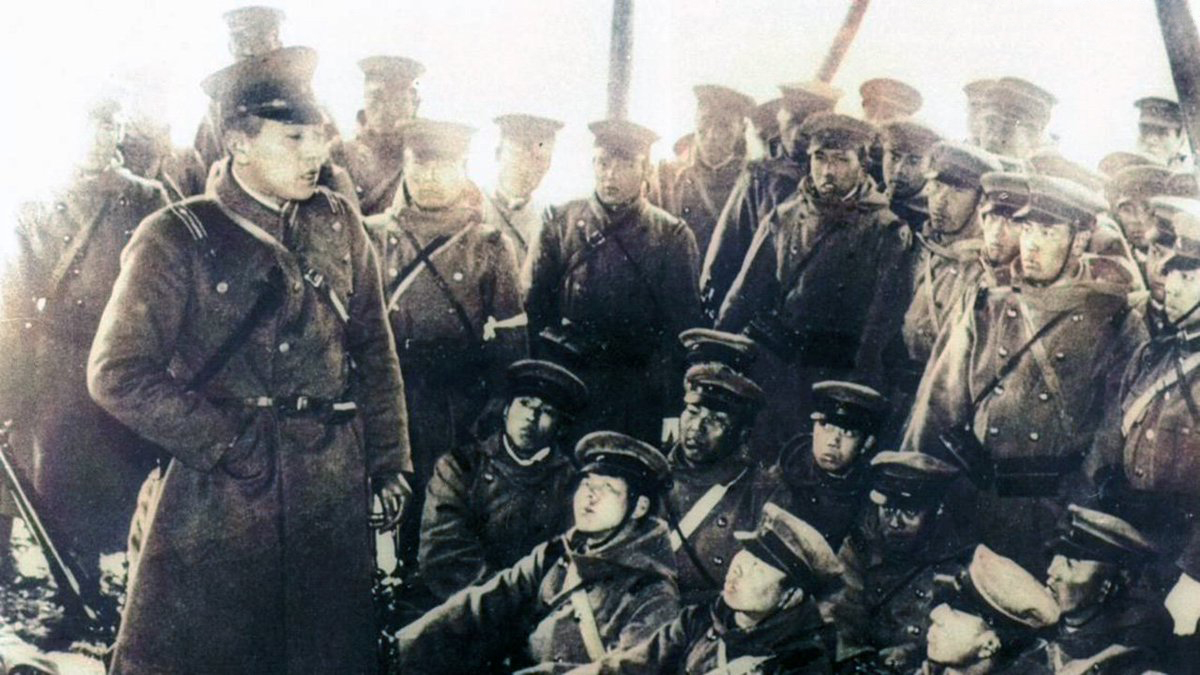
February 26 Incident
Heavy snow was falling on Tokyo when the soldiers marched out. In the predawn darkness of February 26, 1936, roughly 1,400 troops from the Imperial Japanese Army's 1st Division left their barracks not to drill but to kill. Their targets were some of the most powerful men in Japan -- two former prime ministers, the sitting finance minister, the Emperor's closest advisors. By dawn, the young officers who led them had seized the government center of Tokyo, assassinated several officials, and declared a Showa Restoration. They believed the Emperor would thank them. He was furious.
The Faction Behind the Flags
The conspirators belonged to a loose network of junior army officers called the Kokutai Genri-ha, aligned with the radical Imperial Way Faction (Kodo-ha) that emphasized spiritual purity and imperial devotion. These men had not attended the elite Army War College and were effectively barred from high-ranking staff positions. Many came from poor rural families devastated by the Great Depression. They blamed zaibatsu industrialists and corrupt court advisors for exploiting the people while deceiving the Emperor. Their intellectual inspiration was Ikki Kita, a former socialist turned ultranationalist, who envisioned a military-led revolution to restore direct imperial rule. The officers had roughly 100 regular members in the Tokyo area, and their influence far exceeded their numbers -- they had sympathizers among generals and even within the Imperial Family, including Prince Chichibu, the Emperor's own brother.
Blood in the Snow
The heavy snowfall emboldened the rebels, reminding them of the 1860 Sakuradamon Incident when activists assassinated the Shogun's chief advisor in a blizzard. Seven targets were chosen for assassination. Captain Teruzo Ando led troops to attack Admiral Viscount Makoto Saito, Lord Keeper of the Privy Seal, who was shot dozens of times in his bedroom while his wife threw herself across his body. Finance Minister Korekiyo Takahashi, an 81-year-old former prime minister who had worked to restrain military budgets, was slashed and shot in his residence. Inspector General Jotaro Watanabe was killed at his home. At the Prime Minister's official residence, the attackers killed a man they believed was Prime Minister Keisuke Okada -- but they had murdered his brother-in-law, Colonel Denzo Matsuo, by mistake. Okada hid in a storage closet, then escaped disguised as a mourner at Matsuo's funeral. Grand Chamberlain Kantaro Suzuki was shot three times but survived, as did Count Nobuaki Makino.
Four Days of Standoff
By morning, the rebels controlled the Diet building, the War Ministry, Metropolitan Police headquarters, and the Sanno Hotel, flying a banner reading 'Revere the Emperor, Destroy the Traitors.' They submitted demands for a new cabinet led by General Mazaki and the dismissal of rival officers. But Emperor Hirohito, far from grateful, was enraged. He told his chief aide-de-camp that the rebels had killed his most trusted advisors and that they must be suppressed immediately. When informed the army was negotiating rather than attacking, he reportedly said he would lead the Imperial Guard Division against the rebels himself if necessary. By February 29, the Righteous Army -- fewer than 1,500 men -- found themselves surrounded by more than 20,000 loyalist troops and 22 tanks. The general attack was planned for 9:00 a.m. Leaflets dropped from aircraft and radio broadcasts urged surrender. By mid-morning, the soldiers began laying down their arms.
Trials in Secret
Unlike earlier instances of political violence by young officers -- which had typically ended with light sentences -- the Emperor demanded real consequences. A special military tribunal was established on March 4, 1936. All 1,483 members of the Righteous Army were interrogated, and 124 were ultimately prosecuted: 19 officers, 73 non-commissioned officers, 19 soldiers, and 10 civilians. The trials were closed to the public with no defense attorneys permitted and no right of appeal. Seventeen officers and civilians were executed by firing squad, including the two intellectual architects, Ikki Kita and Mitsugi Nishida, who were shot on August 19, 1937. Captain Shiro Nonaka, who had led the largest rebel force of 500 men against police headquarters, committed seppuku rather than surrender. The Imperial Way Faction was purged from the army. But the outcome was paradoxical: freed from infighting, the military tightened its grip on a civilian government that had been fatally weakened by the assassination of its moderate leaders.
Ghosts of Nagatacho
The coordinates of the incident center on Nagatacho, Tokyo's government district, where the Diet building, the Prime Minister's residence, and key ministries still stand. For decades after the war, the families of the executed rebels were forbidden from commemorating them. In 1952, after the Allied occupation ended, they established a memorial stone at Kenpei-ji Temple in Shibuya. A larger monument stands at the Budo-kaikan in Shinjuku. On February 26 each year, a small ceremony is held. The incident left an invisible scar on the neighborhood -- the Prime Minister's residence where Matsuo was killed in Okada's place, the Sanno Hotel where rebels set up headquarters, the Metropolitan Police building where Nonaka's 500 men seized communications equipment. None of these sites bears a plaque or marker. The snow that February morning has melted into Tokyo's concrete, but the four days when young soldiers nearly overthrew a government remain one of the most dramatic episodes in modern Japanese history.
From the Air
Located at 35.664N, 139.697E in the Nagatacho district of central Tokyo, the government quarter where the coup attempt centered. The National Diet Building and Prime Minister's residence are visible landmarks. Nearest airports: Tokyo Haneda (RJTT) approximately 8 nm south, Narita International (RJAA) approximately 37 nm east. Best viewed at 2,000-3,000 feet AGL. The Imperial Palace grounds are immediately to the northeast, providing a clear visual reference.