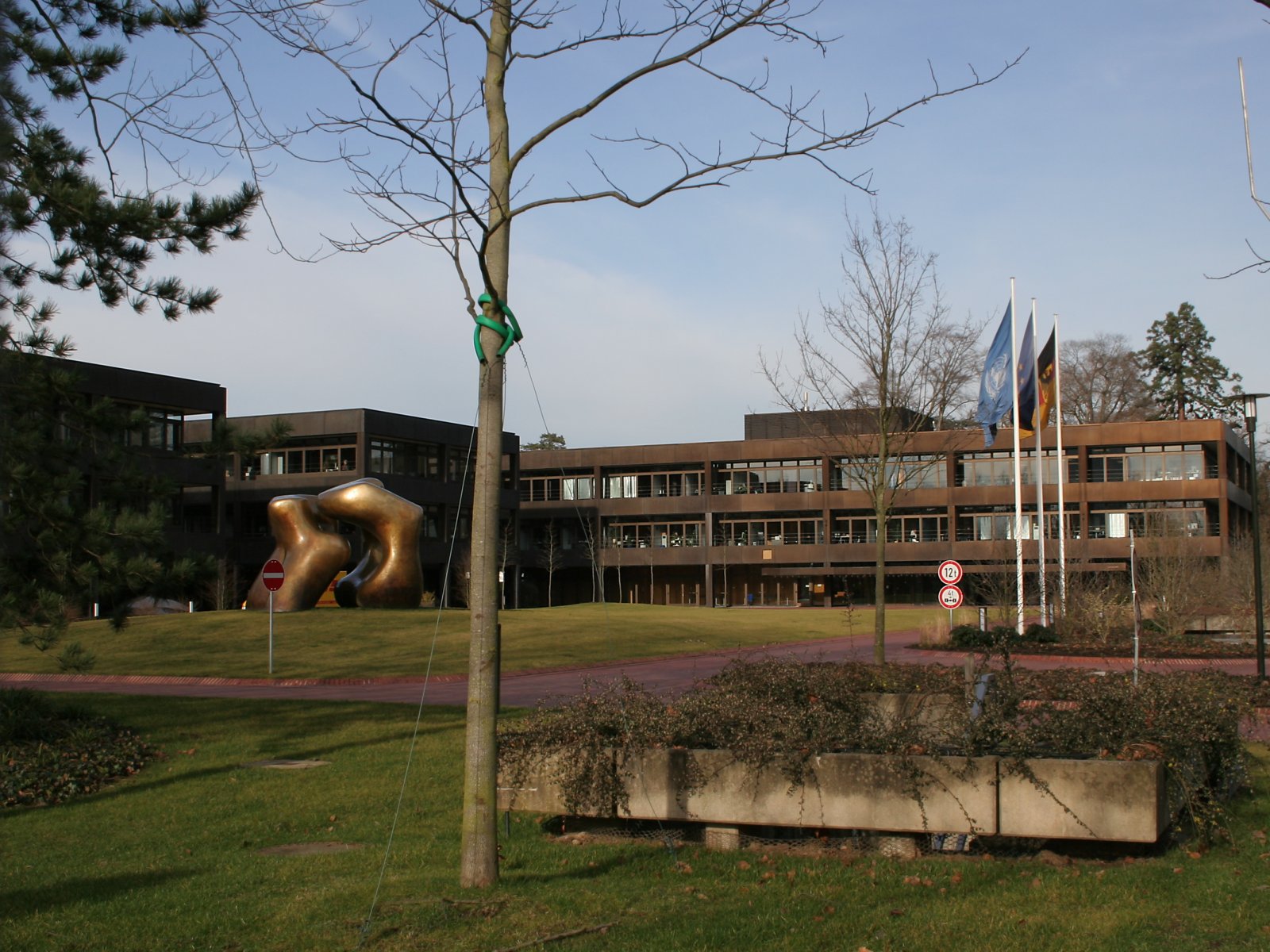
Federal Chancellery (Bonn)
Helmut Schmidt called it the charm of a Rhineland savings bank, and the comment stuck because the building gave him so little to work with. Three storeys, brown panels, recessed glass at the ground floor, a steel skeleton hanging on six concrete cores. Walk past it on Adenauerallee today and you might mistake it for the regional headquarters of an insurance firm. That, more or less, was the point. For twenty-three years this unassuming complex on the Görreswiese meadow was where Schmidt, Helmut Kohl, and Gerhard Schröder ran the Federal Republic, and the architecture was meant to say something specific about that republic: we have learned not to build palaces for power.
The Meadow South of the Palais
By 1969 the old Palais Schaumburg had simply run out of room. Konrad Adenauer had moved into it in 1949 as the first chancellor of a country still occupied by the Allies, and for two decades the chancellery had absorbed annexes, prefabs, and the so-called Houses 2 and 3. When Willy Brandt's social-liberal coalition came in with ambitious new portfolios in education and social policy, his chancellor of the chancellery, Horst Ehmke, decided the workaround was over. The Federal Government chose the Görreswiese, immediately south of the palace, and opened a public design competition. Planungsgruppe Stieldorf won. Construction began in 1973. In July 1976 the chancellor's people walked across the park from Schaumburg into a building that contained more than 200,000 cubic meters of new volume and 30,000 square meters of floor — and looked, deliberately, like almost nothing.
Charm of a Savings Bank
The critics did not love it. They called the architecture indecisive and reserved, and Schmidt's quip about the savings bank entered the Bonn Republic's stock of self-deprecating jokes. But the jury had asked for exactly this: a low-rise structure that sat below the crowns of the park trees and below the cornice of the Palais Schaumburg, with fully flexible floor plans on a steel skeleton, big glazed walls opening to the gardens. Power was supposed to be visible but not loud. Compare it to the Reichskanzlei that Albert Speer had built for Hitler in Berlin in 1939, all marble and intimidation, and the modesty starts to look less like timidity and more like an argument. The new Bundesrepublik had decided what kind of state buildings it would not be making anymore.
Henry Moore on the Forecourt
In 1979, Schmidt — the building's first occupant and most acid critic — set about softening the entry. He turned the forecourt into a green lawn and brought in Henry Moore's bronze Large Two Forms, two bulbous abstract shapes that visitors instinctively want to walk between. In May 1982 a bust of Konrad Adenauer joined them on the nearby Chancellor's Place, the founding father presiding over his successors' workplace. By then the building had developed an internal life that was harder to see from outside. Cabinet met here. Kohl, who would occupy the chancery for sixteen years, hosted Mitterrand and Gorbachev in these rooms. The reunification of Germany was negotiated, in part, in offices that looked out onto Moore's sculpture and a Rhineland lawn.
Berlin, and What Stays
The Berlin-Bonn Act of 1994 set the move in motion. In 1999 the chancellery's main seat shifted east, first into the GDR's former Staatsratsgebäude and then in 2001 to the curving white block on the Spreebogen. The Bonn building was handed to the Federal Ministry for Economic Cooperation and Development, which needed a thorough renovation — one of the largest asbestos remediation projects in Germany — before it could move in. The site is now a protected monument on Bonn's Route of Democracy. Walk through and you can still trace the choreography of the Bonn years: the driveway from Görresstraße, the Kanzlerbungalow tucked into the park as the chancellor's residence, the Palais Schaumburg looming as ceremonial backdrop, the savings-bank box doing the actual work. It is a very German arrangement, and it tells you almost everything about how the Federal Republic preferred to picture itself.
From the Air
50.7193 N, 7.1192 E in Bonn's Gronau district, on the west bank of the Rhine just south of the Bundeshaus and within the Government Quarter. Bonn-Hangelar (EDKB) is the closest small airfield about 6 km northeast; Cologne-Bonn (EDDK / CGN) lies roughly 20 km north. Best viewed from 2,500–3,500 feet on a clear day, with the low brown rectangle of the former chancellery sitting south of the Palais Schaumburg's white facade and west of the Rhine.