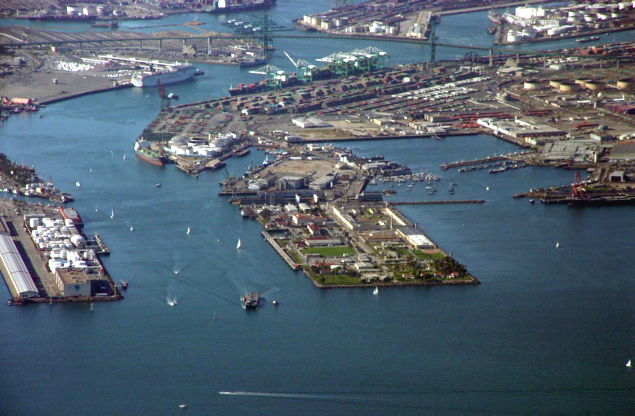
Federal Correctional Institution, Terminal Island
Al Capone arrived here in 1939, his mind already ravaged by syphilis, to serve out the final years of his sentence in the California sun. Charles Manson passed through twice in the 1950s and 1960s, years before he would become synonymous with evil. The Federal Correctional Institution on Terminal Island sits at the mouth of Los Angeles Harbor, wedged between the working ports of San Pedro and Long Beach, and its inmate roster reads like a who's who of twentieth-century American notoriety.
Where Harbor Meets History
The prison opened on June 1, 1938, at the southern tip of Terminal Island, adjacent to a Coast Guard base. It cost $2 million to construct - a substantial sum during the Depression - and featured a central quadrangle surrounded by three cell blocks. That first day, 610 male and 40 female prisoners took up residence. The location was strategic: isolated enough for security, yet close to the growing metropolis that would soon become the nation's entertainment capital. Within a year, the prison would receive perhaps its most famous inmate when Capone, the former kingpin of the Chicago Outfit, arrived to complete his sentence for tax evasion.
War and Transformation
World War II brought dramatic change. In 1942, the U.S. Navy seized the facility, converting it first into a receiving station and later into barracks for court-martialed sailors. The prison sat empty of civilian inmates until 1950, when the Navy deactivated the site and handed it to California for use as a medical and psychiatric institution. Five years later, in 1955, the federal government reclaimed it, transforming Terminal Island into a low-to-medium security facility. For over two decades, men and women served time here together, with female prisoners housed separately - an unusual arrangement that ended in 1977 when overcrowding forced the women's transfer to Dublin, California.
The Club Fed Years
By the 1970s, Terminal Island had earned an unwelcome reputation. Inmates called it 'Club Fed,' a reference to its relatively relaxed atmosphere compared to harder federal facilities. The nickname proved embarrassing enough that in the early 1980s, administrators added more barbed wire and armed guards to change the perception. Then came scandal: six employees were indicted on charges ranging from bribery to selling marijuana to inmates. Among them was Charles DeSordi, the prison's chief investigator of crimes - the highest-ranking federal prison official ever indicted at that time. The corruption revelations shattered any remaining illusions about easy time.
A Roster of Infamy
The names that passed through Terminal Island's gates span the spectrum of American transgression. Jazz singer Anita O'Day served time for heroin possession in 1954. Timothy Leary, the Harvard lecturer turned LSD guru, landed here in 1974. Henry Hill, the mobster later immortalized in Goodfellas, did time in the 1970s. Edward Bunker wrote his acclaimed crime novel No Beast So Fierce within these walls, later appearing in Reservoir Dogs. Perhaps most poignantly, the Port Chicago 50 - fifty African-American sailors convicted of mutiny for refusing to load ammunition after an explosion killed 320 of their fellow servicemen - were imprisoned here from 1944 to 1946, their case becoming a landmark in the fight for civil rights in the military.
Island of Second Chances
Today, Terminal Island operates as a federal correctional institution where inmates work factory jobs through UNICOR, producing metal products for the government and refurbishing equipment. Education programs offer college courses through Coastline Community College. The facility sits where it always has - at the harbor's mouth, watching ships pass between San Pedro and Long Beach. From the air, it appears as a compact compound on the island's southern shore, a place where the famous and forgotten alike have contemplated their choices while container ships moved goods through one of America's busiest ports.
From the Air
Located at 33.73N, 118.27W on Terminal Island at the entrance to Los Angeles Harbor. The prison complex is visible at the island's southern tip, adjacent to the Coast Guard base. Best viewed at 2,000-3,000 feet. Nearby airports include Long Beach (KLGB) to the east and Torrance (KTOA) to the northwest. The Vincent Thomas Bridge connects Terminal Island to San Pedro and makes an excellent visual reference.