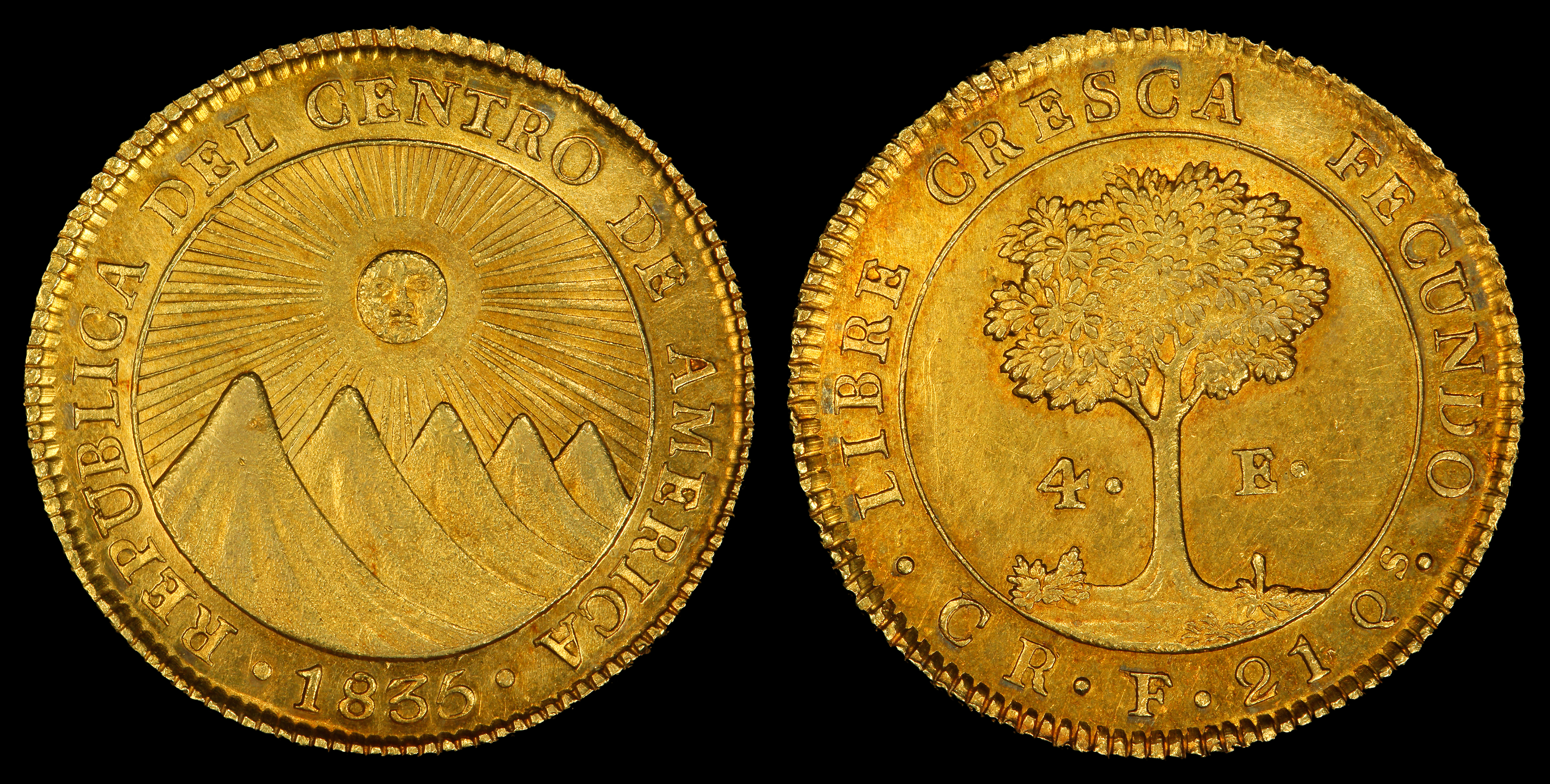
Federal Republic of Central America
On July 1, 1823, a congress in Guatemala City declared independence from Mexico and proclaimed a new nation: the United Provinces of Central America. Five states — Costa Rica, El Salvador, Guatemala, Honduras, and Nicaragua — would govern themselves as a single federal republic, their constitution modeled on that of the United States. It was an audacious experiment. These were territories that had been ruled from afar for three centuries, first by Spain and then briefly by Mexico. They shared a language, a religion, and a colonial legacy, but almost nothing in the way of roads, institutions, or trust between their regional elites. The federation lasted sixteen years. In that time it held contested elections, fought two civil wars, expelled its clergy, moved its capital, and watched its states secede one by one until, in 1841, the last member — El Salvador — declared independence from a government that had already ceased to exist.
Independence by Degrees
Central America's path to independence was neither clean nor unified. When Spain's colonies began breaking away in the early 1800s, the Captaincy General of Guatemala remained cautiously loyal to the Spanish crown even as rebellions flared in San Salvador in 1811 and Guatemala in 1813. The real rupture came not from revolutionaries but from events in Spain itself. On September 15, 1821, Central American leaders signed the Act of Independence — but within months they were debating whether to join Agustin de Iturbide's Mexican Empire. Monarchists won the vote, and in January 1822 the region was annexed to Mexico. Liberals resisted violently. El Salvador fought off two Mexican invasions. Costa Rica erupted in its own civil conflict, the Ochomogo War. When Iturbide abdicated in March 1823, the annexation collapsed, and Central America's congress seized the moment to declare full independence from both Spain and Mexico.
A Constitution Without Roads
The National Constituent Assembly that drafted the federation's constitution was composed of 64 delegates, though Costa Rica, Honduras, and Nicaragua refused to send theirs until Mexican troops withdrew. Adopted on November 22, 1824, the constitution borrowed heavily from the U.S. model: a bicameral Congress, a president with a four-year term, and a Supreme Court. But the resemblance was superficial. The president could not veto legislation, could not send laws back for reconsideration, and had to enact every bill within fifteen days. A 20th-century Costa Rican scholar would later describe the presidency as "merely decorative." More critically, the federal government lacked the ability to collect taxes effectively, and the states — separated by mountains, jungle, and virtually no interstate roads — operated as independent power centers with their own militias, their own rivalries, and their own ideas about who should run things.
Morazan's War
The federation's first election, in April 1825, produced an immediate crisis. Liberal candidate Manuel Jose Arce won the presidency by making concessions to conservatives, then stacked his cabinet with them — enraging the liberals who had put him in office. By 1827, Central America was at war with itself. El Salvador invaded Guatemala; Honduras took sides; Arce sent troops into Honduras to arrest the liberal governor. Out of this chaos emerged Francisco Morazan, a Honduran military officer who rallied exiled liberals, defeated the conservative forces at the Battle of La Trinidad in November 1827, and eventually besieged Guatemala City itself. The city surrendered on April 12, 1829. Morazan became the dominant figure in Central American politics — elected president in 1830 — but his methods were as divisive as his enemies'. He expelled clergy, confiscated church properties, exiled conservative leaders under threat of death, and used military force to settle disputes with state governors. His invasions of El Salvador alone could fill a separate chapter.
The Unraveling
By the mid-1830s, the federation was fracturing under pressures that no constitution could contain. Nicaragua seceded in 1832 over fears of federal authoritarianism, rejoined after minor reforms, then seceded again in 1838. Costa Rica left for good in 1838. Honduras departed in October 1838. On May 30 of that year, the Federal Congress itself declared that each state was free to establish whatever form of government it wished — effectively voting itself out of existence. Morazan left office in February 1839 with no successor, since no election had been held. On April 17, Guatemalan President Rafael Carrera issued a decree formally dissolving the federation. El Salvador held on until January 30, 1841, the last member to acknowledge what everyone already knew. The dream of a united Central America was not abandoned — politicians, writers, and intellectuals would call for reunification throughout the 19th and 20th centuries, and several attempts were made by force and diplomacy — but none succeeded in holding all five nations together for more than a year.
The Idea That Won't Die
Today all five former members of the Federal Republic belong to the Central American Integration System, an economic and political organization that promotes regional cooperation without the federal structure that tore the original union apart. The federation's failure is often attributed to its constitution — too weak to govern, too borrowed to fit local realities — but the deeper causes were economic. Agricultural exports were insufficient, the federal government could not repay its foreign loans, and the lack of roads between states made the federation a geographic fiction. The liberal-conservative divide that fueled two civil wars was not unique to Central America, but the absence of institutional infrastructure to manage that divide was fatal. What remains is a question that Central Americans have never fully resolved: whether five small nations sharing one isthmus are stronger together or apart.
From the Air
The Federal Republic of Central America was governed from Guatemala City (14.634°N, 90.507°W) until 1834, when the capital moved to San Salvador (13.699°N, 89.191°W). From cruising altitude, the federation's former territory stretches from southern Mexico to the border of Gran Colombia (modern Panama), spanning roughly 900 miles along the Central American isthmus. Guatemala City's La Aurora International Airport (MGGT) sits at 4,900 feet elevation in the highland valley that served as the federation's original seat of power. The volcanic chain running through Guatemala, El Salvador, Honduras, and Nicaragua is visible as a dramatic spine along the Pacific side of the isthmus.