Federation of Rhodesia and Nyasaland
On 1 August 1953, three territories in southern Africa were stitched together into a single federation. Southern Rhodesia, a self-governing British colony with a large white settler population, was joined to the protectorates of Northern Rhodesia and Nyasaland -- territories whose African majorities had not been consulted about the arrangement and largely opposed it. The Federation of Rhodesia and Nyasaland was supposed to prove that a multiracial state could thrive in Africa, a partnership between settlers and indigenous peoples that would produce prosperity for all. Instead, it demonstrated precisely the opposite: that economic growth means little when political power is concentrated in the hands of a racial minority. Within a decade the experiment was over, and the three territories went their separate ways.
The Logic of Union
The idea of linking the Rhodesias and Nyasaland had circulated since the 1920s. The Hilton Young Commission of 1929 recognized that the territories' economic interests were interconnected, and the Bledisloe Commission of 1938 agreed -- but stopped short of recommending union, noting instead that African opinion was overwhelmingly hostile. After World War II, the idea gained new urgency. Southern Rhodesia had developed a manufacturing base during the war, Northern Rhodesia possessed the copper mines of the Copperbelt, and Nyasaland contributed labor. White settlers in Southern Rhodesia saw federation as a path to dominion status within the Commonwealth. Britain, seeking to consolidate its shrinking empire into economically viable units, was receptive. What African leaders wanted -- self-determination -- was treated as a problem to be managed rather than a principle to be honored.
Copper, Kariba, and the Illusion of Prosperity
The federation's economy performed impressively by colonial metrics. GDP jumped from £350 million in its first year to nearly £450 million two years later, driven largely by Northern Rhodesia's copper exports and Southern Rhodesia's expanding industrial sector. In 1955, the federal government announced the construction of the Kariba Dam on the Zambezi -- at the time, the largest man-made dam on Earth, costing £78 million. It was an engineering marvel, generating hydroelectric power that fueled further industrial growth. But the prosperity was radically unequal. The average income of a European resident was roughly ten times that of an African worker in the cash economy, and only a third of Africans were employed in that economy at all. Northern Rhodesia's copper revenue flowed disproportionately to Southern Rhodesia's factories and infrastructure. Nyasaland, the poorest territory, received the least.
Voices of Dissent
African opposition to the federation never wavered. In Nyasaland, Dr. Hastings Kamuzu Banda emerged as the leading voice against what he called an imposed union designed to entrench white supremacy. The African National Congress chapters in Northern Rhodesia and Nyasaland organized protests and boycotts. In 1959, the colonial authorities declared a state of emergency in Nyasaland, detaining Banda and other nationalist leaders. The Devlin Commission, appointed to investigate, produced a report that stunned the British establishment: it described Nyasaland as a "police state" and acknowledged that opposition to federation was not the work of a few agitators but the genuine sentiment of the vast majority. Meanwhile, Northern Rhodesia's governor, Sir Arthur Benson, had privately written a blistering critique of the federation and its prime minister, Sir Roy Welensky -- a letter whose contents eventually leaked and deepened the political crisis.
The Wind of Change
Harold Macmillan's famous "Wind of Change" speech to the South African Parliament in February 1960 signaled that Britain was prepared to accept African nationalism as an irresistible force. For the federation, the signal was terminal. French African colonies were already independent; Belgium had hastily vacated the Congo, sending thousands of European refugees fleeing into Southern Rhodesia. The Monckton Commission, appointed to review the federation's constitution, recommended that territories be allowed to secede -- a recommendation Welensky bitterly opposed. But events had overtaken him. Nyasaland gained internal self-government in 1963 under Banda, and Northern Rhodesia followed under Kenneth Kaunda. On 31 December 1963, the federation was formally dissolved, having lasted exactly ten years and five months.
Three Nations, Three Fates
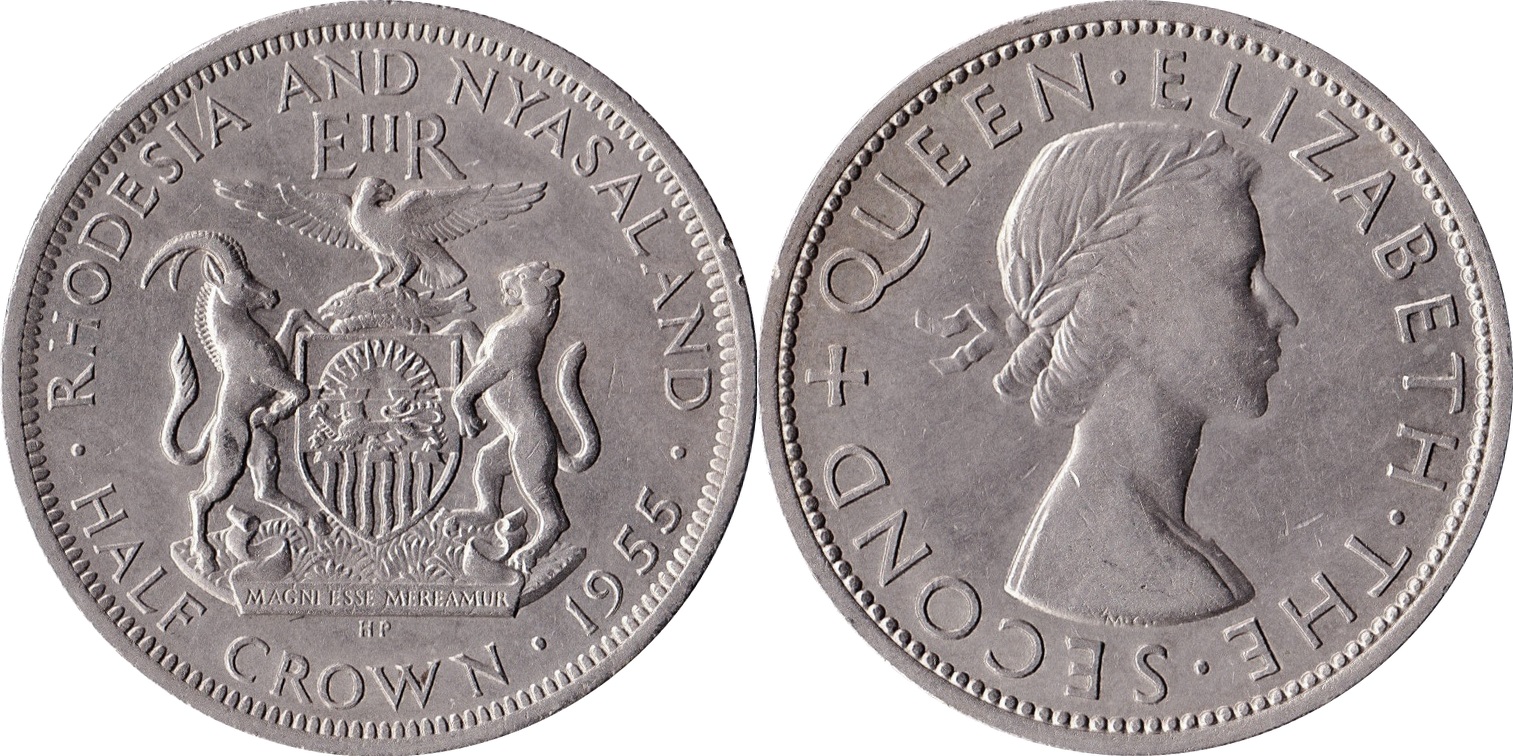
The breakup set each territory on a starkly different course. Nyasaland became independent Malawi in July 1964, and Northern Rhodesia became Zambia in October of the same year. Southern Rhodesia's path was more tortuous. Its white-minority government, under Ian Smith, issued a Unilateral Declaration of Independence from Britain in 1965, beginning a fifteen-year saga of international sanctions, guerrilla war, and ultimately majority rule. Zimbabwe finally emerged in 1980. The federation's coins, stamps, and postage -- including a full set issued in 1955 bearing Queen Elizabeth II's portrait -- became collectors' items, artifacts of a political entity that had tried to freeze history in place while the continent was transforming around it.
From the Air
The federation's capital was Salisbury, now Harare, at 17.86°S, 31.03°E. From 5,000-8,000 feet AGL, central Harare's grid is clearly visible. Harare International Airport (FVHA) is the primary field. The Kariba Dam, the federation's greatest engineering project, lies roughly 350 km northwest on the Zambezi River and is visible from altitude as a vast lake straddling the Zimbabwe-Zambia border. Lusaka (FLKK) in Zambia and Lilongwe (FLLW) in Malawi mark the other two former federal territories.