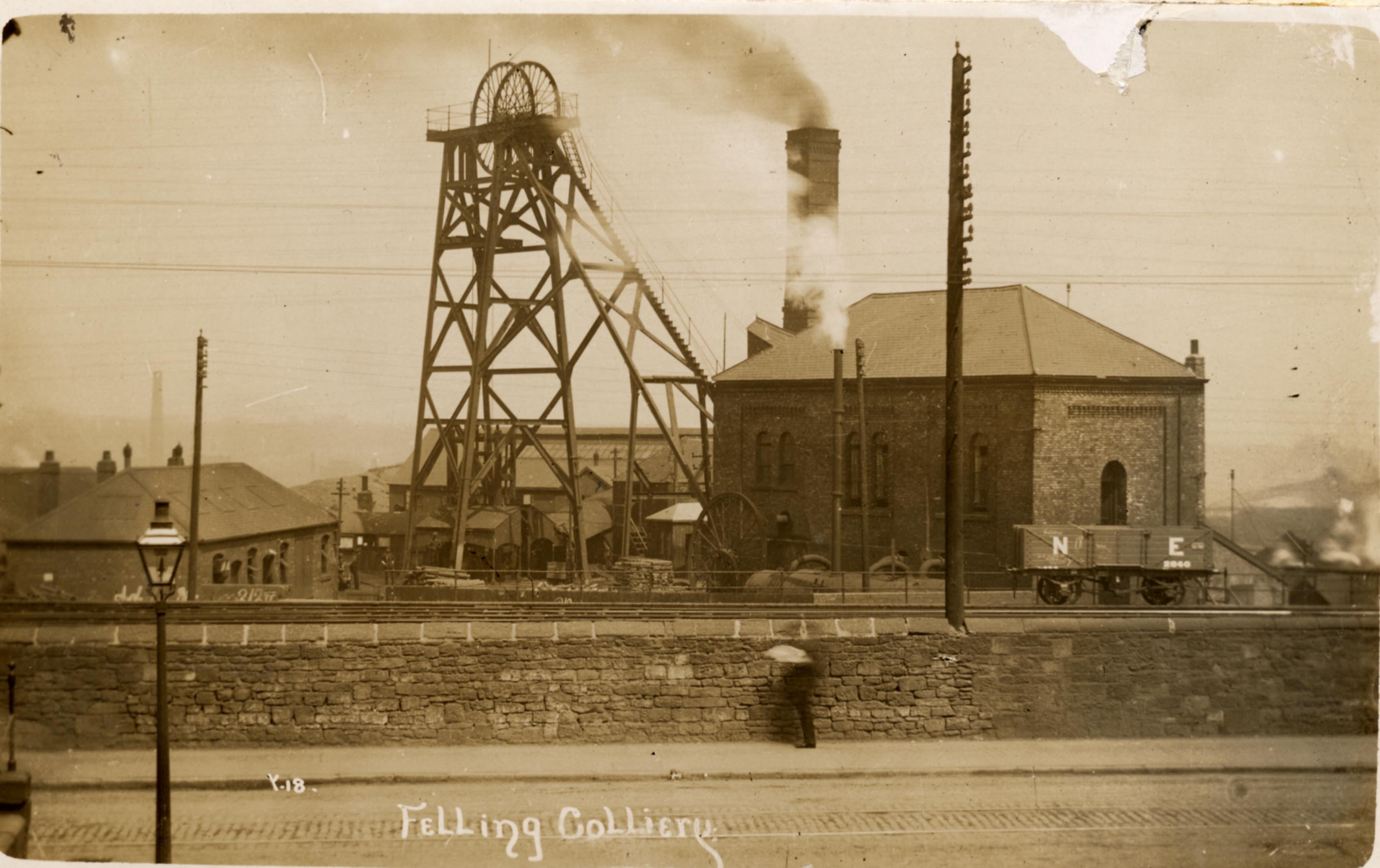
Felling mine disasters
At half past eleven on the morning of 25 May 1812, the earth shook for half a mile around Felling Colliery. Clouds of dust and coal erupted from both shafts, hurling baskets and timber into the air and destroying the winding gear above ground. Eighty-seven men and boys were trapped below. A rescue party descended forty-five minutes later, using a Spedding mill -- a device that produced light by spinning a steel cylinder against a flint -- because open flames were too dangerous. They noted that the sparks from the mill fell "like dark drops of blood" in the poisoned air. Then a second explosion threw them from their feet.
Entombed at Felling
The rescuers who descended after the first blast quickly realised they could not reach the trapped miners. Blackdamp -- the suffocating mixture of carbon dioxide and nitrogen that accumulates after an explosion -- made breathing impossible more than a few yards from the shaft base. When a second explosion struck while men were still underground, any remaining hope died. The suggestion to seal the pit and starve the fire of oxygen was met with shouts of "murder" from the crowd gathered above. Local memory held that three men had once survived forty days underground in a pit near Byker, and the families refused to accept their men were dead. The owners promised that "no expense should be spared" for rescue but refused to offer a reward, saying "they would be accessary to no man's death by persuasion or a bribe."
One Hundred and Seventeen Days
The pit was sealed on 29 May and not reopened until 8 July, when gas samples were cautiously collected and tested. The issuing gas still exploded when held near a candle flame. Four more days passed before the air was safe enough to descend. What the recovery teams found below was harrowing. The bodies had lain in the mine for seven weeks and were badly decayed. The Reverend John Hodgson, parish priest of Jarrow and Heworth, persuaded the bereaved families to accept a common burial at St Mary's Churchyard, after a doctor warned that carrying the remains home for a traditional wake might spread typhus. Mothers and widows struggled to identify the dead -- most were recognised not by their faces, which were "too much mangled and scorched to retain any of their features," but by their clothes, shoes, and tobacco boxes. One body was never found.
The Spark That Changed Mining
Hodgson's meticulous account of the disaster -- one of the first to attempt a scientific analysis of a mine explosion -- became a public call to action. By October 1812, the Sunderland Society had been formed, bringing together clergymen, doctors, mine owners, and engineers to study ventilation and develop safer lighting. Among its members were William Reid Clanny, who had already built an impractical early safety lamp, and George Stephenson, then the enginewright at Killingworth colliery. Stephenson designed the Geordie lamp, which fed air through narrow tubes too small for a flame to pass through. Sir Humphry Davy independently created the Davy lamp, surrounding the flame with iron gauze fine enough to prevent ignition of the surrounding gas while allowing methane to burn harmlessly inside. The height of the luminous cone above the flame served as a crude gas detector.
The Colliery That Would Not Rest
Felling exploded again on Christmas Eve 1813, killing nine men and thirteen boys along with twelve horses. The dead were in the headways near the upcast shaft; those working in the boards further away survived. A third disaster in 1821 and a fourth in 1847 added to the toll. The 1847 explosion was caused by something tragically preventable: an engineman had added fresh coal to an underground boiler fire and fully closed the damper before going off shift. Partial combustion generated gas that eventually escaped and detonated. Peter Gibbon, one of the survivors, noticed the air quality change through his Davy lamp and said to his workmate George Chapman, "Do ye mind what a current of air there was!" Chapman went to investigate and was later rescued, but died the following day.
The Memorial at St Mary's
A monument in St Mary's Churchyard marks the common grave of ninety-one victims of the 1812 disaster. It stands as a square base surmounted by a square pyramid, with brass plaques on each face listing names and ages. The youngest were boys. Mining communities understood that death was always close -- the men who went underground each morning worked by the light of devices that could, on any given day, ignite the invisible gas seeping from the coal seams. What Felling changed was not the danger but the response to it. Hodgson's insistence on understanding what had happened, rather than simply mourning it, set in motion the development of safety technologies that would spread through coalfields worldwide. The men and boys of Felling Colliery did not die in vain, but the cost of the knowledge their deaths produced was borne entirely by their families.
From the Air
Felling is located at 54.955N, 1.571W on the south bank of the River Tyne in the Tyne and Wear metropolitan area, just east of Gateshead. The colliery site is no longer visible, having been absorbed by urban development. St Mary's Churchyard with the memorial monument is in the village. Best viewed at 1,500-3,000 ft AGL. Nearest ICAO: EGNT (Newcastle) approximately 3nm north.