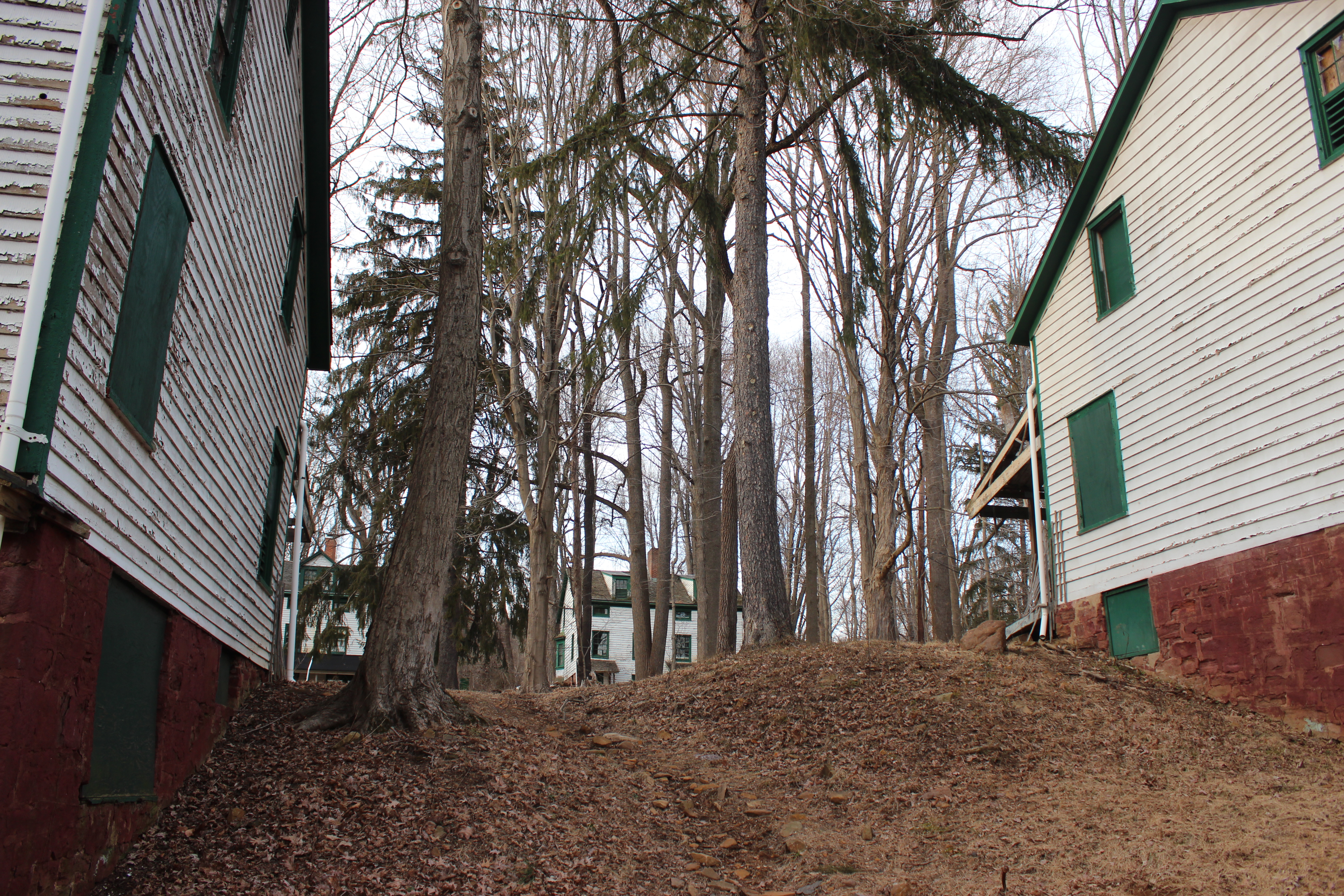
Feltville Historic District
Locals call it the Deserted Village, and the name has stuck through nearly two centuries of comings and goings. Feltville sits in the Watchung Reservation in Berkeley Heights, Union County - a cluster of eight houses, a church, and a carriage house tucked into forested hills just twenty-five miles from Manhattan. The place has been a mill town, a farming community, and a summer resort. It has been abandoned, revived, and abandoned again. Three families still live here as permanent residents. Everyone else comes to visit, drawn by the strange gravity of a place that people keep leaving but never quite forget.
King David's Domain
The first European to settle here was Peter Willcox, an Englishman from Long Island who arrived around 1736 and built a sawmill on what was then frontier land. More than a century later, in 1844, a Boston businessman named David Felt bought the property from Willcox's descendants. Felt needed a factory site, and within two years he had built a mill on Blue Brook, constructed two dams to power it, and erected a town for his workers. He named the settlement Feltville and ran it with an iron hand. Residents were required to attend church services in the community churchhouse. Their children had to attend classes in a one-room schoolhouse. The workers nicknamed their employer "King David." By 1850, about 175 people lived in Feltville, packed four families to a house in the larger buildings, two in the smaller ones. A nondenominational Union Church with a resident pastor served the community.
Twice Deserted
After fifteen years of his benevolent autocracy, King David sold the property. The successor businesses failed, one after another, and the settlement earned its melancholy nickname: the deserted village. In 1882, Warren Ackerman bought the place and reinvented it as Glenside Park, a summer resort. He built a carriage house - now called Masker's Barn - and marketed the wooded setting to vacationers. But the Jersey Shore proved a more powerful draw. Interest dwindled as summer visitors chose the beach over the mountains, and Feltville was deserted a second time. Eventually the Union County Park Commission acquired the property and folded it into the Watchung Reservation, renting the remaining houses to families and stabilizing the structures against further decay.
The Murals in the Mexican Cottage
After Glenside Park closed in 1916, a local civil engineer named Edward J. Grassmann purchased several properties in the village as a private club. Grassmann, a lifelong Elizabeth resident who had made his fortune in land surveying and kaolin processing, was passionate about the American Southwest and Latin America. He decorated two structures to reflect that passion, naming one the Mexican Cottage and the other the Indian Cottage. Sometime in the late 1920s, Grassmann persuaded the celebrated Nicaraguan-Mexican artist Roberto de la Selva to paint murals throughout the first floor of the Mexican Cottage. De la Selva, primarily a sculptor, spent months in rural Union County creating scenes of native Mexicans at work, play, and worship - images that include both ancient gods and the Virgin Mary. These are the only murals de la Selva is known to have painted anywhere, making them significant to both Feltville's history and the international art world. In 2013, Preservation New Jersey named the mural site one of the ten most endangered historic places in the state.
Ghosts and Apple Cider
A local legend claims that in 1912, three young sisters went camping deep in the woods and never returned. Searchers found only their bonnets. The story goes that nearly half the remaining residents moved away in fear, and those who stayed never let their children wander the forest unsupervised again. Whether the tale is true or embellished, it has fed the village's eerie reputation for more than a century. Today, the county leans into the atmosphere: each October, two weeks before Halloween, haunted hayrides carry families through the village while guides narrate its history with dramatic flair. On other weekends, staff host apple cider pressing demonstrations, children's games, and displays of archaeological artifacts. The foundation of Felt's original mill is still visible beside Blue Brook. Masker's Barn, restored in September 2011, stands as the district's most prominent surviving structure. The village was added to the National Register of Historic Places on June 6, 1980.
From the Air
Located at 40.681N, 74.387W within the Watchung Reservation in Berkeley Heights, NJ. The historic district is nestled in a forested valley within the Watchung Mountains, visible as a dense tree canopy with scattered clearings. Morristown Municipal Airport (KMMU) is approximately 8 nm to the northwest. Best viewed at 2,000-3,000 ft AGL. The Watchung Reservation's forested ridge and Blue Brook corridor serve as visual references.