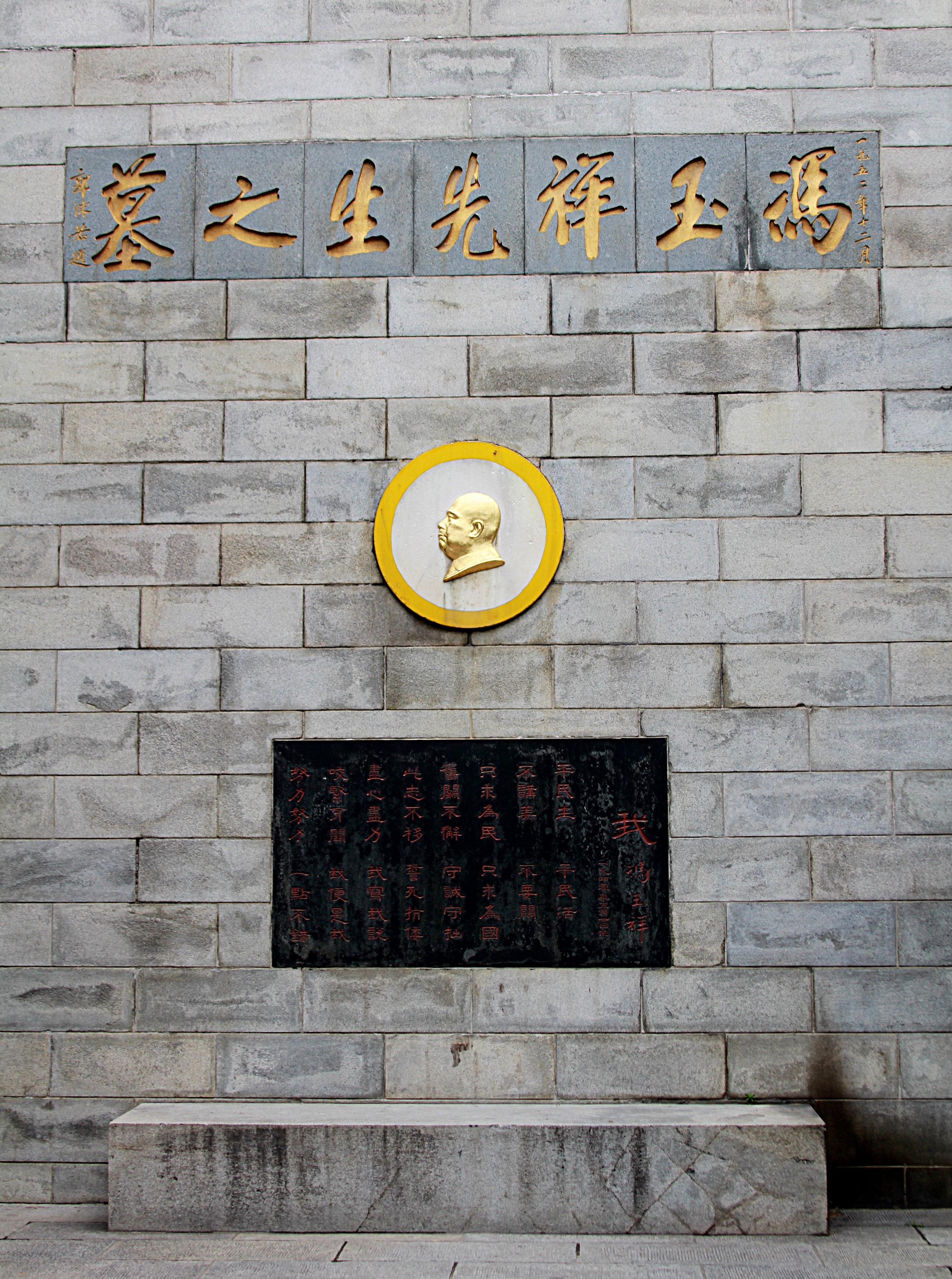
Feng Yuxiang
They called him the "Christian General," and the nickname stuck for good reason. Feng Yuxiang ran his army like a Methodist revival camp: no gambling, no prostitution, no opium. His soldiers drilled and prayed in equal measure, and a British missionary compared them favorably to Cromwell's Ironsides. In an era when Chinese warlords were synonymous with corruption and brutality, Feng stood apart -- a man who had joined the military at eleven, saved his pay to help lower-ranking soldiers, and converted to Christianity in 1914 after nearly being executed for revolutionary activity. His tomb now sits in the hills near Tai'an in Shandong Province, on land he chose for his retirement after being squeezed out of power by rivals on every side.
A Soldier From the Cradle
Feng Yuxiang was born in 1882 in Zhili Province, the son of an officer in the Huai Army. He enlisted at eleven as a deputy soldier -- the lowest rank, earning food and a uniform but no salary. While his peers gambled away their earnings, Feng saved his and shared it with soldiers who had even less. By sixteen he was a regular, and by 1902 he had transferred to Yuan Shikai's Beiyang Army, the most powerful military force in China. When the Xinhai Revolution erupted in 1911, Feng joined the Luanzhou Uprising against the Qing dynasty. The uprising failed and he was imprisoned, but Feng's talent for survival was already evident. Within three years he had regained his rank and was serving Yuan Shikai's new government. It was during this period that he converted to Methodism, baptized with the help of Chinese diplomat Wang Zhengting.
The Warlord Who Preached Temperance
After Yuan Shikai's death in 1916, China splintered into competing warlord domains. Feng carved out his own territory in the northwest, governing with a peculiar blend of Christian socialism and iron discipline. He banned opium, morphine, gambling, and prostitution in his domains -- measures that earned him admiration from Western missionaries and suspicion from fellow warlords. His political moves were equally bold. In 1924, during the Second Zhili-Fengtian War, Feng launched a surprise coup in Beijing that toppled the ruling Zhili clique and reorganized his forces as the Guominjun. He invited Sun Yat-sen to Beijing for reunification talks, though the talks came to nothing. By 1926, defeated by a coalition of his enemies, Feng retreated to the northwest before joining Chiang Kai-shek's Northern Expedition. The alliance was never comfortable, and by 1929 Feng had turned against Chiang, joining the Central Plains War -- only to be defeated again.
Defiance Against Japan
Stripped of military command, Feng channeled his energy into the cause that had driven him since boyhood. As a young soldier, he had witnessed Japanese atrocities during the 1895 Sino-Japanese War and had sworn that if he ever gained power, he would fight them to the death. Every year from 1915 onward, he and his officers wore belts inscribed with the words "In Memory of the National Humiliation of May 7th," marking Japan's infamous Twenty-One Demands. In May 1933, Feng took command of the Chahar People's Anti-Japanese Army Alliance. With over 100,000 men and frontline commanders Ji Hongchang and Fang Zhenwu, his forces drove the Japanese and Manchukuoan troops out of Chahar Province. But Chiang Kai-shek, fearing Communist infiltration of the alliance, besieged the army with 60,000 men. Trapped between Chiang and the Japanese, Feng resigned and retired to Tai'an in Shandong.
Fire on the Black Sea
Feng's final years traced a restless arc. He held nominal positions in the Nationalist government through the 1930s and early 1940s, called for Chiang's release during the Xi'an Incident, and briefly commanded Chinese forces at the defense of Shanghai in 1937. After the war, he traveled to the United States, becoming an outspoken critic of both Chiang's regime and the Truman administration that supported it. He spent months as a visiting scholar at Berkeley. In 1948, en route to the Soviet Union by ship, Feng Yuxiang died in a fire aboard his vessel on the Black Sea, along with one of his daughters. Whether it was an accident or assassination has never been settled. Richard Evans called him "an honest man." Peter Moody countered that many of Feng's allies might dispute this, "since he betrayed every one of them." Both assessments contain truth. His tomb near Tai'an draws visitors who see in Feng something rare among the warlords of his era: a man who, whatever his contradictions, never stopped fighting.
From the Air
Feng Yuxiang's tomb is located at 36.21°N, 117.10°E, near Tai'an in Shandong Province, immediately east of Tianwai Village square at the foot of Mount Tai. The area is characterized by hilly terrain south of the Yellow River plain. Nearest major airport: Jinan Yaoqiang International (ZSJN), approximately 60 km to the north. From the air, look for the distinctive bulk of Mount Tai rising to 1,545 meters, with the tomb area in the lowlands to the west.