Fenway Park: The Ballpark That Refused to Die
When Roger Clemens arrived in Boston for the first time in 1984, his taxi pulled up to a brick building wedged between Lansdowne Street and Jersey Street in the Kenmore Square neighborhood. Clemens told the driver he had the wrong address -- he was looking for a baseball stadium, not a warehouse. Only when the driver told him to look up and he saw the light towers did the young pitcher realize he had arrived at Fenway Park. That confusion captures something essential about the place. Fenway does not announce itself. It hides in plain sight among buildings of similar height and character, a ballpark so woven into its neighborhood that it practically disappears. Then you step inside, and it becomes the most distinctive stadium in America.
Born in the Shadow of the Titanic
Fenway Park opened on April 20, 1912. Mayor John F. Fitzgerald threw out the first pitch, and Boston defeated the New York Highlanders 7-6 in eleven innings. The newspapers barely noticed. Five days earlier, the Titanic had sunk, and the coverage of that disaster drowned out everything else. Owner John I. Taylor had purchased the land and built the park on an asymmetrical city block, which gave the field its famously lopsided dimensions. Architect James E. McLaughlin designed the structure, and the asymmetry that resulted from cramming a ballpark into a Boston neighborhood became Fenway's defining characteristic. The name itself came from the surrounding Fenway area, though Taylor's family conveniently owned the Fenway Realty Company.
The Monster and Its Secrets
The Green Monster is the 37-foot left field wall that looms just 310 feet from home plate. Part of the original 1912 construction, the wall started as wood, was covered in tin and concrete in 1934 when the hand-operated scoreboard was installed, and was resurfaced with hard plastic in 1976. It was not even painted green until 1947 -- before that, advertisements covered every inch. The nickname "Monster" is relatively recent; for decades, Bostonians simply called it "the wall." The scoreboard is still updated by hand from inside the wall, and if a ball in play passes through one of the scoreboard openings while operators are changing numbers, the batter gets a ground rule double. The inside walls are covered with player signatures accumulated over generations. In 2003, terrace seating was added on top, giving fans some of the most coveted seats in all of sports.
Quirks That Became Sacred
Fenway's oddities are not design choices -- they are accidents of geography that became beloved traditions. Pesky's Pole, the right field foul pole, stands a disputed 302 feet from home plate (Johnny Pesky himself estimated it at "around 295 feet"). Named after the light-hitting shortstop who managed just 17 career home runs, the pole was officially dedicated on his 87th birthday in 2006. In the right field bleachers, a single red seat -- Section 42, Row 37, Seat 21 -- marks where Ted Williams hit the longest home run in Fenway history on June 9, 1946. The ball landed on Joseph Boucher's head, punching through his straw hat. A bewildered Boucher could only ask how he was supposed to know it was coming. From 1912 to 1933, left fielders had to play on a ten-foot incline called Duffy's Cliff, named for Duffy Lewis, who mastered the art of running uphill to catch fly balls.
The Park They Tried to Replace
In 1999, Red Sox CEO John Harrington announced plans to demolish Fenway and build a new 44,130-seat replica nearby. The proposal sparked an uproar. Groups like "Save Fenway Park" organized to block the project, which critics saw as a scheme to inflate the team's sale price. The demolition never happened. Instead, Janet Marie Smith led a ten-year renovation beginning around 2002 that the Boston Globe credited with "saving Fenway Park." The renovation added seats atop the Green Monster, built the right field roof deck, upgraded concessions, and extended the park's projected lifespan to 2062. Fenway's lowest attendance -- 306 spectators on October 1, 1964 -- stands in stark contrast to the sellout streak that began in May 2003 and lasted 794 consecutive regular season games, shattering the previous major league record of 455.
More Than Baseball
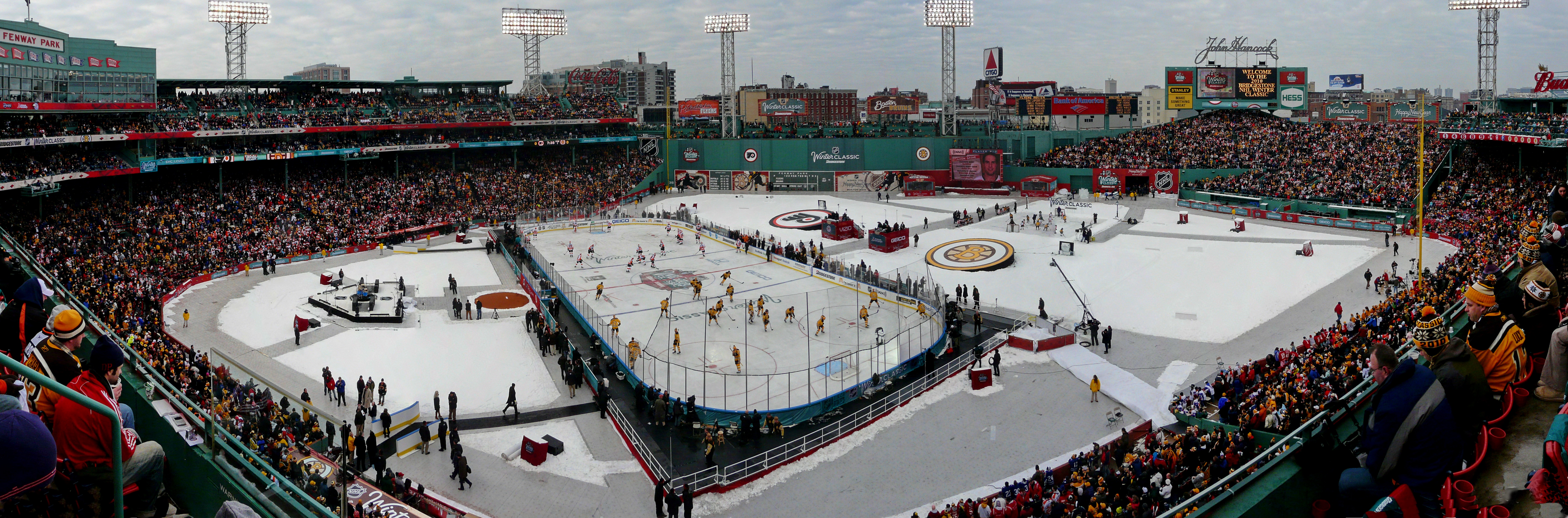
Fenway has hosted far more than Red Sox games. The Boston Redskins, Boston Yanks, and Boston Patriots all played football here. Boxing cards drew crowds from 1920 through 1956, including a 1930 bout by future heavyweight champion James J. Braddock. In 1929, wrestler Gus Sonnenberg defeated Ed "Strangler" Lewis before 25,000 fans. The 2010 NHL Winter Classic brought ice hockey to the outfield, and the Bruins won 2-1 in overtime. Stevie Wonder and Ray Charles played the first concert in 1973. Lady Gaga became the first woman to headline in 2017. A 140-foot ski jump was built from center field to the pitcher's mound for a 2016 big air competition. And every game since 2002, in the middle of the eighth inning, 37,000 voices sing along to Neil Diamond's "Sweet Caroline" -- a tradition that Diamond himself honored by performing it live on opening night in 2010.
From the Air
Fenway Park sits at 42.346N, 71.098W in Boston's Fenway-Kenmore neighborhood, near Kenmore Square. From the air, the park blends into surrounding buildings of similar height -- look for the distinctive light towers and the asymmetrical diamond shape. The Green Monster's left field wall is visible as the tallest structure along the third-base side. Boston Logan International Airport (KBOS) is approximately 7km to the east. Best viewed at 1,500-3,000 feet altitude. The Massachusetts Turnpike (I-90) passes nearby to the south. The Charles River is visible to the north.