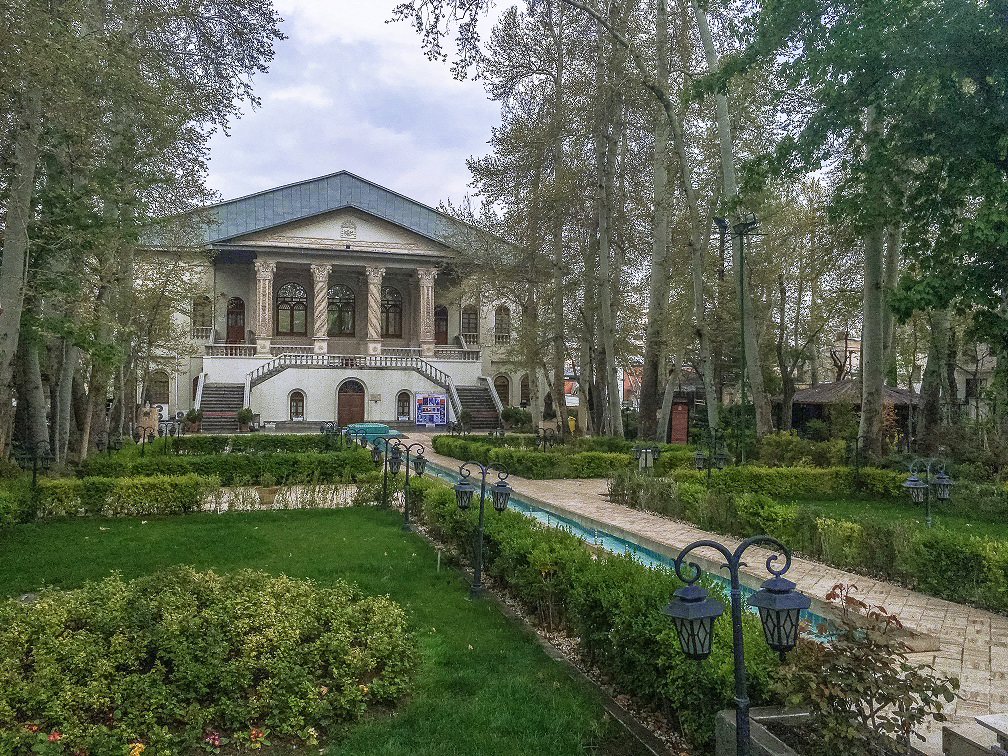
Ferdows Garden
The English word paradise comes from a Persian garden. Specifically, from the Old Iranian paridaiza -- literally, a circular enclosure -- the term the Achaemenid Empire used for the grand walled gardens scattered across its territories. The word traveled through Avestan into Greek as paradeisos, entered Hebrew as pardes after the Jews arrived in Babylon in the fifth century BC, and eventually reached English carrying all the spiritual weight of Eden. Ferdows Garden in northern Tehran is one of those enclosures, a place where the literal and metaphorical meanings of the word still overlap.
A Shah's Unfinished Dream
Mohammad Shah Qajar ordered the construction of a mansion called Mohammadieh in the Tajrish district of Shemiran sometime during his reign, which lasted from 1834 to 1848. He died on September 5, 1848, before the building was finished. The incomplete structure sat unused until Hossein Ali Khan, a courtier known as Mo'ayyer-ol-Mamalek, took up the project, building a two-story mansion in Qajar architectural style on the same grounds. The complex passed to his son Dust-Ali Khan during the reign of Naser ed-Din Shah Qajar, who renamed it Ferdows -- paradise. Then Dust-Ali Khan's son, Dust-Mohammad Khan, married the shah's daughter and built a second mansion to the south of the original, hiring architects from Isfahan and Yazd. He called it Rashk-e Behesht: the Envy of Heaven.
Revolution and Reinvention
The older mansion was eventually destroyed as the complex changed hands over the decades. The surviving structure was purchased by Mohammad Vali Khan Tonekaboni, a figure whose significance extended well beyond real estate. Tonekaboni led the Constitutionalist Revolutionary Forces from Iran's northern provinces of Gilan and Mazandaran during the Persian Constitutional Revolution. He added pools and fountains to the grounds and restored the qanat-fed aqueduct that had once brought fresh water to the garden. The gate visitors pass through today dates from his ownership. After the garden was leased to government ministries, the Ministry of Education turned it into the campus of Shapur primary and secondary school in 1937. Each new use scraped away a layer of the old one while adding its own.
From Filmmaking School to Cinema Museum
Following the 1979 Iranian Revolution, Ferdows Garden became a training center for filmmaking -- a fitting second act for a country whose cinema would gain international acclaim in the decades that followed. In 2002, the compound was transformed again, this time into the Cinema Museum of Iran. The Qajar-era mansion now houses exhibits tracing the history of Iranian film, from its earliest days through the internationally celebrated works of directors who put Tehran on the world's cinematic map. The garden grounds remain a public park, and the mansion is visible from the paths that wind through them -- an image that itself became the subject of the 2005 Iranian film Ferdows Garden, 5 o'Clock in the Afternoon, directed by Siamak Shayeghi.
The Word That Became Heaven
What makes Ferdows Garden remarkable beyond its architecture is what its name reveals about the deep history of an idea. The Dehkhoda Dictionary notes that pardes became a synonym for the Hebrew word gan, meaning the Garden of Eden. The word firdaws appears twice in the Quran, carrying roots that trace back through Judaism and Christianity. A single concept -- a walled garden, beautiful and enclosed -- traveled from ancient Iran through the religions of the Near East and into the spiritual vocabulary of half the world. To walk through the actual Ferdows Garden is to stand inside the physical ancestor of a metaphor that billions of people carry in their imaginations.
From the Air
Located at 35.803N, 51.422E in the Tajrish district of Shemiran, northern Tehran. The garden compound is visible from altitude as a green enclosure in the foothills area north of Tehran's dense urban center, near the base of the Alborz Mountains. Nearest major airport is Tehran Mehrabad International (OIII), approximately 15 km southwest. Tehran Imam Khomeini International Airport (OIIE) is about 60 km south. Best viewed at 3,000-5,000 ft AGL on approach from the south, where the garden contrasts with the surrounding development.