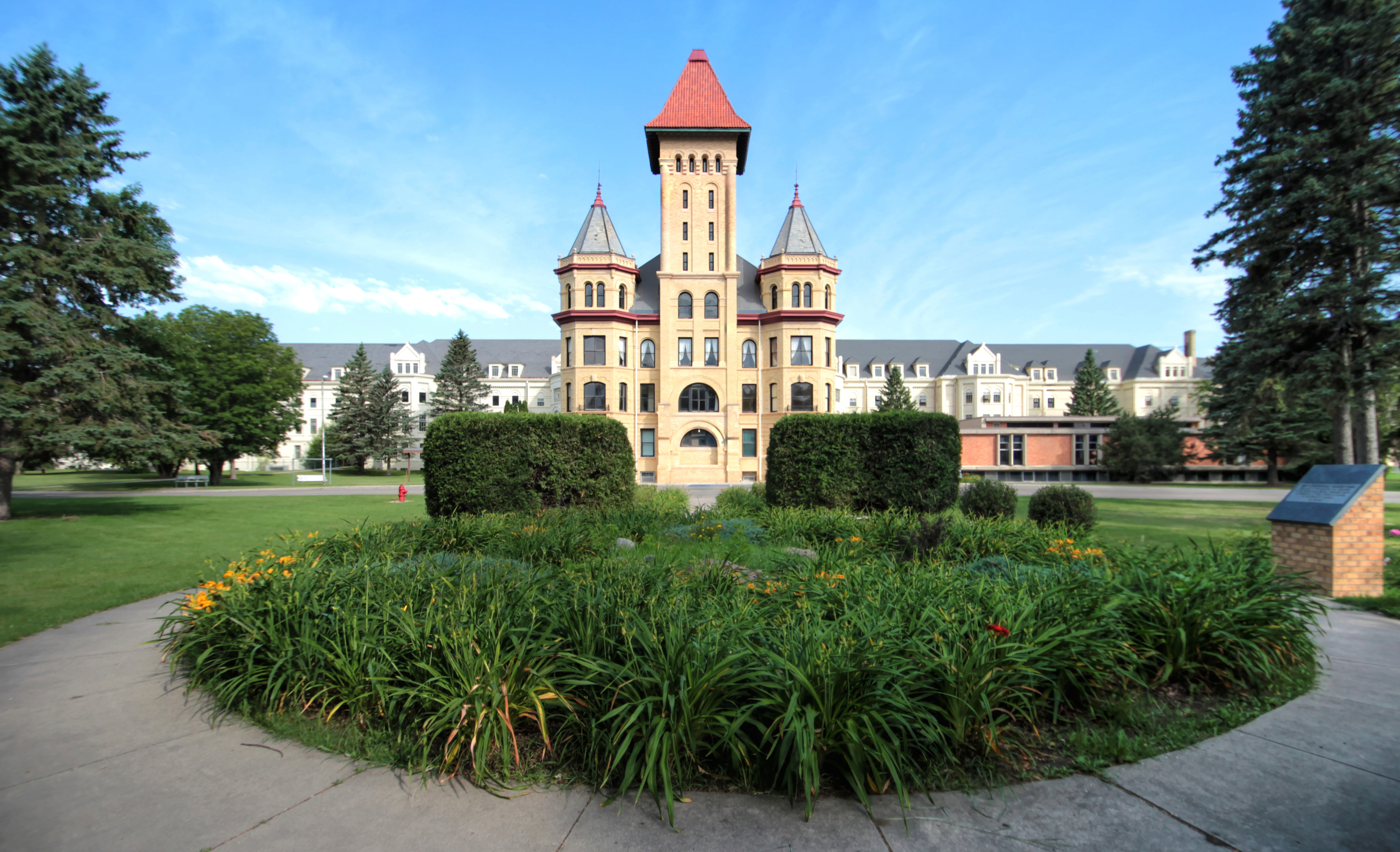
Fergus Falls Regional Treatment Center
Royal Powers built it without blueprints. Not the dam, not the wings, not the soaring central tower -- the carpenter held every measurement, every joint, every angle in his head. That detail, almost unbelievable for a building of this scale, captures the strange ambition behind the Fergus Falls State Hospital. When Minnesota's legislature commissioned its third asylum for the mentally ill in 1885, they were not just building a hospital. They were building a theory of healing made tangible in brick and stone, a place where the very proportions of hallways and the angles of sunlight through windows were supposed to restore broken minds. Designed by architect Warren B. Dunnell and opened on July 29, 1890, the hospital followed the Kirkbride Plan -- a philosophy that architecture itself could be medicine. For 117 years, until its closure in 2007, this institution on the western Minnesota prairie defined both a town and an era in American mental health care.
A Cure Built in Stone
Physician Thomas Kirkbride devised his plan in the mid-nineteenth century around a deceptively simple idea: the building is the treatment. A central administrative block anchored each Kirkbride asylum, with long, staggered wings radiating outward like the fingers of an open hand. Patients lived in these wings, where uniform rooms, austere facades, and abundant natural light were meant to impose discipline and order on disordered minds. The approach was called 'moral treatment,' and it included farming, sewing classes, exercise, and entertainment alongside the architecture. By the time Fergus Falls was commissioned, Minnesota's existing hospitals in St. Peter and Rochester were desperately overcrowded -- the State Board of Health had called conditions at St. Peter 'appalling and a disgrace' as early as 1872. On December 14, 1886, Fergus Falls won the site selection by a vote of 4-1 over Brainerd, Sauk Centre, and Alexandria, partly because the existing hospitals were both in southern Minnesota and the state wanted one north of the Twin Cities.
The Town the Hospital Built
The first patients arrived the day the doors opened: two men sent by an Otter Tail County judge. The next day, eighty patients transferred from the overwhelmed St. Peter hospital. All were men -- farmers and laborers, mostly -- because women were not admitted until 1893, when 125 female patients made the journey from St. Peter. Only the West Detached Ward was finished in 1890; the rest of the wings and the grand main building were not completed until 1912. By the late 1920s the hospital's population had swelled to around 1,700, making it the largest mental health facility in the state. The institution and the city grew in tandem: Fergus Falls more than doubled in population between 1890 and 1930. The hospital was the economic engine, the social anchor, the reason many families had come to this stretch of prairie in the first place.
The Long Reckoning
The cruel irony was inescapable. Built to solve overcrowding, the Fergus Falls State Hospital quickly became overcrowded itself. Patients could be admitted voluntarily, but many arrived by court order, and most stayed for life. Over the decades, hospital leaders pioneered treatments like occupational therapy and, later, shock treatment. But the court system increasingly used the institution as a warehouse for social outcasts -- the poor, the inconvenient, the simply different. Most patients had few resources and no advocates. The hospital operated for over a century, adapting to evolving standards in mental health care, treating chemical dependency and developmental disabilities alongside psychiatric illness. It was added to the National Register of Historic Places in 1986, even as the philosophy that created it had long since fallen out of favor. When the doors finally closed in 2007, the campus became one of the largest abandoned Kirkbride structures in America.
Demolition, Salvation, and Canvas
The decade after closure brought a grinding tug-of-war between preservation and pragmatism. Colliers Real Estate listed the complex for sale in 2012. A plan to convert the buildings into a hotel, spa, and restaurants won city council approval in 2013, but financing collapsed. A citizens' group launched a grassroots fundraising drive for $700,000 in late 2014, racing against a year-end deadline. The effort ultimately fell short. In January 2018, city officials voted unanimously to seek state funding for demolition, requesting $8.9 million to clear the campus while preserving only the vacant central tower. The state granted $3.5 million, and demolition began with the mid-century administration building. Meanwhile, a quieter transformation had already taken root. In 2014, Springboard for the Arts established Hinge Arts at the Kirkbride, an artist residency program housed in the former nurses' dormitory. Selected artists live on the grounds, creating work that reflects on the building's history and the past and present of mental health treatment -- turning a monument to institutional care into a space for creative expression.
From the Air
Located at 46.299N, 96.081W in Fergus Falls, Minnesota, on the western edge of the state's lake country. The sprawling hospital campus is visible from altitude on the south side of town, with the distinctive central tower still standing amid cleared grounds. Fergus Falls Municipal Airport-Einar Mickelson Field (KFFM) lies approximately 3 miles southeast. The Otter Tail River winds through the city. Approach from the east over the chain of lakes in Otter Tail County for the best perspective on the campus and surrounding prairie landscape. Cruising altitude of 3,000-5,000 feet AGL provides good visibility of the campus layout.