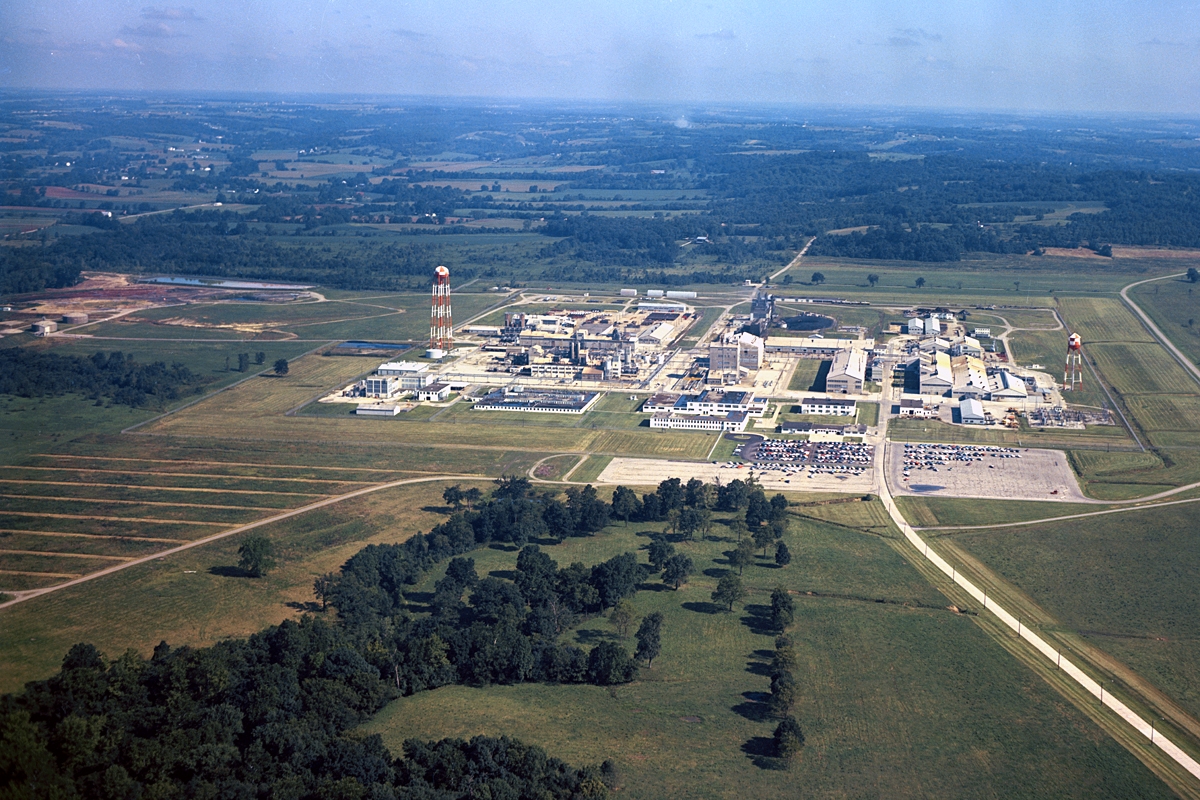
Fernald Feed Materials Production Center
The front page of The Cincinnati Times-Star announced it plainly on March 31, 1951: the Atomic Energy Commission was building a "$3 million uranium ore refining plant near Fernald." What the newspaper could not have known was that this facility would produce 170,000 metric tons of uranium metal over the next four decades, release millions of pounds of radioactive dust into the Ohio countryside, contaminate the drinking water aquifer beneath it, and eventually cost $4.4 billion to clean up. Today, the site where farmers once grew corn above the Great Miami aquifer is a nature preserve. It is also permanently unfit for human habitation.
Born from Cold War Panic
The Soviet Union detonated its first atomic bomb on August 29, 1949. The Korean War erupted ten months later. Suddenly, the scattered network of uranium processing plants the Manhattan Project had left behind -- a chemical works in St. Louis, a facility in Cleveland, a smelter in Niagara Falls -- could not keep up with demand. Walter J. Williams, the AEC's Director of Production, pushed to consolidate everything into one massive facility. The Catalytic Construction Company evaluated dozens of sites across the Ohio Valley, scoring them on flat terrain, rail access, water supply, electric power, and proximity to a large labor force. Fernald, a rural hamlet northwest of Cincinnati where farms lacked electricity and roads were unpaved, checked every box. The government offered local landowners between $375 and $652 per acre. Three refused. The AEC condemned their property, and a federal judge signed the seizure order on April 24, 1951.
Nine Plants, One Mission
The Fernald complex operated nine specialized plants in an industrial chain that transformed raw uranium ore into finished metal fuel rods. Plant 1 crushed and sampled incoming ore, including radium-bearing pitchblende from the Belgian Congo that released invisible radon gas. Plants 2 and 3 dissolved the ore in nitric acid and extracted purified uranyl nitrate. Plant 4, the Green Salt Plant, converted uranium trioxide into uranium tetrafluoride through fluidized-bed reactors running at extreme temperatures. In Plant 5, workers packed green salt and magnesium granules into steel-lined vessels called "bombs" and heated them until a thermite reaction produced molten uranium metal at temperatures that could exceed 2,500 degrees Fahrenheit. The solidified uranium "derbies" were then melted, cast into ingots, rolled into rods, and shipped to the Hanford and Savannah River weapons sites. At peak production in 1960, Fernald processed 10,000 metric tons of uranium in a single year.
The Secrets That Seeped Out
In 1984, the public learned what nearby residents had long suspected: Fernald was releasing millions of pounds of uranium dust into the atmosphere. The contamination was not limited to air. Radioactive material had leached into the soil, seeped into groundwater, and spread through the Great Miami aquifer that supplied drinking water to surrounding communities. Workers inside the plant had been exposed to ionizing radiation, uranium compounds, chlorinated solvents, and toxic metal salts. The revelations carried a particularly macabre footnote. In June 1984, pipe fitter David Bocks disappeared during his shift. His remains were later found inside a uranium processing furnace in Plant 6, where a sudden temperature drop had been recorded at 5:15 that morning. Investigators could not determine whether it was suicide or murder, but some believed Bocks had been killed by coworkers who suspected him of being a whistleblower in the emissions scandal. The nearby Fort Scott Camp, the oldest Roman Catholic summer camp in the country, shut its doors in 1989 because of contamination fears.
The $4.4 Billion Reckoning
Fernald was proposed as a Superfund site in July 1989 and officially listed that November. Congress ordered the facility closed and cleaned up. The scale of remediation was staggering. Fluor Corporation won the contract in 1992 and spent the next fourteen years dismantling the entire complex: imploding Plant 4 in 1996, demolishing the Metals Fabrication Plant in 2002, tearing down the Pilot Plant and Scrap Recovery Plant in 2003. Thousands of tons of contaminated concrete, sludge, and soil were removed. Low-level waste was shipped to disposal facilities in Utah and Texas, while more concentrated waste was sealed in eight on-site disposal cells. The cleanup finished on October 29, 2006 -- twelve years ahead of schedule and $7.8 billion under the original cost estimate. Two medical monitoring programs still track the health of nearly ten thousand local residents and over two thousand former workers.
Wetlands Where Uranium Burned
The Fernald Preserve opened in 2007 on the land where uranium once burned in thermite reactions. Man-made wetlands now cover ground that held processing plants. Birds nest where drums of radioactive ore once stood stacked in rows. A LEED Platinum visitor center tells the story of what happened here. But beneath the restored surface, the legacy persists. Test wells continuously monitor uranium levels in the groundwater plume extending south of the old plant area. Filtration systems still scrub contamination from the aquifer. Restrictions prohibit new wells anywhere contamination exceeds safety limits. These operations are expected to continue indefinitely. The Fernald Preserve is a place of genuine natural beauty built on ground that can never be truly clean -- a landscape that embodies the cost of the atomic age in the most literal way imaginable.
From the Air
Located at 39.298°N, 84.691°W, approximately 18 miles northwest of Cincinnati, Ohio. The site straddles the Hamilton-Butler county line. From the air, the Fernald Preserve appears as an expanse of green wetlands and open space contrasting with surrounding agricultural land -- the capped waste disposal cells are visible as geometric mounds. Cincinnati/Northern Kentucky International Airport (KCVG) is about 25 miles south. Butler County Regional Airport (KHAO) is roughly 15 miles north. Recommended viewing altitude: 3,000-5,000 feet AGL.