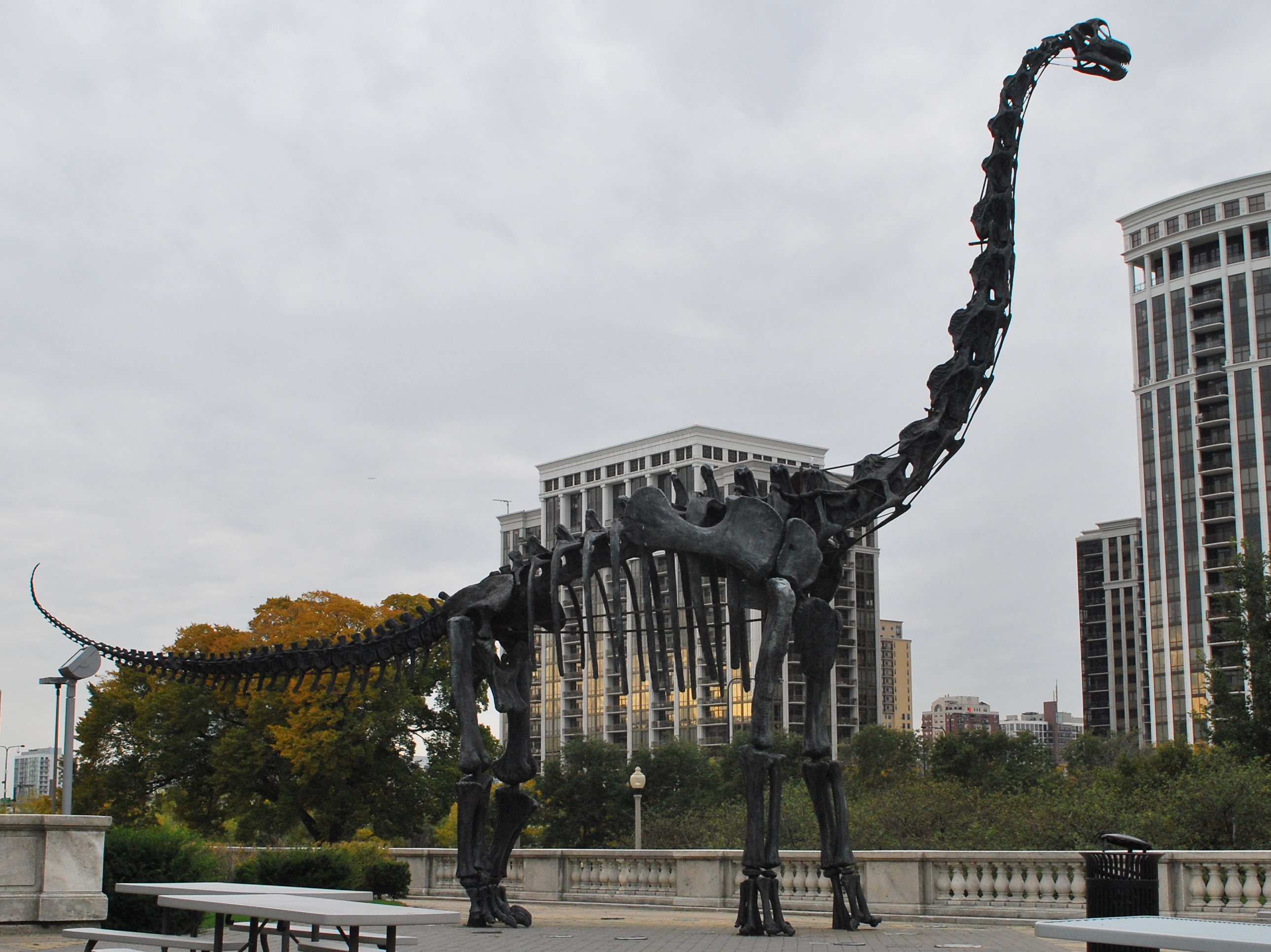
Field Museum of Natural History
Twenty-three human mummies lie in climate-controlled darkness on the museum's second floor. Below them, the man-eating lions of Tsavo stare from their glass case with flat amber eyes, the same pair that killed and ate an estimated 35 railroad workers in Kenya in 1898. Down the hall, a 67-million-year-old Tyrannosaurus rex named Sue stands reassembled in her own private gallery, jaws agape, every serrated tooth a reminder that this building on Chicago's lakefront holds the dead of virtually every era in Earth's history. The Field Museum of Natural History is not merely a museum. It is a warehouse of time itself, 24 million specimens and artifacts crammed into a neoclassical marble palace that has anchored Chicago's Museum Campus since 1921.
A World's Fair Legacy
The Field Museum exists because a world's fair ended and someone asked: what happens to all this stuff? In 1893, the World's Columbian Exposition drew 27 million visitors to Chicago's Jackson Park, filling grand exhibition halls with natural specimens and cultural artifacts from around the globe. Edward Ayer, a lumber baron and voracious collector, convinced department store magnate Marshall Field to bankroll a permanent home for the exposition's collections. Incorporated on September 16, 1893, as the Columbian Museum of Chicago, the institution set up shop in the Fair's Palace of Fine Arts -- the only exposition building to survive. It was renamed the Field Museum of Natural History in 1905 to honor its benefactor. In 1921, the museum relocated to its current neoclassical home on the lakefront, designed by Daniel Burnham's firm, joining what would become Museum Campus alongside the Shedd Aquarium and Adler Planetarium. By the late 1930s, it stood among America's three premier natural history museums, alongside the American Museum of Natural History in New York and the Smithsonian's National Museum of Natural History in Washington.
Sue and the Hall of Evolving Planet
On May 17, 2000, the Field Museum unveiled the skeleton that would become its most famous resident. Sue, named for discoverer Sue Hendrickson, is the largest T. rex specimen ever found -- over 40 feet long, 13 feet tall at the hips, and an estimated nine tons when alive some 67 million years ago. An examination of Sue's bones revealed the animal died at age 28, a longevity record for T. rex until the Dutch specimen Trix was found in 2013. The original skull, too heavy and fragile for the mounted skeleton, sits in its own case nearby. In December 2018, Sue was moved into a dedicated gallery within the Griffin Halls of Evolving Planet, where the skeleton was updated with gastralia (belly ribs) and a repositioned wishbone reflecting current paleontological understanding. The broader Evolving Planet exhibit traces four billion years of life, from single-celled organisms to Permian synapsids to the dinosaurs and early hominids that followed.
Worlds Within Worlds
The Field Museum's permanent exhibitions span continents and millennia with a density that can overwhelm. Inside Ancient Egypt features 23 human mummies and a three-story replica of the mastaba tomb of Unas-Ankh, son of Unas, the last pharaoh of the Fifth Dynasty, complete with 5,000-year-old hieroglyphs in two authentic rooms. The Ancient Americas traces 13,000 years of human ingenuity through six galleries running from Ice Age hunters to Aztec and Incan empire builders. An authentic 19th-century Maori Meeting House, Ruatepupuke II, from Tokomaru Bay, New Zealand, fills a gallery in the Regenstein Halls of the Pacific. The Cyrus Tang Hall of China, opened in 2015, displays 350 objects spanning thousands of years. And Native Truths: Our Voices, Our Stories, opened in 2021, uses roughly 400 artifacts to interpret Native American culture while addressing modern-day challenges through direct collaboration with Indigenous communities.
The Invisible Museum
What visitors see represents a tiny fraction of what the Field Museum holds. Behind the public galleries, over 24 million specimens fill climate-controlled storage rooms that together form one of the world's most important research collections. The bird skin collection ranks fourth worldwide. The mollusk collection is among the five largest in North America. The fish collection ranks among the largest on the planet. During the museum's first 50 years, over 440 expeditions acquired specimens from every part of the world. The library holds 275,000 volumes, including the working collection of Berthold Laufer, America's first sinologist -- some 7,000 volumes in Chinese, Japanese, Tibetan, and Western languages. The photo archives contain over 250,000 images. And somewhere in the stacks sits one of only two known copies of Audubon's Birds of America arranged in taxonomic order, once owned by Audubon's family physician. Working laboratories let visitors watch scientists at work: extracting DNA, preparing fossils, or conserving anthropological specimens from around the world.
Lions, Taxidermy, and the Art of Preservation
Two taxidermied lions greet visitors in the museum's mammal halls, but these are no ordinary specimens. They are the Tsavo Man-Eaters, a pair of maneless male lions that terrorized workers building a railroad bridge over the Tsavo River in Kenya in 1898, killing an estimated 35 people before being shot by Lieutenant Colonel John Henry Patterson. The museum's connection to taxidermy runs deeper than any single exhibit. Carl Akeley revolutionized the craft here, producing the first truly natural-looking mammal and bird specimens for both exhibition and study. The museum's conservators have continued that tradition of innovation, pioneering methods from pheromone trapping for moth control to ultra-sealed barrier film micro-environments that protect archaeological metals from corrosion. It is a place where the science of keeping things from falling apart is as serious as the science of understanding what those things once were.
From the Air
Located at 41.866N, 87.617W on Chicago's lakefront Museum Campus, the Field Museum's massive white neoclassical building is unmistakable from the air -- it sits at the south end of Grant Park between Lake Shore Drive and the Lake Michigan shoreline, flanked by the Shedd Aquarium to the east and Soldier Field to the south. The columned facade faces north toward the Chicago skyline. Nearest airports: Chicago Midway International (KMDW), approximately 8nm southwest; Chicago O'Hare International (KORD), approximately 14nm northwest. From 3,000-5,000 feet, the entire Museum Campus is clearly visible as a green peninsula jutting into the lake.