Fifth Battle of Ypres
Almost no one remembers the Fifth Battle of Ypres. It does not have a famous poem the way the Second does, no Passchendaele mud like the Third, no cinematic catastrophe like the Somme. It lasted five days. Casualties were comparatively light. The advance was the largest the Ypres front had seen in four years - up to eighteen miles in places. By the time it ended on 2 October 1918, the Allies stood east of ground that had taken half a million men to win and then lose in 1917. The Fifth Battle of Ypres is what victory looks like when nobody is talking yet about victory: a wet, methodical, undramatic ending to four years of stalemate.
After the German Spring
The summer of 1918 had broken the German army. The vast spring offensives that began in March - Ludendorff's last gamble to win the war before American manpower arrived - had spent themselves by July with no decisive victory. American divisions were now landing in France at a rate of 250,000 men a month. The German army was eating horse meat and going hungry, its replacement pools empty, its morale crumbling. On 18 July, Marshal Ferdinand Foch began a series of attacks across the entire Western Front - the Grand Offensive. He would not let the Germans rest anywhere. In Flanders, the British Second Army under General Herbert Plumer, the Belgian Army under King Albert I, and elements of the French Sixth Army formed the Groupe d'Armees des Flandres, the northernmost pincer of the great Allied push.
The Morning of 28 September
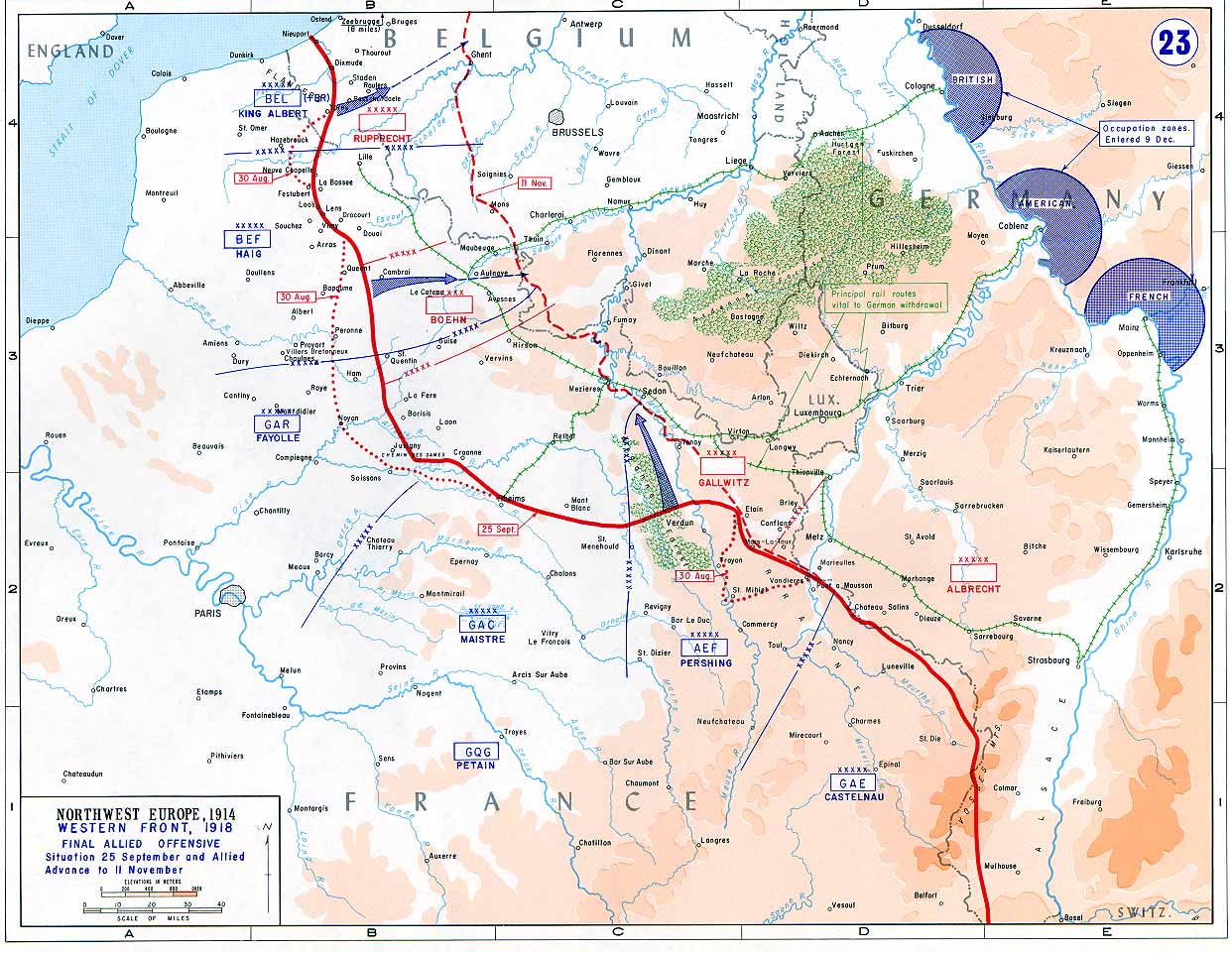
The attack began at first light on 28 September 1918, after a three-hour artillery bombardment. The German 4th Army holding Flanders had fewer than five divisions in the area - a shadow of the force that had defended these same ridges for years. The Allied infantry advanced behind their barrage and found German positions that crumbled rather than fought. By evening on the first day, the British had taken Kortewilde, Zandvoorde, Kruiseecke and Becelaere; Belgian troops had captured Zonnebeke, Poelcappelle, Schaap Baillie and the great Houthulst Forest. The ground had been won at appalling cost in 1917 at Passchendaele and then abandoned during the German spring withdrawal in 1918. Now it was being walked over in a single day. The names that had cost Britain and Canada and Australia and New Zealand so dearly were falling almost in the time it took to read them.
Rain, Again
Then it rained. The Flemish ground that had drowned Third Ypres in 1917 turned again to the cream-cheese mud the soldiers all knew. By 29 September, Messines and Terhand and Dadizeele had fallen. By 30 September, every piece of high ground around Ypres was finally in Allied hands. But the advance was slowing now under the same conditions that had crippled every previous offensive here. Wagons stuck. Field artillery could not be brought forward. On 1 October the Belgian troops were east of Moorslede and Staden and Diksmuide. The next day the offensive ran out of supplies. Food and ammunition had to be air-dropped by parachute from British aircraft - a tactic so new it barely had a name. By 2 October the Fifth Battle of Ypres was over. The Battle of Courtrai picked up where it ended, two weeks later.
Casualties on a Different Scale
What is remarkable about the Fifth Battle of Ypres, in the context of all that had come before, is what did not happen. The Allies advanced up to eighteen miles, averaging six - distances that in 1916 or 1917 would have cost a hundred thousand men. The British and Belgian losses were a fraction of that. The German army was no longer fighting the way it had fought at Third Ypres a year earlier; whole companies surrendered, and many more simply faded back. The war had not become humane - the British were still losing thousands of dead - but the balance of the killing had finally shifted. In 1917, advancing six miles at Passchendaele had cost about 275,000 British casualties. In 1918, those six miles were a single morning's work.
The Quiet End
Most of the men who attacked at Ypres on 28 September 1918 had no idea that the war was about to end. They expected to fight through another winter; they had been told to. The Belgian troops who liberated their own villages along the line of advance were the first to walk Belgian soil east of Ypres in nearly four years. When the armistice came on 11 November, the Allied line was far east of where the Fifth Battle had left it, near Ghent. The Ypres Salient - that bulge of ground that had defined the war for half of Europe - had ceased to exist. The town behind them was rubble. Six hundred thousand Allied soldiers were buried in the surrounding fields, and the wheat planted over them would for years bring up bones.
Why Nobody Remembers
There are reasons the Fifth Battle of Ypres slipped out of memory. It was an Allied victory and victorious advances do not produce the literature of suffering that lost or stalemated battles do. It was over too quickly to produce the long magazine pieces and the war poets. It happened forty days before the armistice, so its participants were absorbed into the larger story of how the war ended. And the names of the villages it freed - Zonnebeke, Becelaere, Dadizeele - had already been spent at Passchendaele the year before. But this is where the Flanders war actually ended for the salient: not in glory, not in catastrophe, but in five autumn days of methodical advance and steady rain. Around Ypres today, the cemeteries hold the dead of every year of the war. A surprising number of them died in late September and early October 1918, almost in sight of the end.
From the Air
The Fifth Battle of Ypres front ran from Diksmuide (51.03 N, 2.86 E) south through Houthulst Forest, Zonnebeke (50.87 N, 2.99 E), and on toward Comines on the Lys. Best aerial perspective is from west to east at 2,000-3,500 ft AGL, following the historic Menin Road from Ypres eastward to watch the ground roll up toward the old German positions on the ridges. The advance covered roughly 18 miles on its widest axis, so a full transit takes time at low altitudes. Wevelgem (EBKT) is the closest civil field, sitting almost on the line of advance. Ostend-Bruges (EBOS) on the coast and Lille-Lesquin (LFQQ) are both useful. The terrain is now intensively farmed and the old battlefield is invisible except in cemeteries, woods that were once strongpoints, and the occasional concrete pillbox in a field corner.