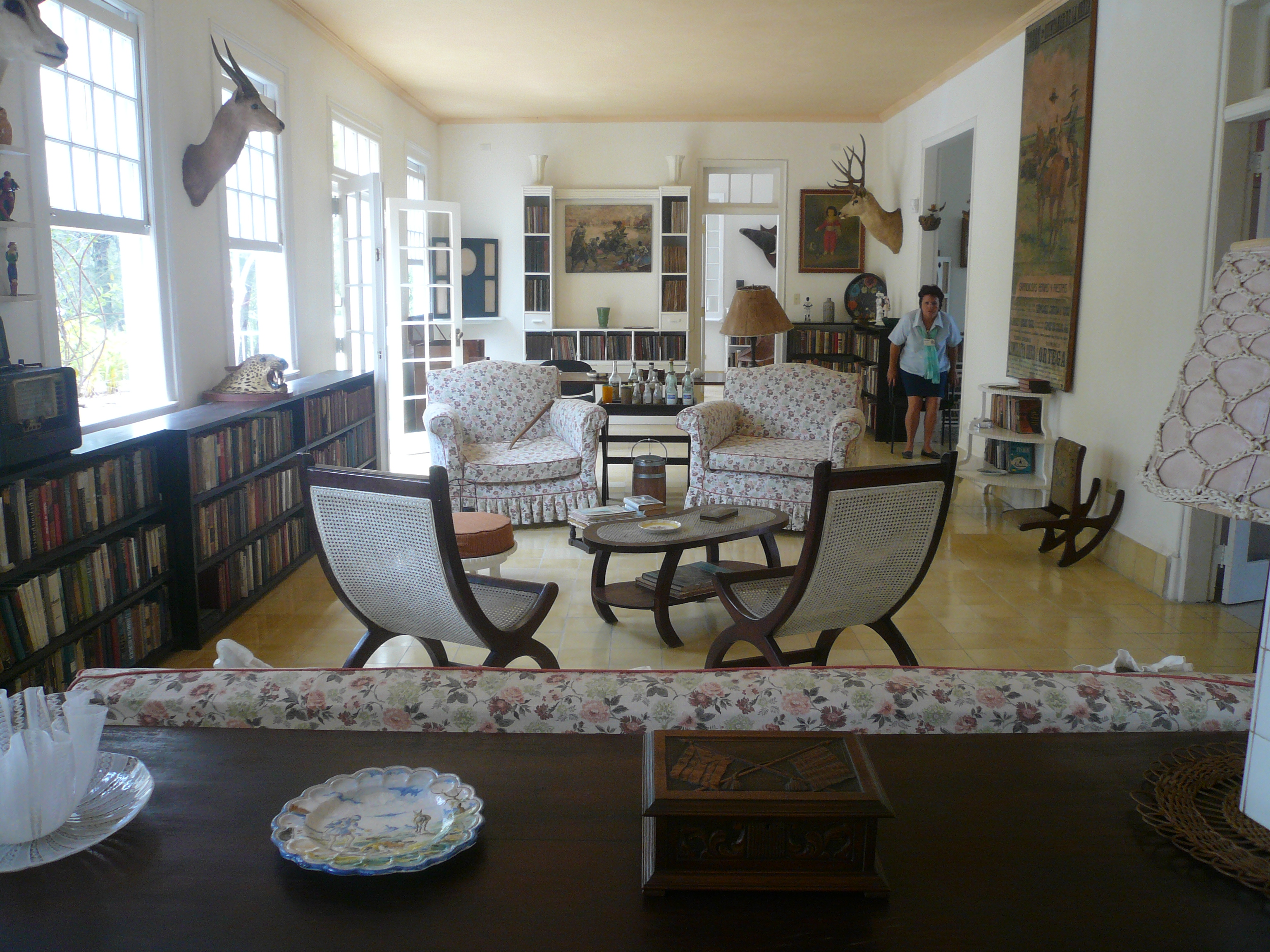
Finca Vigía
The writing tower stands empty. Mary Hemingway had it built in 1946 so her husband could work in peace above the treetops, with a view of downtown Havana shimmering in the distance. Ernest never used it. He preferred the bedroom, standing at his typewriter in the mornings, working barefoot on the tile floor of the one-story house perched on a hill southeast of Havana. The cats inherited the tower instead. This was Finca Vigía -- the Lookout Farm -- and for more than 20 years it was the place where Hemingway was most at home, the place where he wrote some of his greatest work, and the place he walked away from on July 25, 1960, never to return.
A Twelve-Thousand-Dollar Refuge
The house was already half a century old when Hemingway found it. Built in 1886 by Catalan architect Miguel Pascual y Baguer on land once occupied by a Spanish Army surveillance barracks -- vigía means lookout -- the property sat on a hill surrounded by tropical growth. Hemingway first came to Cuba in mid-1939, renting a room at the Hotel Ambos Mundos in Old Havana. But when Martha Gellhorn, his third wife, arrived to be with him, she refused the cramped hotel quarters and went house-hunting. She found the finca, and Hemingway paid $12,500 for it in December 1940, using royalties from For Whom the Bell Tolls, the Spanish Civil War novel he had begun at the Hotel Ambos Mundos and finished partly in Idaho. The property came with a farmhouse, a tennis court, a pool, and water wells, all wrapped in overgrown manigua and flame-red flamboyan trees.
Where the Words Came
Finca Vigía became the workshop for some of the most celebrated prose of the 20th century. Hemingway wrote much of For Whom the Bell Tolls here, drawing on his experiences covering the Spanish Civil War alongside Gellhorn in the late 1930s. After their divorce in 1945, he stayed on at the finca with Mary Welsh Hemingway, his fourth and final wife, spending winters in Cuba and summers in Idaho. It was at the finca that he wrote The Old Man and the Sea, published in 1952 -- the story of an aging fisherman from the nearby village of Cojímar who battles a giant marlin in the waters off Havana. That novella won the Pulitzer Prize in 1953 and helped win Hemingway the Nobel Prize in Literature in 1954. The connection between the house and the work was immediate and physical: the sea that Santiago fished in The Old Man and the Sea was visible from the back veranda.
The Cats of the Finca
Hemingway's famous association with cats began not in Key West, as many assume, but here in Cuba. At the Key West house, he had kept peacocks. It was at the finca that he started collecting cats, beginning with a gray Angora named Princessa obtained from a Key West breeder. In 1942, he adopted two male Cuban kittens he named Good Will and Boise, and he wrote extensively about Boise's habits. By 1943, eleven cats roamed the property. When Mary built the writing tower, Hemingway's refusal to use it meant the cats claimed it as their domain. Today there are no cats at the Cuban property, though Hemingway's Key West home still houses descendants of his American cats, some famously polydactyl. None of the Cuban cats, however, carried the extra-toed trait.
The Last Summer
The Cuban Revolution of January 1959 did not immediately threaten Hemingway's life at the finca. He maintained good relations with the new government and in the summer of 1960 personally presented a trophy to Fidel Castro, who had won a sport fishing contest named after the author. But depression and illness were closing in. On July 25, 1960, Hemingway left Cuba for the last time, abandoning a home filled with more than two decades of his life. That fall, the Cuban government expropriated foreign property across the island, including Finca Vigía. The U.S. severed diplomatic relations in October 1960, and after the Bay of Pigs invasion in April 1961, any return became impossible. Hemingway, treated for severe depression through the first half of 1961, took his own life at his Idaho home on July 2 of that year. He was 61.
A House Frozen in Time
After Hemingway's death, the Cuban government made the finca a museum. Mary Hemingway's account differs from the official Cuban version: she said the government informed her it intended to expropriate the house along with all foreign-held real property, and that she negotiated to retrieve only some paintings, a few books, and manuscripts stored in a Havana vault. Everything else -- the furniture, the library of thousands of volumes, the personal belongings -- stayed. The house was restored and reopened to tourists in 2007, though it has been listed among the world's most endangered historic sites by both the US National Trust for Historic Preservation and the World Monuments Fund. Hemingway's wooden fishing boat Pilar rests on the grounds. Researchers who have visited report that the Cuban government has maintained the property responsibly despite decades without American funding. The rooms remain arranged as Hemingway left them, his typewriter and books in place, as if the writer had simply stepped out for a walk and might come back at any moment.
From the Air
Located at 23.07°N, 82.30°W in the San Francisco de Paula district, approximately 10 km southeast of central Havana. The house sits on a hilltop with clear sight lines to downtown Havana, though it is surrounded by residential development. Best viewed at 2,000-3,000 feet AGL. José Martí International Airport (MUHA) is approximately 12 nm to the west. The nearby fishing village of Cojímar, setting of The Old Man and the Sea, lies to the northeast along the coast.