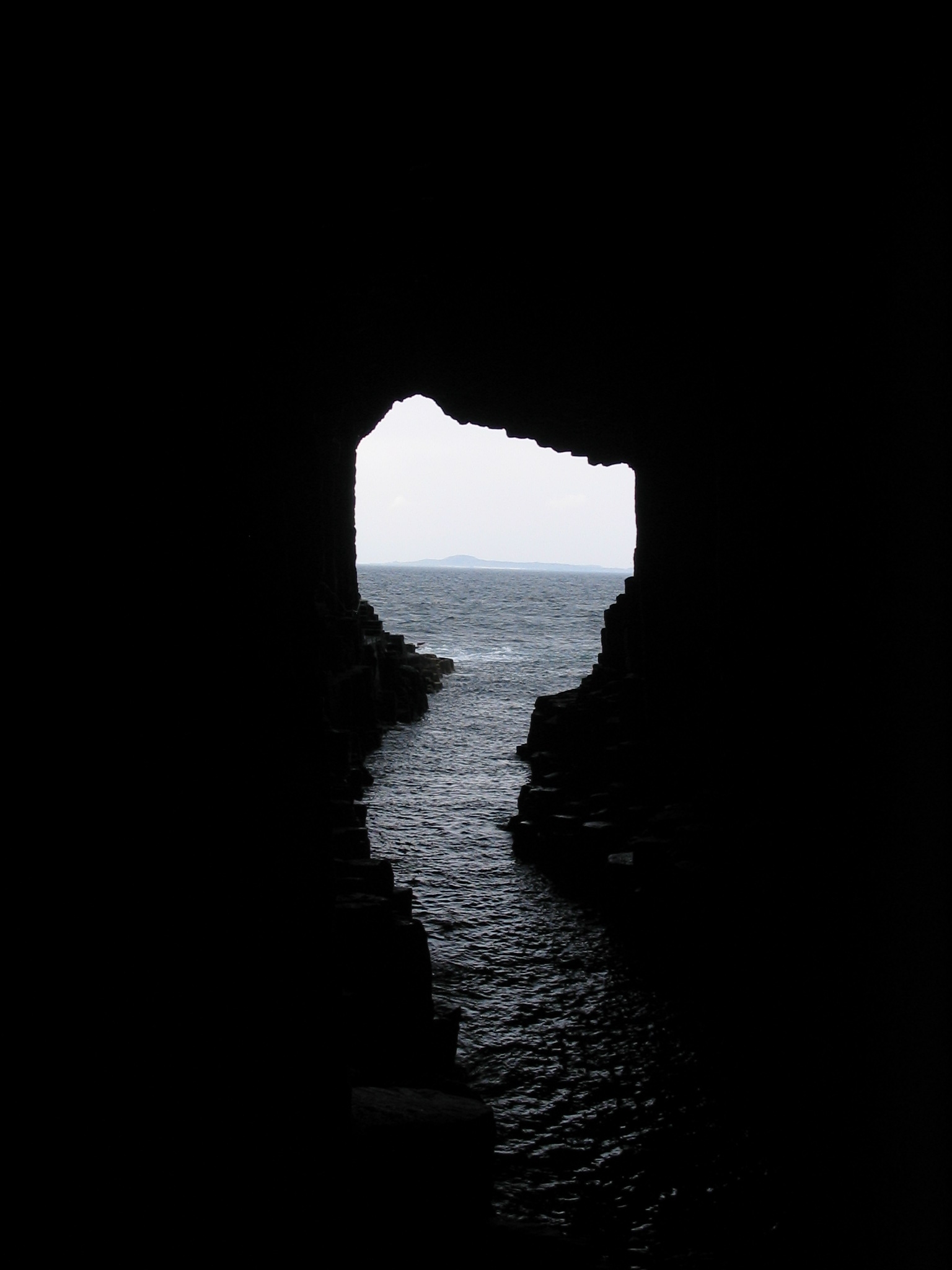
Fingal's Cave
In August 1829, the twenty-year-old Felix Mendelssohn sailed to the uninhabited island of Staffa in Scotland's Inner Hebrides and stepped inside a sea cave unlike anything he had encountered. The cave's walls were formed from thousands of hexagonal basalt columns, fitted together with geometric precision as if designed by an architect. The sea surged through its mouth, and the sound -- amplified and modulated by the cave's vaulted ceiling -- was unearthly: a deep, resonant boom punctuated by hollow echoes. Mendelssohn sketched the opening bars of a melody that same evening. The resulting composition, The Hebrides Overture, made Fingal's Cave famous across Europe.
Sixty Million Years of Cooling
The cave owes its form to a Paleocene lava flow, roughly sixty million years old, that cooled in a particular way. As the molten basalt solidified, contraction on its upper and lower surfaces created fractures that began in blocky patterns and gradually organized into regular hexagons -- the same geometry that appears in drying mud, honeycombs, and the Giant's Causeway in Northern Ireland, which shares the same volcanic origin. As the cracks deepened toward the centre of the flow, they formed the tall, prismatic columns that line Fingal's Cave today. The sea did the rest, eroding the softer rock between the columns and hollowing out a cathedral-like space. Measurements of the cave vary -- sources give depths ranging from 45 to 85 metres and heights of 20 to 23 metres -- but the experience is consistent: standing at the entrance, you look down a corridor of dark stone columns into green water, while the Atlantic pours through and the acoustics turn the sea's voice into something that sounds almost deliberate.
Fingal, Fionn, and the White Stranger
The cave's Gaelic name is An Uamh Bhin -- 'the melodious cave' -- a name that predates any English visitor. It became Fingal's Cave through the work of James Macpherson, the eighteenth-century Scottish poet who published his Ossian cycle of poems claiming to be translations of ancient Gaelic originals. In Macpherson's rendering, Fingal was a great hero; in Irish mythology, the same figure is Fionn mac Cumhaill, the giant who according to legend built the Giant's Causeway as a bridge between Ireland and Scotland. Macpherson apparently derived 'Fingal' from the Gaelic for 'white stranger,' possibly through a misunderstanding of the older name 'Finn.' The naming is fitting: the cave connects Scotland to Ireland through geology as well as legend, both lands sharing the same basalt formations from the same ancient eruption.
The Parade of the Famous
Naturalist Sir Joseph Banks brought the cave to English-speaking attention in 1772, and from that point it became a required stop on the Romantic tour of Scotland. Mendelssohn's visit in 1829 was the most consequential, but he was neither the first nor the last celebrity to make the pilgrimage. Queen Victoria visited and declared herself impressed. The German novelist Theodor Fontane described it in his 1860 travel book Beyond the Tweed. J. M. W. Turner painted it. The cave's appeal transcended era and medium: Pink Floyd wrote an instrumental named for it (intended for the film Zabriskie Point but never used), the artist Matthew Barney filmed scenes of Cremaster 3 here, and Alistair MacLean's When Eight Bells Toll, starring Anthony Hopkins, used the location. The cave was originally part of the Ulva estate belonging to Clan MacQuarrie until 1777, and the National Trust for Scotland now manages it as part of a national nature reserve.
The Sound Inside
Sightseeing boats run from Oban and Mull between April and September, weather permitting, passing the cave mouth so passengers can see the columns and hear the sea's resonance. On calm days it is possible to walk along a narrow causeway of broken column tops into the cave itself, though the footing is uneven and the entrance floods at high tide. Inside, the sensation is of standing in a natural organ pipe. The sea enters in rhythmic pulses, the sound reverberating off the columnar walls with a pitch and duration that changes with the tide and swell. It is not music in any human sense, but it is not random noise either -- it is a sound shaped by geometry, by the precise angles of the hexagonal columns and the cave's arched ceiling. Mendelssohn understood this instantly. The Hebrides Overture does not attempt to reproduce the sound of the cave; it captures the feeling of being inside something that is simultaneously geological and musical, ancient beyond measure and alive with every wave.
From the Air
Fingal's Cave is on the uninhabited island of Staffa at 56.43°N, 6.34°W in the Inner Hebrides. The island's basalt columns are visible from the air, as is the dark mouth of the cave on the southern shore. Iona lies approximately 6 nm to the south. Nearest airstrip: Oban (EGEO) approximately 30 nm to the southeast. Boat access only; weather dependent.