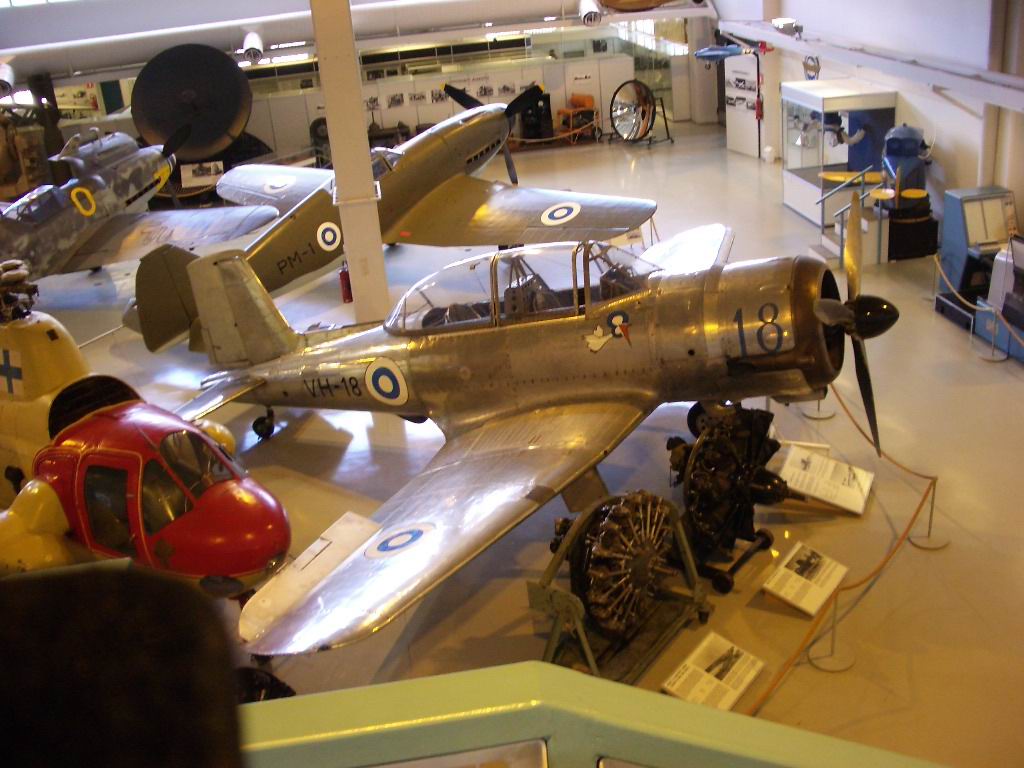
Finnish Air Force Museum
A Brewster Buffalo sits a short walk from a MiG-21. A Messerschmitt Bf 109 shares hangar space with a Fokker D.XXI. At the Finnish Air Force Museum in Tikkakoski, near Jyvaskyla Airport, the aircraft collection reads less like a coherent national inventory and more like a roll call of twentieth-century geopolitics. Finland's air force flew American, British, French, German, Dutch, and Soviet machines -- sometimes in the same conflict -- because a small nation surrounded by powerful neighbors takes whatever wings it can find. The museum, formerly known as the Aviation Museum of Central Finland, draws roughly 25,000 visitors a year to a collection that spans from the earliest days of Finnish aviation in the early 1900s to the jet age.
Borrowed Wings
Finland's aviation history is a story of improvisation. During the Winter War and Continuation War against the Soviet Union, the Finnish Air Force assembled one of history's most eclectic fleets. The Brewster Buffalo, rejected as inadequate by the U.S. Navy, became Finland's most successful fighter -- Finnish pilots achieved an astonishing kill ratio with an aircraft the Americans had written off. The museum preserves one of these Buffalos alongside a Bristol Blenheim bomber and a Bell P-39 Airacobra, aircraft that arrived from different allied and neutral nations through a web of wartime procurement that reflected Finland's precarious diplomatic position. A Bf 109G-6, serial number MT-507, represents the German fighters that Finland operated during the Continuation War, when the country found itself co-belligerent with Nazi Germany against the Soviet Union -- an alliance born of necessity rather than ideology.
From Propellers to Cold War Jets
The collection traces Finland's postwar pivot with uncomfortable clarity. After the war, Finland's relationship with the Soviet Union was codified in the 1948 Agreement of Friendship, and Soviet aircraft entered the inventory. The museum displays a MiG-15 trainer, a MiG-17, and both single-seat and twin-seat variants of the MiG-21 -- the backbone of Finland's Cold War interceptor force. Mil Mi-1 and Mi-4 helicopters round out the Soviet contingent. But Finland also maintained Western ties where it could. Swedish-built Saab 35 Drakens served in both single and twin-seat configurations, and the French Fouga Magister became the standard jet trainer. This duality -- Eastern fighters alongside Western trainers and utility aircraft -- defined Finnish air power during the Cold War in a way that no other European nation experienced.
Pioneers and Prototypes
The earliest machines in the collection reach back to aviation's adolescence. An Avro 504K represents the biplane trainers that introduced a generation of Finnish pilots to powered flight. A replica of the Thulin Type D evokes the Scandinavian aviation pioneers who adapted French Morane-Saulnier designs for northern conditions. Among the most intriguing exhibits are the Finnish-designed aircraft: the VL Pyorremyrsky, a wartime fighter prototype that arrived too late to see combat; the VL Humu, an indigenous attempt to build a fighter from available materials; and the VL Pyry, a training aircraft that served for decades. The Valmet Vihuri II rounds out the domestic designs. These Finnish-built aircraft reveal a nation that understood the strategic importance of aviation self-sufficiency even when its industrial base made that goal nearly impossible to achieve.
The Museum at the Airfield
The museum's location beside Jyvaskyla Airport in Tikkakoski is no accident. The area has served as a military aviation hub for decades, and the proximity to an active airfield gives the collection an immediacy that purpose-built museum spaces often lack. Beyond the aircraft, the exhibition includes engines, aircrew equipment, and the holdings of the Air Force Signals Museum, which occupies its own section. A large collection of scale models provides context for aircraft types not represented at full scale. The Foundation of Aviation Museum of Central Finland owns and operates the facility, maintaining aircraft in various states of restoration -- some on display, others stored elsewhere awaiting their turn. For visitors arriving by air into Jyvaskyla, the museum is visible from the approach path, its outdoor displays a preview of what waits inside.
From the Air
Located at 62.40N, 25.67E adjacent to Jyvaskyla Airport (EFJY) in Tikkakoski. The museum is directly beside the airport and outdoor aircraft displays may be visible from approach or departure patterns. Recommended viewing altitude is 1,500-3,000 feet during approach to EFJY for the best perspective on the museum grounds and the airfield relationship. The surrounding terrain is flat with scattered forest, typical of central Finland's lake district.