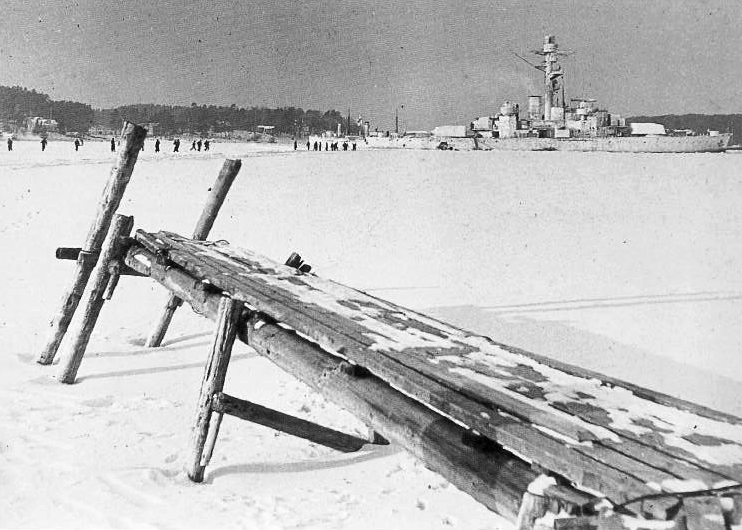
Finnish Coastal Defence Ship Ilmarinen
She carried the name of a god. Ilmarinen, the mythological blacksmith who forged the heavens in Finland's national epic the Kalevala, lent his name to one of the most concentrated naval artillery platforms ever built. Launched at Turku in 1933, this compact coastal defence ship bristled with oversized guns designed to deter Soviet battleships from Finland's shores. For eight years she served as the Finnish Navy's flagship, painted white to hide from bombers during the Winter War, shelling Soviet positions during the Continuation War. Then, on September 13, 1941, a mine caught in her paravane cable changed everything. The explosion tore through her hull, and in just seven minutes, Ilmarinen rolled over and sank, taking 271 men to the bottom of the Baltic Sea in the greatest single loss in Finnish naval history.
Born from Tragedy
The Finnish Navy that commissioned Ilmarinen was born of desperation. In 1925, an aging torpedo boat went down in a fierce Baltic storm, taking her entire crew of 53 sailors to their deaths. The disaster sparked a heated national debate that led to the Finnish Navy Act of 1927 and a fleet renewal program. Among the new acquisitions were two coastal defence ships - Vainamoinen and Ilmarinen - designed by a Dutch company that was actually a front for German interests working around Treaty of Versailles restrictions. These vessels were optimized for the shallow, island-choked waters of the Finnish archipelago rather than the open sea. With a displacement of 3,900 tons and a shallow draft, they rolled unpleasantly in anything but calm waters, but they packed enormous firepower for their size.
Four Guns Against the Soviet Fleet
The heart of Ilmarinen's power lay in her four 254mm Bofors guns, massive weapons that could hurl a heavy shell over 30 kilometers. These were backed by eight 105mm dual-purpose guns in four turrets for defense against torpedo boats and aircraft, plus anti-aircraft weapons that were upgraded after disappointing performance in the Winter War. The ship's purpose was clear: prevent Soviet landing operations and naval blockades that threatened Finland's vital sea trade. Combined with coastal artillery in permanent positions and defensive minefields, Ilmarinen and her sister ship were meant to make any Soviet admiral think twice before venturing too close to Finnish waters. The obvious targets were Soviet capital ships like the battleships Marat and Oktyabrskaya Revolutsiya - vessels that dwarfed the Finnish ships but would have faced deadly opposition in the confined archipelago waters.
War Comes to the Archipelago
When the Winter War erupted in 1939, Ilmarinen and Vainamoinen raced to the Aland Islands to guard against invasion. As thick ice covered the Baltic that December, the threat shifted and both ships sailed to Turku, where they provided anti-aircraft defense for the city. Painted white against the winter landscape, they were harder for Soviet bombers to spot, though aircraft still targeted them, killing one crew member and wounding several others. During the Continuation War of 1941, the ships went on the offensive, shelling Soviet positions at Hanko Peninsula five times between July and November. On July 12, 1941, Ilmarinen fired twenty shells at a Soviet airfield that German bombers had already struck. It was one of her last combat actions.
Seven Minutes to Eternity
Operation Nordwind on September 13, 1941, was meant to support German landings on Estonian islands. A Finnish-German naval group, including Ilmarinen, would conduct a diversionary operation to draw the Soviet fleet away from the real invasion force. Minesweepers led the formation, but some mines escaped detection. No one aboard Ilmarinen noticed the dragging paravane cable had snagged something. When the ship turned, the mines struck her hull and detonated. The explosion ripped a massive hole in the ship. She listed heavily, then rolled over and went down in just seven minutes. Of her crew, only 132 survived - pulled from the freezing Baltic by the patrol boat VMV 1, which risked her own destruction from magazine explosions to rescue survivors. The dead included most of the crew, trapped inside the capsized hull. Survivors later formed the Ilmarisen uimaseura - Ilmarinen's Swimming Club. Among them were the ship's captain, Commander Ragnar Goransson, the Commander of the Finnish Navy himself, and Lieutenant Viljo Revell, who would become a renowned architect. The wreck was located in 1990, resting upside-down in deep mud. It remains a protected war grave, a steel tomb for the sons of Finland who served the ship named for the eternal smith.
From the Air
The wreck site lies at approximately 59.45N, 21.08E in the Baltic Sea, between Finland and Estonia. The waters here are relatively shallow by ocean standards but deep enough that the ship lies undisturbed. Nearest major airports include Tallinn (EETN) to the south and Helsinki-Vantaa (EFHK) to the northeast. The Aland Islands, where Ilmarinen once patrolled, are visible to the north. This is an active shipping lane between Scandinavia and the Baltic states.