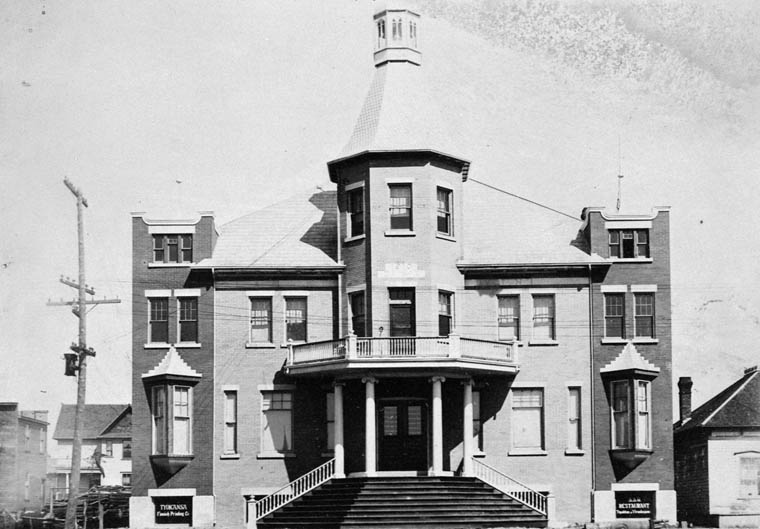
Finnish Labour Temple
The inscription carved into the facade read "Labor Omnia Vincet" -- labour conquers all. For over a century, the Finnish Labour Temple at 314 Bay Street in Thunder Bay, Ontario lived up to that motto in ways its builders could never have predicted. Built in 1910 by Finnish immigrants who pooled their money through a temperance society and a workers' league, the Big Finn Hall became the beating heart of Finnish cultural and political life in Northwestern Ontario. It hosted labour congresses and film festivals, housed a beloved basement restaurant and a Finnish-language newspaper, and survived ideological splits that would have destroyed lesser institutions. What finally brought it down was not politics but fire.
Two Societies, One Building
The Finnish Labour Temple was born from unlikely collaboration. The Finnish-American Workers' League Imatra #9 and the "Uusi Yritys" -- the New Attempt Temperance Society -- formed the Finnish Building Company to make it happen. The socialist local purchased the lot in June 1907. Architect C.W. Wheeler drew up blueprints by December 1908. When the doors opened in March 1910, the community celebrated with three consecutive days of ceremonies. Almost immediately, the building became more than a meeting hall. The Finnish Publishing Company rented the basement, where it printed Tyokansa -- "The Working People" -- the first Finnish-Canadian newspaper. Co-operative restaurants and a billiards room operated downstairs. By September 1910, the Trades and Labour Congress of Canada held its annual convention there, praising the "industry, thrift and co-operative spirit" of the Finnish community in its commemorative booklet.
The Split on Bay Street
The First World War shattered the hall's political ecosystem. The Canadian government declared foreign-language affiliates of the Social Democratic Party illegal. Finnish newspapers were banned. Organizers were arrested. Many Finnish workers joined the One Big Union, which held its national convention at the Finnish Labour Temple. There, in 1919, a fault line cracked open. Finnish socialists believed the working class needed a political party. Finnish syndicalists believed change came through direct economic action -- strikes, not ballots. The socialists lost. They bought the building next door at 316 Bay Street, the "Little Finn Hall," and aligned with the Communist Finnish Organization of Canada. The syndicalists who kept the Labour Temple affiliated with the Industrial Workers of the World after the Winnipeg General Strike. Two Finn halls, side by side on Bay Street, representing two visions of workers' power. The ideological geography could not have been more literal.
Wobblies and Pancakes
The IWW-affiliated Finns -- the Wobblies -- made the Finnish Labour Temple their Canadian administrative headquarters. They housed the news bureau for the Industrialisti, the Finnish-language IWW daily. They paid off the building's mortgage. And through the auxiliary organization known by its Finnish acronym CTKL, they established the Hoito Restaurant in the basement and a chain of People's Co-operative stores across the region. The Hoito became legendary. Generations of Thunder Bay locals and visiting tourists descended the basement stairs for Finnish pancakes, thick coffee, and a dining experience that felt unchanged by decades. The IWW competed with communist-dominated unions into the 1940s, but as younger Finnish-Canadians assimilated into mainstream society, the movement faded into a mutual aid society for aging members.
New Waves, Old Walls
In the late 1960s, the last major wave of Finnish immigration to Canada brought new energy to Bay Street -- but not the energy the old Wobblies would have recognized. The newcomers formed the Finlandia Club and became the hall's majority shareholders. They were a generation removed from the labour struggles of their predecessors, and many were apolitical or conservative, associating left-wing politics with the brutality of Stalinism and the trauma of the Finnish Winter War. The hall adapted. In 2015, a ceremony marked the Finnish Labour Temple as a National Historic Site. A new generation of locals began revitalizing the building, and the Finlandia Co-operative tried to raise funds to purchase it. When that effort fell short, a private buyer acquired it in October 2020 with plans to reopen the Hoito and convert upper floors to apartments.
Fire, Foundation, Future
On the evening of December 22, 2021, smoke billowed from the rooftop during renovations. The fire that burned through the Finnish Labour Temple was devastating, and by mid-February 2022, the remains had been completely demolished. But the story did not end there. On March 3, 2022, workers recovered a time capsule hidden in the foundation during the original 1909 construction -- a message from builders who trusted their work would last. The property owner has committed to rebuilding, recreating the original facade including the iconic cupola, and re-establishing the Hoito Restaurant on the main floor rather than the basement. The Latin inscription will return: Labour conquers all. The Finnish immigrants who formed a building company from a temperance society and a workers' league would understand. They built this place once before, from nothing but shared purpose and pooled resources. They would recognize the impulse to build it again.
From the Air
The Finnish Labour Temple site is at 48.43°N, 89.23°W on Bay Street in the former Port Arthur section of Thunder Bay, Ontario. The Finnish quarter runs along Bay Street near the waterfront. From the air, look for the downtown grid of the former Port Arthur district along the north shore of Thunder Bay harbour. The site is currently under reconstruction after the 2021 fire. Nearest major airport is Thunder Bay International (CYQT), approximately 5 nm west-southwest. Best viewed below 3,000 ft AGL when flying over the Thunder Bay waterfront area. The harbour and grain elevators provide good visual landmarks for orientation.