First Barbary War
In March 1786, Thomas Jefferson and John Adams sat across from Tripoli's ambassador in London, asking a straightforward question: on what grounds did the Barbary states make war on nations that had done them no injury? The ambassador's reply was equally straightforward -- it was written in the Koran, he said, that it was the right and duty of the faithful to plunder and enslave unbelievers. Jefferson took the answer back to Congress and spent the next fifteen years arguing that paying tribute to pirates would never stop the piracy. When he finally became president in 1801, he got his chance to prove it.
The Price of Independence
For centuries, Barbary corsairs from the North African regencies of Algiers, Tunis, and Tripoli, along with the independent Sultanate of Morocco, had seized merchant ships across the Mediterranean, enslaving crews and demanding ransom. European powers paid tribute or bought treaties to protect their trade. American shipping had been protected first by Britain, then by France under the Treaty of Alliance during the Revolution. When that protection lapsed after the 1783 Treaty of Paris, American merchant vessels became targets almost immediately. In October 1784, Moroccan pirates seized the brigantine Betsey. Algeria captured the schooner Maria in July 1785. The Barbary states demanded $660,000 each for peace -- and Congress gave its negotiators a budget of $40,000. The math did not work.
Tribute, Ransom, and a New Navy
By 1795, the United States was paying. Congress appropriated $800,000 for prisoner releases and peace treaties, and negotiator Joseph Donaldson signed an agreement with Algiers that included $642,500 in silver coinage upfront plus an indefinite annual tribute of $21,600 in shipbuilding supplies. One hundred fifteen American sailors came home. But the demand for tribute never stopped. When Jefferson took office, Yusuf Karamanli, the Pasha of Tripoli, demanded $225,000 -- at a time when total federal revenues were barely over $10 million. Jefferson refused. The continuing extortion had already driven Congress to recommission the Navy in 1794 and establish the Department of the Navy in 1798. Now those investments would be tested. Before Jefferson even learned that Tripoli had declared war, he dispatched a squadron of three frigates and a schooner under Commodore Richard Dale with instructions to protect American ships if hostilities had begun.
Blockade and Burning
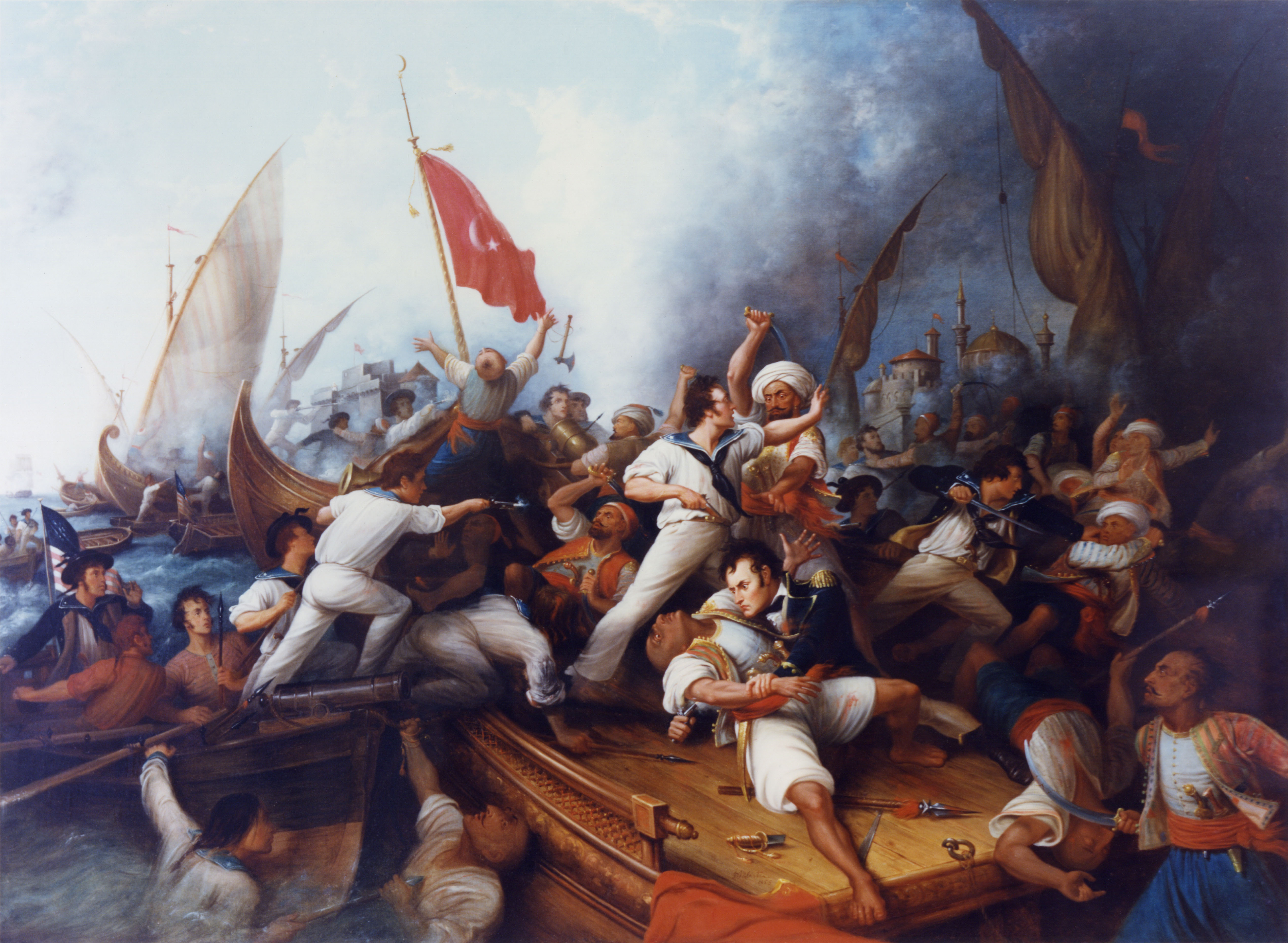
The American squadron joined Swedish warships already blockading Tripoli -- Sweden had been at war with the Tripolitans since 1800. Commodore Edward Preble secured the use of Sicilian ports from King Ferdinand IV of Naples, along with gunboats, mortar boats, and supplies. Tripoli was formidable: 150 pieces of heavy artillery, 25,000 soldiers, and a fleet of brigs, schooners, galleys, and gunboats. The blockade was porous and frustrating. The first real action came on 1 August 1801, when the armed schooner under Lieutenant Andrew Sterret defeated the 14-gun Tripolitan corsair Tripoli. In 1803, the frigate Philadelphia ran aground in Tripoli harbor and was captured -- a disaster that Lieutenant Stephen Decatur partially redeemed months later when he led a raiding party to burn the captured ship rather than let it serve the enemy. The action earned Decatur international fame and, from British Admiral Horatio Nelson, the reported compliment of 'the most bold and daring act of the age.'
To the Shores of Tripoli
The war's turning point came not at sea but across the Sahara. In April 1805, former consul William Eaton and Marine 1st Lieutenant Presley O'Bannon led a force of eight Marines and roughly 500 mercenaries -- Greeks from Crete, Arabs, and Berbers -- on an extraordinary overland march from Alexandria, Egypt, to attack the Tripolitan city of Derna. They captured it, raising the American flag in victory on foreign soil for the first time. The action is immortalized in the Marines' Hymn: 'the shores of Tripoli.' Under simultaneous military and diplomatic pressure, Pasha Yusuf Karamanli signed a treaty on 4 June 1805, ending hostilities in exchange for a $60,000 ransom payment for American prisoners. Jefferson drew a careful distinction between tribute -- which he had refused -- and ransom. The war proved that the young republic could project military power across an ocean. The Navy and Marine Corps became permanent institutions, and Decatur returned home as the nation's first post-revolutionary war hero.
Unfinished Business
The peace held for barely two years. By 1807, Algiers had rebuilt its fleet and resumed seizing American ships. The United States, sliding toward the War of 1812, could not respond until 1815, when the Second Barbary War finally ended all tribute payments. In Annapolis, Maryland, the Tripoli Monument -- carved from Carrara marble in Italy in 1806 and shipped home aboard the frigate Constitution -- stands as the oldest military monument in the United States. It honors six officers killed during the war, men whose names are otherwise largely forgotten but whose fight established a principle that would define American foreign policy for generations: the nation would not pay for the right to trade freely on the open sea.
From the Air
Located at 32.96°N, 13.16°E in the harbor area of Tripoli, Libya. The city's harbor was the center of Barbary corsair operations and the target of the American naval blockade (1801-1805). Tripoli was defended by extensive fortifications along the waterfront. Mitiga International Airport (HLLM) lies east of the old city. Tripoli International Airport (HLLT) is to the south. The Battle of Derna took place far to the east at Derna (32.77°N, 22.64°E). Recommended viewing altitude: 5,000-8,000 feet to see the harbor and the old fortification lines along the coast.