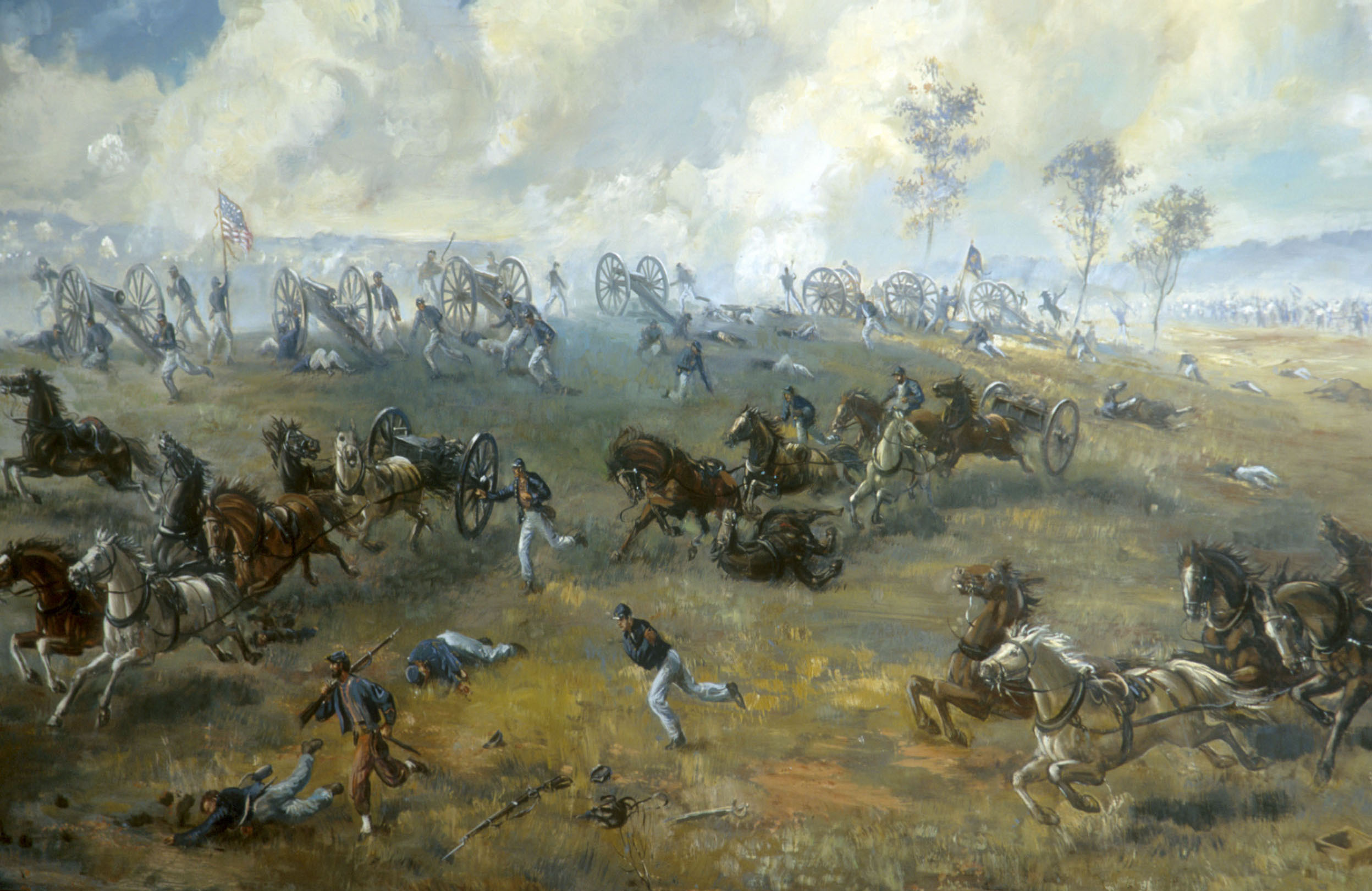
First Battle of Bull Run
They came with picnic baskets. On July 21, 1861, congressmen, socialites, and curious citizens rode out from Washington in carriages to watch what they expected would be a brief and glorious Union victory. The battlefield lay only 27 miles from the Capitol dome, close enough for a day trip. What these spectators witnessed instead was the first brutal lesson of the Civil War: that this conflict would be neither short nor bloodless. By nightfall, Union soldiers and Washington's finest were fleeing together down the road back to the capital, tangled in a panicked mass of overturned wagons and abandoned artillery.
The End of Innocence
The battle unfolded along the banks of Bull Run creek near the town of Manassas Junction, a critical railroad hub in northern Virginia. Union General Irvin McDowell led roughly 35,000 largely untrained troops against a Confederate force of similar size under Generals P.G.T. Beauregard and Joseph E. Johnston. McDowell's plan was sound enough on paper: a flanking march to strike the Confederate left. But his raw recruits moved slowly, giving the Confederates time to shift reinforcements by rail from the Shenandoah Valley. It was one of the first times in military history that railroads played a decisive tactical role in battle.
A Stone Wall on Henry Hill
By midday, the Union attack had pushed the Confederates back to Henry House Hill, where the battle's most enduring legend was born. As retreating Southern troops streamed past, General Barnard Bee rallied his men by pointing to Thomas J. Jackson's Virginia brigade standing firm on the hilltop. "There is Jackson standing like a stone wall!" Bee reportedly shouted. Whether meant as praise or frustration, the nickname stuck. Jackson's stubborn defense gave the Confederates time to regroup. Fresh troops arriving from the Valley tipped the balance, and by late afternoon, the Confederate counterattack sent Union lines crumbling. The retreat became a rout, soldiers and civilians alike clogging the roads back to Washington.
Shockwaves Through Two Capitals
The Northern public reeled. An easy victory had been promised, and the humiliation cut deep. President Lincoln signed a bill on July 22 calling for 500,000 additional volunteers to serve up to three years. McDowell was relieved of command, replaced by George B. McClellan. The South's reaction was more measured. Despite their victory, thoughtful Confederates recognized the harder fights ahead. Jefferson Davis called for 400,000 more volunteers. Historians have since argued that the Confederate victory may have been a disguised curse, breeding overconfidence in the South while galvanizing Northern resolve. Both sides began the grim work of building real armies for a war that would last four more years and claim over 600,000 lives.
Flags, Names, and a Lasting Confusion
The battle left unexpected legacies. On the smoke-filled field, soldiers on both sides struggled to tell friend from foe because the Confederate "Stars and Bars" looked dangerously similar to the Union "Stars and Stripes" when hanging limp. This deadly confusion led directly to the adoption of the distinctive Confederate Battle Flag. Even the battle's name became contested ground: the Union named it for Bull Run creek, while the Confederacy called it Manassas after the nearby town. Both names persist to this day. The same fields would see bloodshed again thirteen months later at the Second Battle of Bull Run, when many of the same soldiers, now hardened veterans, returned to fight on ground they already knew.
Hallowed Ground Today
The battlefield is now preserved as Manassas National Battlefield Park, listed on the National Register of Historic Places since 1966. More than 900,000 visitors walk these fields each year, tracing the routes of men who marched into the first great slaughter of a conflict that would reshape a nation. The American Battlefield Trust and its partners have preserved more than 385 acres of the battlefields at Manassas in 15 transactions since 2010. Standing on Henry Hill today, you can still see the rolling Virginia countryside that those picnicking spectators gazed upon, transformed forever on a hot July Sunday in 1861.
From the Air
The battlefield is located at 38.815N, 77.523W, in Prince William County, Virginia, roughly 27 miles southwest of Washington, D.C. From the air, look for the open fields and gentle hills between the town of Manassas and the Bull Run creek. The Stone Bridge over Bull Run and Henry House Hill are key landmarks. The Henry Hill Visitor Center is visible off Sudley Road near the park's south entrance. Nearby airports: Manassas Regional (KHEF) 4nm south, Washington Dulles International (KIAD) 15nm northeast. Recommended viewing altitude: 2,000-3,000 feet AGL for battlefield terrain features.